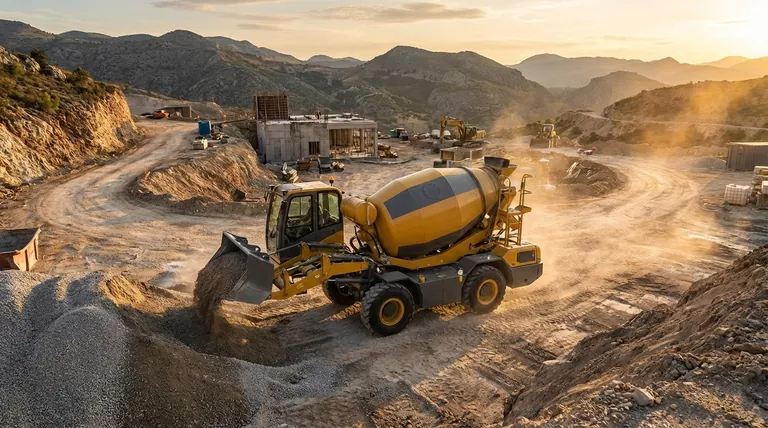
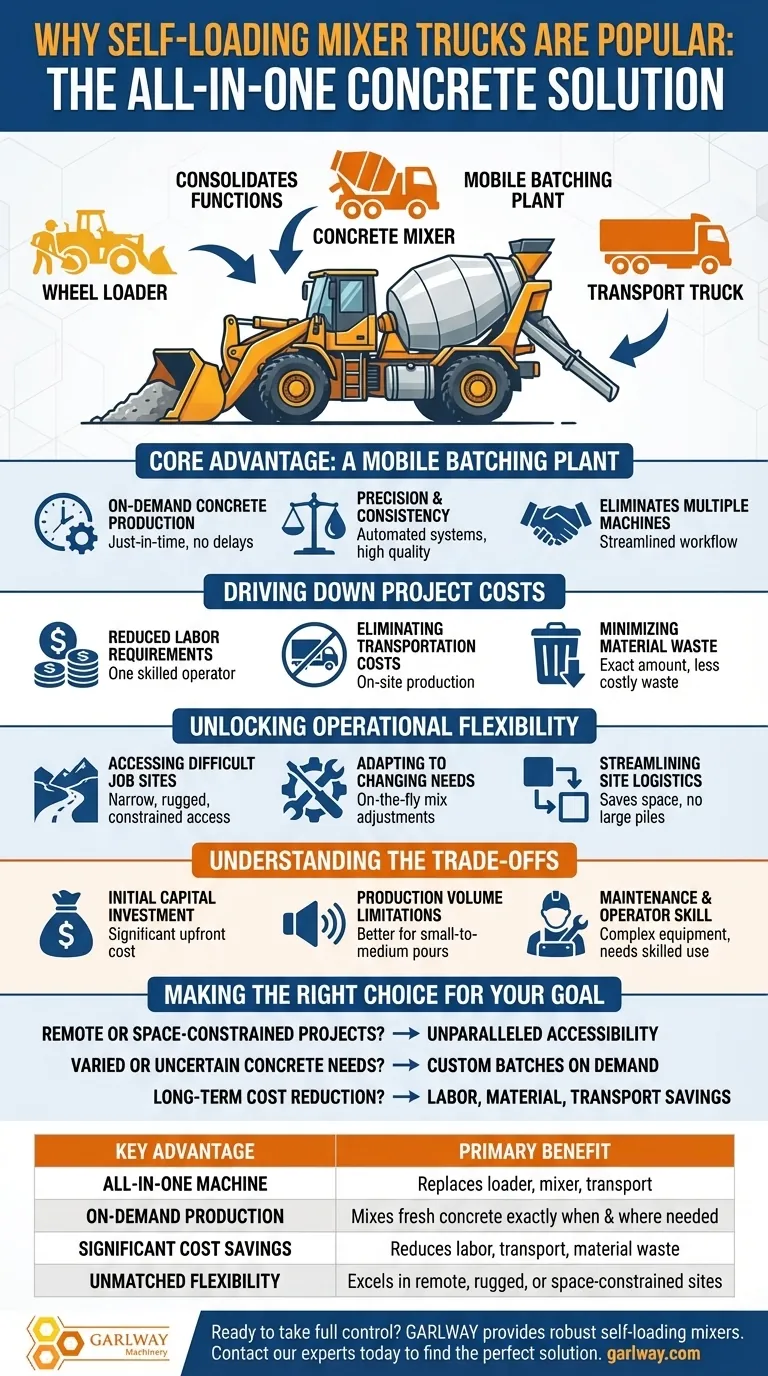
The primary reason for the popularity of self-loading mixer trucks is their ability to consolidate the functions of a wheel loader, a concrete mixer, and a transport truck into a single, highly efficient machine. This consolidation dramatically reduces labor costs, saves time, and gives construction teams unprecedented control over their concrete supply directly at the job site.
The true value of a self-loading mixer is not just its list of features, but its power to transform concrete production from a complex logistical challenge into a self-contained, on-demand process that adapts to the real-world conditions of a project.
The Core Advantage: A Mobile Batching Plant
A self-loading mixer fundamentally changes how teams approach concrete work. It’s best understood not as a truck, but as a complete, mobile production facility.
Consolidating Multiple Machines
The vehicle's integrated shovel loads its own raw materials—aggregate, sand, and cement—into the mixing drum. This eliminates the need for a separate wheel loader and operator, immediately streamlining the workflow.
On-Demand Concrete Production
Instead of ordering from a distant batching plant and risking delays or premature setting, teams can produce fresh concrete exactly when and where it is needed. This "just-in-time" capability is invaluable for project scheduling.
Precision and Consistency
Modern self-loading mixers feature automated water systems and weighing mechanisms. This ensures precise proportioning for every batch, leading to a consistent, high-quality concrete mix that meets project specifications.
Driving Down Project Costs
The efficiency gains from a self-loading mixer translate directly into significant financial savings, impacting multiple areas of a project budget.
Reduced Labor Requirements
A single skilled operator can manage the entire process of loading, mixing, and discharging the concrete. This can replace a team of three or more workers required for traditional site mixing or coordinating ready-mix deliveries.
Eliminating Transportation Costs
By producing concrete on-site, you eliminate the premium paid for ready-mix concrete delivery, especially for remote locations where transport fees can be substantial.
Minimizing Material Waste
Traditional methods often lead to over-ordering concrete to ensure there is enough for a pour. With a self-loading mixer, you create the exact amount required, drastically cutting down on costly material waste.
Unlocking Operational Flexibility
Perhaps the most compelling benefit is the sheer adaptability these machines offer, allowing them to excel in environments where traditional methods fail.
Accessing Difficult Job Sites
Their design allows them to navigate narrow urban streets, rugged rural roads, and constrained construction sites that are inaccessible to large ready-mix trucks and separate loading equipment.
Adapting to Changing Needs
If project requirements change, the operator can adjust the mix ratio on-the-fly for the very next batch. This flexibility is impossible with a truckload of pre-mixed concrete from a central plant.
Streamlining Site Logistics
By combining functions, these mixers save valuable space on a job site. There is no need for large, separate piles of aggregate or a stationary mixer, which frees up the area for other critical operations.
Understanding the Trade-offs
While powerful, self-loading mixers are not the perfect solution for every scenario. Objectivity requires acknowledging their limitations.
Initial Capital Investment
The upfront purchase price of a self-loading mixer is significant. For companies that only occasionally need concrete, ordering from a ready-mix supplier may be more cost-effective.
Production Volume Limitations
These machines are designed for small-to-medium volume pours. For massive, continuous pours like high-rise foundations, a dedicated batching plant and a fleet of traditional transit mixers remain more efficient.
Maintenance and Operator Skill
This is a complex piece of hydraulic and mechanical equipment. It requires a skilled operator to use efficiently and safely, and it demands a consistent maintenance schedule to ensure reliability.
Making the Right Choice for Your Goal
To determine if this machine is the right investment, consider your primary operational challenges.
- If your primary focus is working on remote or space-constrained projects: The self-loading mixer's unparalleled accessibility and small footprint make it the superior choice.
- If your primary focus is projects with varied or uncertain concrete needs: The ability to produce small, custom batches on demand makes it ideal for minimizing waste and ensuring specification compliance.
- If your primary focus is long-term cost reduction across many projects: The savings on labor, material, and transport can provide a strong return on investment for a busy contractor.
Ultimately, the self-loading mixer empowers you to take complete control of your concrete supply chain.
Summary Table:
| Key Advantage | Primary Benefit |
|---|---|
| All-in-One Machine | Replaces a wheel loader, mixer, and transport truck. |
| On-Demand Production | Mixes fresh concrete exactly when and where it's needed. |
| Significant Cost Savings | Reduces labor, transport fees, and material waste. |
| Unmatched Flexibility | Excels in remote, rugged, or space-constrained job sites. |
Ready to take full control of your concrete supply and boost your project's efficiency?
As GARLWAY, a specialist in construction machinery, we provide robust and reliable self-loading mixer trucks, winches, and concrete batching plants designed for the real-world challenges faced by construction companies and contractors globally. Our equipment empowers you to work smarter, reduce costs, and conquer difficult job sites.
Contact our experts today to find the perfect self-loading mixer solution for your business needs and start saving time and money on your next project.
Visual Guide
Related Products
- Skid Steer Self Loading Concrete Mixers for Construction
- Belle Mixer Drum Self Loading Mortar Mixers JS3000
- Ready Mixer Machine for Construction Ready Mix Machinery
- JW1000 Mobile Cement Mixer Concrete Mixer Truck and Batching Plant
- Mini Cement Mortar Mixer Truck for Construction
People Also Ask
- How does the control system improve production efficiency in a self loading concrete mixer? Automate Mixing for Speed & Quality
- What is the purpose of keeping the drum rotating during transportation in a self loading concrete mixer? Ensure Quality & Consistency
- How does the weighing process work in a self loading concrete mixer? Achieve Precise, On-Site Concrete Batching
- What components are involved in the loading process of a self loading concrete mixer? A Guide to the Key Systems
- How should materials be loaded into a self-loading concrete mixer? Master the Step-by-Step Process