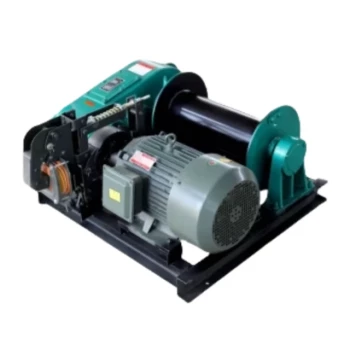
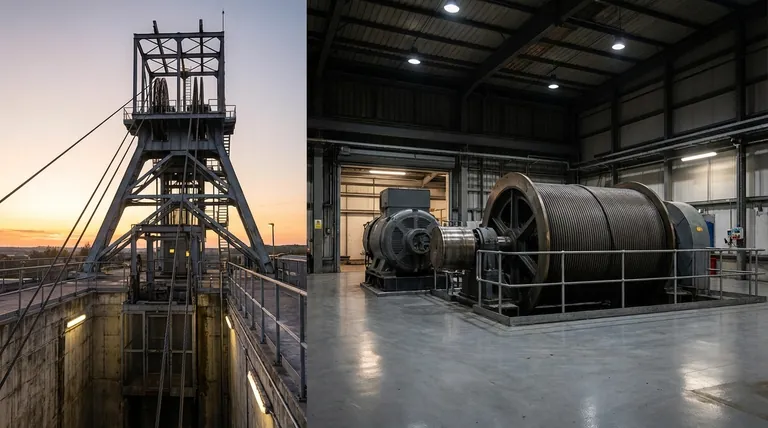
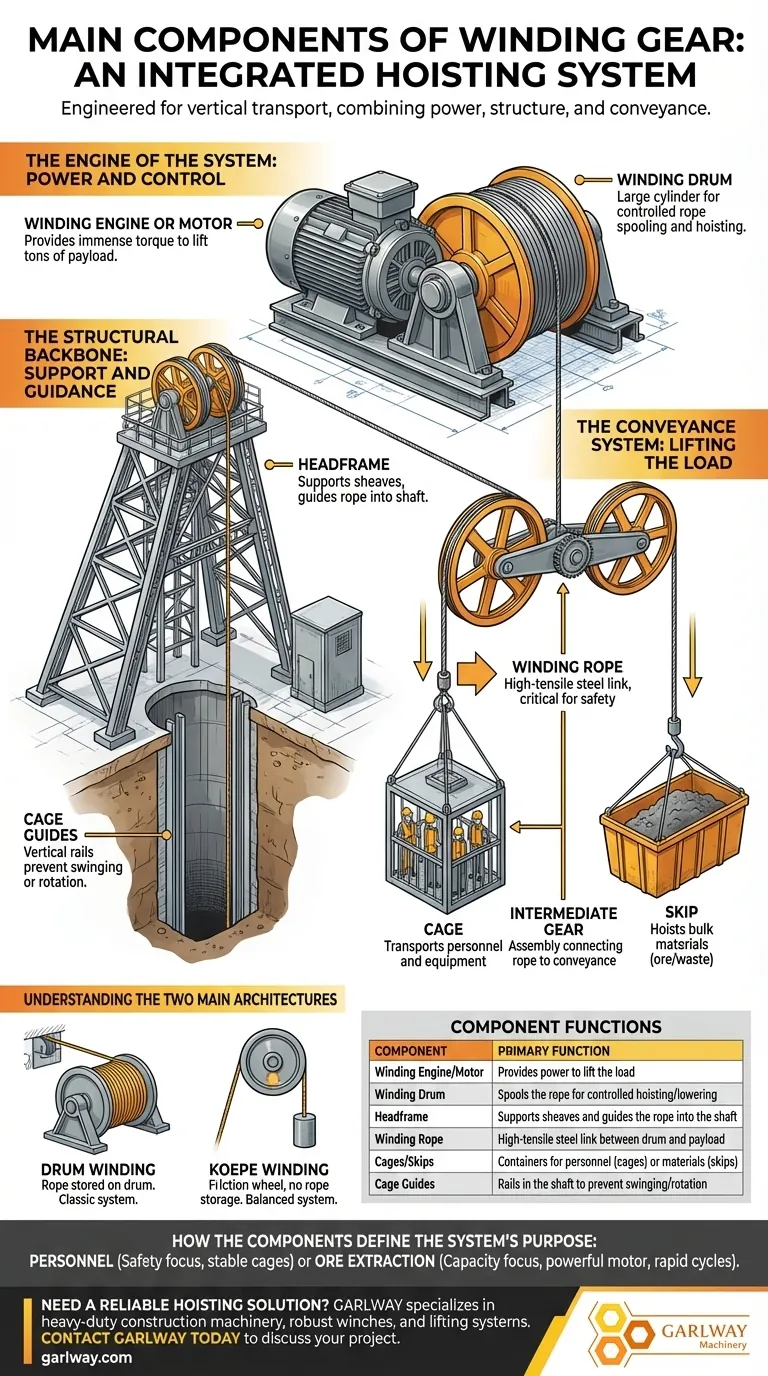
The primary components of a winding gear system are the winding engine or motor, the headframe, the winding rope and drum, and the cages or skips used for transport. These elements are connected by intermediate gear and guided within the mine shaft by cage guides to ensure safe and efficient vertical movement.
At its core, winding gear is a specialized hoisting system engineered for vertical transport within a shaft. The individual components are not isolated parts; they form an integrated system where power, structure, and conveyance work in precise harmony to lift heavy loads safely.
The Engine of the System: Power and Control
The entire operation begins with the generation and application of torque to lift the load. This is the heart of the winding gear.
The Winding Engine or Motor
This is the prime mover of the system. It provides the immense power required to hoist cages or skips, which can weigh many tons, from deep within a mine.
The Winding Drum
The drum is a large cylinder onto which the winding rope is spooled. As the motor turns the drum, the rope is either wound up (hoisting) or unwound (lowering) in a controlled manner.
The Structural Backbone: Support and Guidance
A massive, stationary structure is required to support the moving components and ensure the load remains stable during transit.
The Headframe
The headframe is the most visible component, often a towering lattice steel structure that can be up to 200 feet high. It stands directly over the shaft opening and supports the pulley wheels (sheaves) that guide the winding rope from the drum down into the shaft.
Cage Guides
These are essentially vertical rails that run the length of the shaft. The cage or skip is fitted with shoes that engage with these guides, preventing it from swinging or rotating during its rapid journey.
The Conveyance System: Lifting the Load
This group of components is directly involved in carrying the payload, whether it's personnel, materials, or mined ore.
The Winding Rope
A high-tensile steel rope is the critical link between the winding drum and the payload. Its integrity and strength are paramount to the safety and function of the entire system.
Cages or Skips
These are the containers that carry the load. Cages are typically used for transporting people and equipment, while skips are designed for hoisting bulk materials like ore or waste rock.
Intermediate Gear
This refers to the assembly of chains, shackles, and suspension gear that securely connects the winding rope to the top of the cage or skip.
Understanding the Two Main Architectures
While the components are largely the same, they can be configured into two primary systems, each with different operational principles.
Drum Winding
This is the classic system where one or more ropes are anchored to and wound directly onto a large drum. The length of the rope that can be stored on the drum determines the maximum depth of the wind.
Koepe Winding
The Koepe system is a more modern alternative that does not store the rope on a drum. Instead, the rope passes over a single friction wheel (the Koepe wheel) driven by the motor, with a cage on one end and a counterweight on the other, creating a balanced system.
How the Components Define the System's Purpose
The specific design of these components is dictated entirely by the winding gear's primary function.
- If your primary focus is moving personnel: The system will emphasize a highly stable cage, multiple safety features in the engine, and rigorous inspection of the winding ropes.
- If your primary focus is high-volume ore extraction: The design will feature large-capacity skips, a powerful motor for rapid cycle times, and durable cage guides to handle high speeds.
Ultimately, each component works in concert to create a safe and efficient vertical lifeline for the operation it serves.
Summary Table:
| Component | Primary Function |
|---|---|
| Winding Engine/Motor | Provides power to lift the load |
| Winding Drum | Spools the rope for controlled hoisting/lowering |
| Headframe | Supports sheaves and guides the rope into the shaft |
| Winding Rope | High-tensile steel link between drum and payload |
| Cages/Skips | Containers for personnel (cages) or materials (skips) |
| Cage Guides | Rails in the shaft to prevent swinging/rotation |
Need a reliable hoisting solution for your construction or mining project?
GARLWAY specializes in heavy-duty construction machinery, including robust winches and lifting systems built for demanding environments. Our expertise ensures safe, efficient, and powerful vertical transport for construction companies and contractors worldwide.
Contact GARLWAY today to discuss how our equipment can be the backbone of your project's success.
Visual Guide
Related Products
- Hydraulic Winding Engine Harbor Freight Winch
- Electric Hoist Winch Boat Anchor Windlass for Marine Applications
- Heavy Duty Electric Boat Winch Windlass Anchor
- Quick Windlass Portable Winch for Truck and Boat Best Boat Winch
- 12000 lb Electric Boat Trailer Winch with Windlass Anchor Warn
People Also Ask
- What role does hydraulic fluid play in hydraulic winches? It's the Lifeblood of Your Heavy-Duty Pulling Power
- What vehicles commonly use hydraulic winches? For Industrial Trucks Needing Unmatched Power
- What are the features of hydraulic winches? Unmatched Power and Continuous Duty for Heavy Loads
- What preventive measures can be taken to avoid oil leakage in hydraulic winches? Ensure Long-Term Reliability
- What does 'power out' mean in a hydraulic winch? Achieve Absolute Control When Lowering Heavy Loads