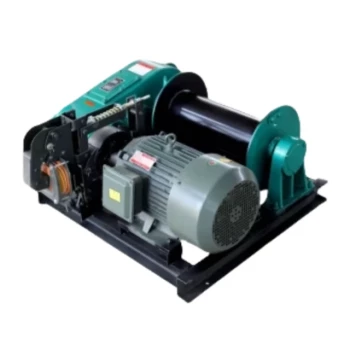
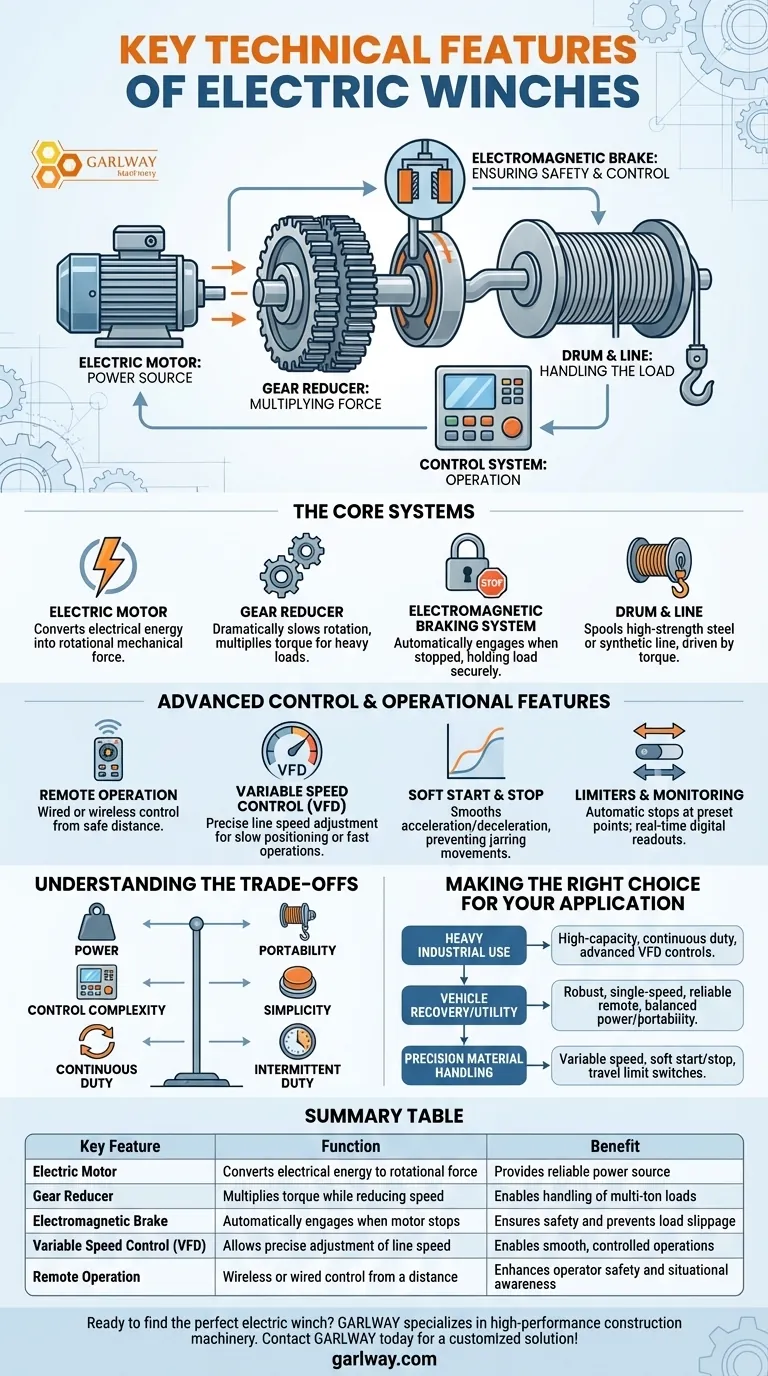
At their core, electric winches are defined by four key technical features: the electric motor that provides power, a gear reducer that multiplies torque, an electromagnetic brake for safety, and a control system for operation. These components work in concert to translate electrical energy into precise and powerful pulling or lifting force.
The true value of an electric winch lies not in any single feature, but in the sophisticated integration of its power, drivetrain, and control systems. Understanding how these systems interact is crucial for selecting a tool that is both effective and safe for your specific task.
The Core Systems of an Electric Winch
An electric winch is a deceptively simple machine, but its effectiveness comes from a few critical, well-engineered systems working together.
The Electric Motor: The Power Source
The entire process begins with the electric motor. This is the heart of the winch, converting electrical energy into the rotational mechanical force needed to begin the pulling or lifting process.
The Gear Reducer: Multiplying Force
The motor's high-speed, low-torque rotation is fed into a gear reducer, typically a three-stage enclosed system. This crucial component dramatically slows the rotation speed while multiplying the force (torque), enabling the winch to handle loads weighing several tons.
The Braking System: Ensuring Safety and Control
For safety and precision, electric winches rely on an electromagnetic braking system. This system automatically engages when the motor stops, securely holding the load in place and preventing any unwanted slippage or freefall.
The Drum and Line: Handling the Load
The torque from the gear system drives the winch drum, which spools the line. The line itself can be a high-strength galvanized steel cable or a lighter, high-strength synthetic fiber rope, depending on the application's requirements.
Advanced Control and Operational Features
Beyond the core mechanics, modern electric winches incorporate advanced features that enhance safety, precision, and ease of use.
Remote Operation
Most electric winches offer remote operation, either through a wired pendant or a wireless controller. This allows the operator to stand at a safe distance from the load, improving situational awareness and reducing risk.
Variable Speed Control (VFD)
While basic models have single-speed controls, more advanced industrial winches use Variable Frequency Drives (VFDs). A VFD allows for precise adjustment of the line speed, accommodating both slow, careful positioning and faster operations.
Soft Start and Stop
A key benefit of VFDs is the ability to program a soft start and stop. This smooths the acceleration and deceleration of the load, preventing jarring movements that could cause damage or instability.
Limiters and Monitoring
For automated or repetitive tasks, winches can be equipped with load travel limit switches. These automatically stop the winch when the load reaches a preset point. Some high-end models also feature digital readouts to monitor the exact load and speed in real-time.
Understanding the Trade-offs
Selecting the right electric winch involves balancing several competing factors. Being aware of these trade-offs is key to making an informed decision.
Power vs. Portability
There is a direct relationship between a winch's lift capacity and its physical size and weight. While manufacturers aim for a compact structure and light weight, a heavy-duty winch capable of continuous use will inherently be less portable than a smaller, intermittent-duty model.
Control Complexity vs. Simplicity
A simple, single-speed winch is often more robust and less expensive. However, it lacks the precision of a system with VFD control. The added complexity of a VFD provides unparalleled control but comes at a higher cost and requires more sophisticated setup.
Continuous vs. Intermittent Duty
Industrial winches are often rated for continuous use, meaning they can operate for long periods without overheating. Smaller or more consumer-oriented models may have a limited duty cycle, requiring rest periods to cool down after a certain amount of work.
Making the Right Choice for Your Application
Your final decision should be guided by the specific demands of your task.
- If your primary focus is heavy industrial use: Prioritize a high-capacity winch with a continuous duty rating and advanced VFD controls for precision and safety.
- If your primary focus is vehicle recovery or general utility: A robust, single-speed model with reliable remote operation and a balance of power and portability is ideal.
- If your primary focus is precision material handling: Insist on features like variable speed control, soft start/stop capabilities, and travel limit switches.
Understanding these technical features empowers you to look beyond simple capacity ratings and select a winch perfectly suited to its purpose.
Summary Table:
| Key Feature | Function | Benefit |
|---|---|---|
| Electric Motor | Converts electrical energy to rotational force | Provides reliable power source |
| Gear Reducer | Multiplies torque while reducing speed | Enables handling of multi-ton loads |
| Electromagnetic Brake | Automatically engages when motor stops | Ensures safety and prevents load slippage |
| Variable Speed Control (VFD) | Allows precise adjustment of line speed | Enables smooth, controlled operations |
| Remote Operation | Wireless or wired control from a distance | Enhances operator safety and situational awareness |
Ready to find the perfect electric winch for your construction or industrial needs? GARLWAY specializes in high-performance construction machinery, offering durable winches, concrete mixers, and batching plants for contractors and construction companies worldwide. Our expertise ensures you get the right combination of power, safety, and precision control for your specific application. Contact GARLWAY today for a customized solution that maximizes your operational efficiency and safety.
Visual Guide
Related Products
- Electric 120V Boat Winch by Badlands
- Small Electric Winch 120V and 240V for Compact Applications
- Electric and Hydraulic Winch for Heavy Duty Applications
- 12000 lb Electric Boat Trailer Winch with Windlass Anchor Warn
- Electric Hoist Winch Boat Anchor Windlass for Marine Applications
People Also Ask
- How do electric boat winches work? Unlock Effortless Launching & Retrieval
- How much current does an electric boat winch draw? Plan Your Electrical System for Peak Performance
- Can I run a winch straight from a battery? Essential Power Setup for Safe Operation
- What are the types of electric winches available? Choose the Right Winch for Your Job
- What are the uses of electric winches in mining and tunneling? Enhance Safety and Efficiency Underground