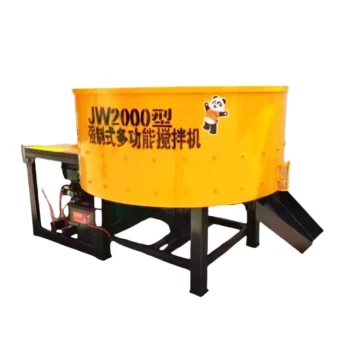
At its core, a concrete mixer is a machine designed around a rotating drum that combines cement, aggregate (like sand or gravel), and water to form concrete. Its key features include the drum itself, internal blades for agitation, a power source, and systems for loading materials and discharging the finished mix.
The true purpose of a concrete mixer isn't just to stir ingredients. It's a system engineered to guarantee consistency, efficiency, and quality—three factors that are notoriously difficult to achieve with manual mixing and are critical to the structural integrity of any construction project.
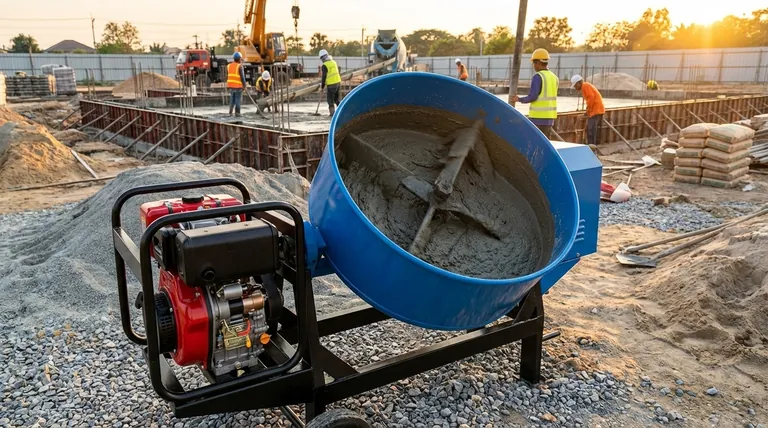
The Anatomy of a Concrete Mixer: Core Components Explained
Understanding a mixer begins with its fundamental parts. Each component plays a specific role in transforming raw materials into a uniform, workable product.
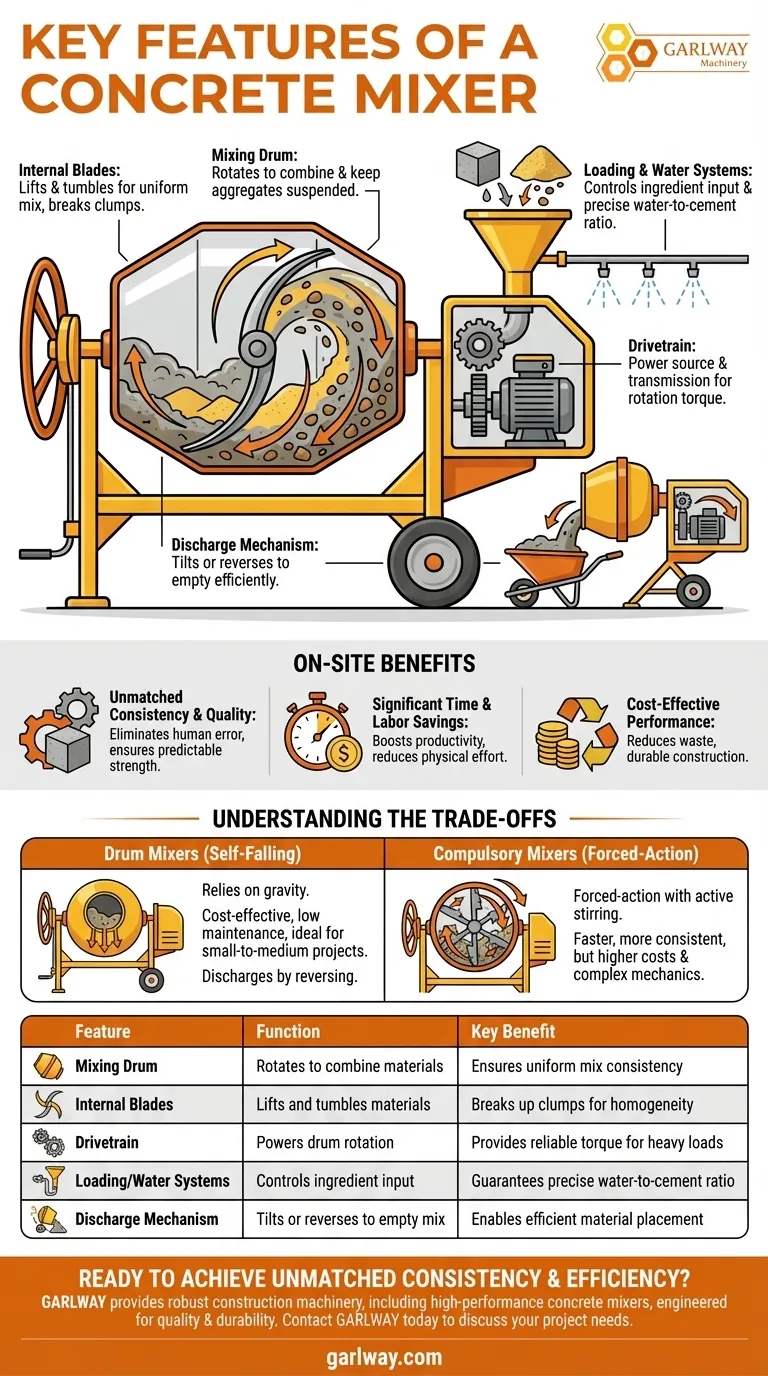
The Mixing Drum: The Heart of the Operation
The most recognizable feature is the rotating drum. This vessel contains the materials during the mixing process.
Its constant rotation is essential for two reasons: it thoroughly combines the ingredients and prevents the heavier aggregates from settling at the bottom, ensuring the mix remains suspended and uniform.
Internal Blades: The Key to a Uniform Mix
Fixed inside the drum are blades or fins. As the drum turns, these blades continuously lift the material up the side of the drum.
The material then tumbles back down due to gravity. This lifting and falling action is what creates a consistent, homogenous mix, breaking up any potential clumps of cement.
The Drivetrain: Powering the Process
The entire operation is powered by a prime mover, which can be an electric motor or a gas/diesel engine.
This engine connects to the drum via a transmission mechanism, which manages the rotational speed and provides the necessary torque to turn a heavy load of wet concrete.
Loading and Water Systems: Controlling the Ingredients
A feeding or loading unit allows for the efficient introduction of cement, sand, and aggregates into the drum.
Simultaneously, a water supply system introduces the precise amount of water needed for the desired consistency. Proper hydration is critical for the concrete's final strength.
The Discharge Mechanism: Getting the Concrete Out
Once the concrete is properly mixed, it must be discharged. This is typically achieved in one of two ways.
Many mixers are designed to tilt the drum downward, allowing the concrete to pour out into a wheelbarrow or formwork. Others reverse the direction of the drum's rotation, which causes the internal blades to push the mix out of the opening.
How These Features Translate to On-Site Benefits
The mechanical features of a concrete mixer directly address the primary challenges of working with concrete on a construction site.
Unmatched Consistency and Quality
The automated action of the drum and blades eliminates human error and inconsistency. This ensures that every batch has the same water-to-cement ratio and aggregate distribution, which is vital for predictable strength and quality.
Significant Time and Labor Savings
A mixer dramatically reduces the time and physical effort required compared to mixing by hand. This boosts worker productivity, allowing a small crew to produce a large volume of high-quality concrete efficiently.
Cost-Effective Performance
By ensuring every batch is mixed correctly, a mixer reduces material waste from improperly mixed batches. Their durable construction and reliable performance make them a cost-effective investment for both small and large construction projects.
Understanding the Trade-offs
While all mixers share core features, their design principles can differ, creating a key trade-off between simplicity and mixing intensity.
Drum Mixers (Self-Falling)
This is the most common type of mixer. It relies primarily on gravity, using the blades to lift material and let it fall to mix.
These mixers are cost-effective, have low maintenance requirements, and are ideal for small to medium-sized projects. The drum typically reverses to discharge the concrete.
Compulsory Mixers (Forced-Action)
Forced-action or compulsory mixers use a more aggressive mixing device inside a stationary drum. Instead of relying on gravity, paddles actively stir the mix at high speed.
This design delivers a faster and even more consistent mix but comes with higher upfront costs and more complex mechanics, including specialized shaft seals and lubrication systems.
Making the Right Choice for Your Project
Selecting the right mixer depends entirely on the scale and technical requirements of your work.
- If your primary focus is small-to-medium projects or cost-effectiveness: A standard drum mixer is the most practical and reliable choice for general-purpose work.
- If your primary focus is high-volume output and strict quality control: A compulsory mixer is often necessary for demanding commercial projects where mix speed and absolute uniformity are paramount.
Ultimately, a concrete mixer is a purpose-built tool that brings automation and predictability to the foundational element of modern construction.
Summary Table:
| Feature | Function | Key Benefit |
|---|---|---|
| Mixing Drum | Rotates to combine materials | Ensures uniform mix consistency |
| Internal Blades | Lifts and tumbles materials | Breaks up clumps for homogeneity |
| Drivetrain | Powers drum rotation | Provides reliable torque for heavy loads |
| Loading/Water Systems | Controls ingredient input | Guarantees precise water-to-cement ratio |
| Discharge Mechanism | Tilts or reverses to empty mix | Enables efficient material placement |
Ready to achieve unmatched consistency and efficiency on your construction site?
GARLWAY specializes in providing robust construction machinery, including high-performance concrete mixers, winches, and concrete batching plants. Our equipment is engineered to deliver the quality, durability, and cost-effectiveness that construction companies and contractors demand globally.
Contact GARLWAY today to discuss your project needs and discover how our concrete mixers can enhance your productivity and build with confidence.
Visual Guide
Related Products
- Portable Concrete Mixer Machine Equipment for Mixing Concrete
- Construction Products Concrete Plant Machine Mixing Concrete Mixer
- Portable Electric Concrete Mixer Machine for Cement Mixing
- JZC400 Mobile Small Concrete Mixer Cement Mixer Machine
- Hydraulic Concrete Mixer Machine Cement Mixing Equipment for Mixture Concrete
People Also Ask
- Why is it necessary to use a portable concrete mixer? Gain Total Control & Efficiency
- How much concrete can you pour with a portable mixer? Find the Perfect Fit for Your Project
- What types of projects are portable concrete mixers suitable for? Ideal for DIY & Small-Scale Construction
- How much does a portable concrete mixer hold? A Guide to Choosing the Right Capacity
- What types of portable concrete mixers exist? Find the Perfect Mixer for Your Project