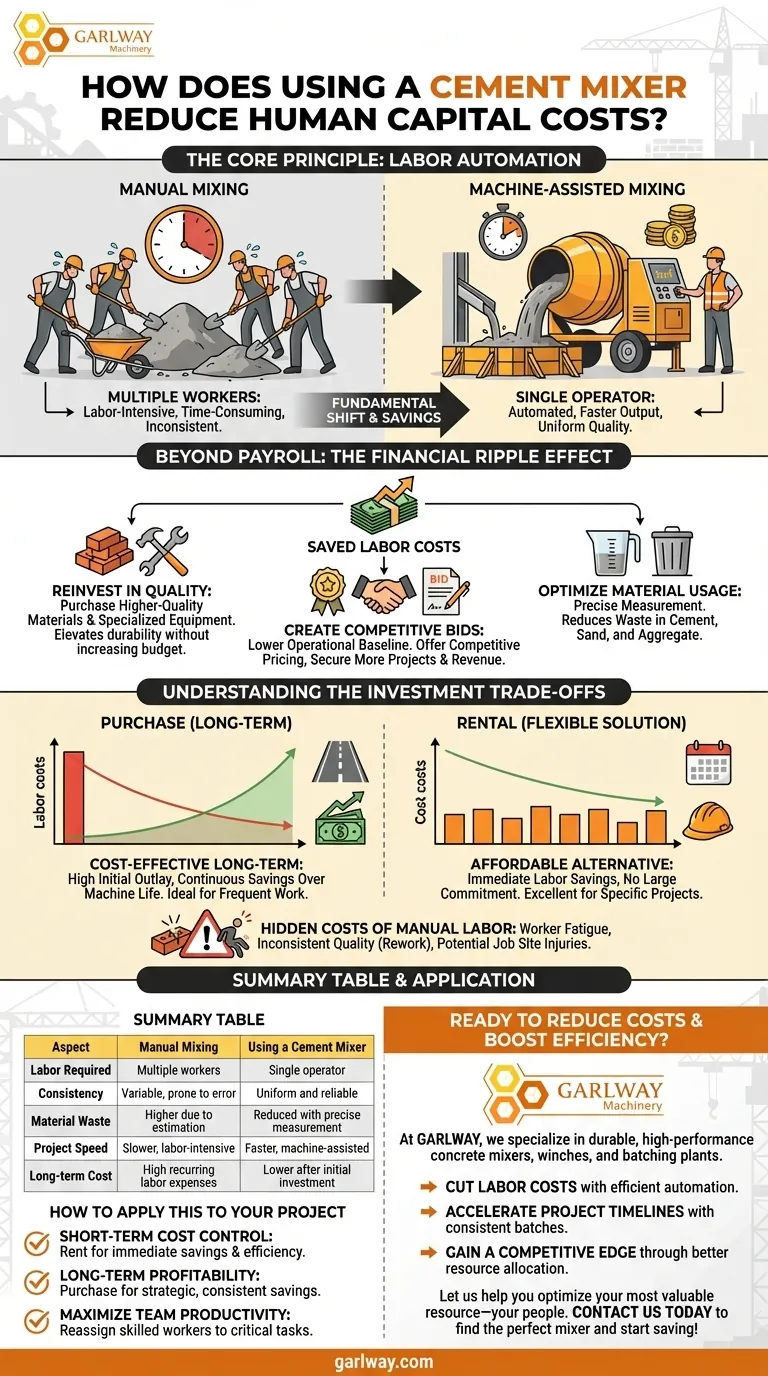
At its core, a cement mixer reduces human capital costs by directly substituting mechanical power for manual labor, allowing a single operator to perform the work that would otherwise require multiple employees. This fundamental shift from a labor-intensive to a machine-assisted process dramatically lowers payroll expenses associated with mixing concrete.
The true financial impact of a cement mixer isn't just in cutting labor hours; it's about converting saved labor costs into strategic advantages, such as using higher-quality materials or offering more competitive project bids.
The Core Principle: Labor Automation
The most direct way a cement mixer impacts human capital is by fundamentally changing the labor equation on a job site. It introduces automation to a physically demanding and time-consuming task.
From Multiple Workers to a Single Operator
Manual mixing is a team effort, often requiring several workers to shovel, add water, and blend the materials. A small cement mixer requires only one worker to load the ingredients and operate the machine, immediately reducing the labor headcount for that specific task.
Increasing Output and Consistency
A mixer produces a consistent, uniform batch of concrete far faster than a team can by hand. This increased productivity means more work gets done with fewer labor hours, accelerating project timelines and further reducing overall labor costs.
Beyond Payroll: The Financial Ripple Effect
The savings generated by reducing the mixing crew extend far beyond the direct payroll. This freed-up capital can be strategically reallocated to improve other areas of the project.
Reinvesting in Quality
Funds that would have been spent on manual labor can be redirected toward purchasing higher-quality materials or other specialized equipment. This elevates the overall quality and durability of the finished work without increasing the total project budget.
Creating Competitive Bids
By lowering the baseline operational costs, contractors can offer more competitive pricing to clients. This provides a significant advantage in the bidding process, potentially securing more projects and increasing revenue.
Optimizing Material Usage
Machine mixing allows for precise measurement of ingredients, which reduces material waste compared to the estimations often used in manual mixing. Saving on cement, sand, and aggregate is another way the equipment lowers overall project expenses.
Understanding the Investment Trade-offs
While a mixer provides clear benefits, the decision of how to acquire one involves weighing upfront costs against long-term gains. This choice directly impacts how you manage capital.
Purchase as a Long-Term Investment
For businesses that frequently handle concrete work, purchasing a mixer is a cost-effective long-term investment. The initial capital outlay is quickly offset by the continuous savings in labor costs over the life of the machine.
Rental as a Flexible Solution
For smaller projects or companies that only occasionally need a mixer, renting offers an affordable alternative. It provides the same immediate labor-saving benefits without the commitment of a large purchase, making it an excellent option for managing project-specific costs.
The Hidden Costs of Manual Labor
Relying solely on manual mixing carries indirect costs, including the risk of worker fatigue, inconsistent batch quality that may require costly rework, and potential job site injuries from the strenuous physical effort involved.
How to Apply This to Your Project
Your decision should align with your primary business objective, whether it's maximizing profit on a single job or building long-term operational efficiency.
- If your primary focus is short-term cost control on a specific job: Renting a mixer provides immediate labor savings and boosts efficiency without requiring a significant capital expense.
- If your primary focus is long-term business profitability: Purchasing a mixer is a strategic investment that consistently reduces human capital costs and enhances project quality across all future jobs.
- If your primary focus is maximizing team productivity: Using a mixer frees up valuable workers from the mixing pit, allowing them to be reassigned to more skilled tasks that move the project forward.
Ultimately, integrating a cement mixer is a strategic decision to optimize your most valuable resource: your people.
Summary Table:
| Aspect | Manual Mixing | Using a Cement Mixer |
|---|---|---|
| Labor Required | Multiple workers | Single operator |
| Consistency | Variable, prone to error | Uniform and reliable |
| Material Waste | Higher due to estimation | Reduced with precise measurement |
| Project Speed | Slower, labor-intensive | Faster, machine-assisted |
| Long-term Cost | High recurring labor expenses | Lower after initial investment |
Ready to reduce your human capital costs and boost project efficiency?
At GARLWAY, we specialize in providing durable and high-performance construction machinery, including concrete mixers, winches, and batching plants, tailored for construction companies and contractors worldwide.
By investing in a GARLWAY cement mixer, you can:
- Cut labor costs by replacing manual effort with efficient automation.
- Accelerate project timelines with consistent, high-quality concrete batches.
- Gain a competitive edge through lower operational costs and better resource allocation.
Let us help you optimize your most valuable resource—your people. Contact us today to find the perfect mixer for your needs and start saving!
Visual Guide
Related Products
- HZS25 Best Cement Mixer for Quick Mix Concrete at Bunnings
- JDC350 Small Cement Concrete Mortar Mixer
- Concrete Cement Mixer Machine Drum Mixer for Construction
- JW1000 Mobile Cement Mixer Concrete Mixer Truck and Batching Plant
- JZC500 Large Cement Mixer Machine Price for Concrete Mix
People Also Ask
- How do cement mixers enhance safety on construction sites? Reduce Strain, Hazards, and Accidents
- What are the main components of a cement mixer? A Guide to Core Parts & Functions
- What are some tips for using a cement mixer effectively? Maximize Your Mixer's Performance & Concrete Quality
- How does cleaning a cement mixer after use benefit its performance? Maximize Lifespan and Mix Quality
- Why is it important to clean the cement mixer after use? Prevent Costly Damage and Ensure Quality Concrete