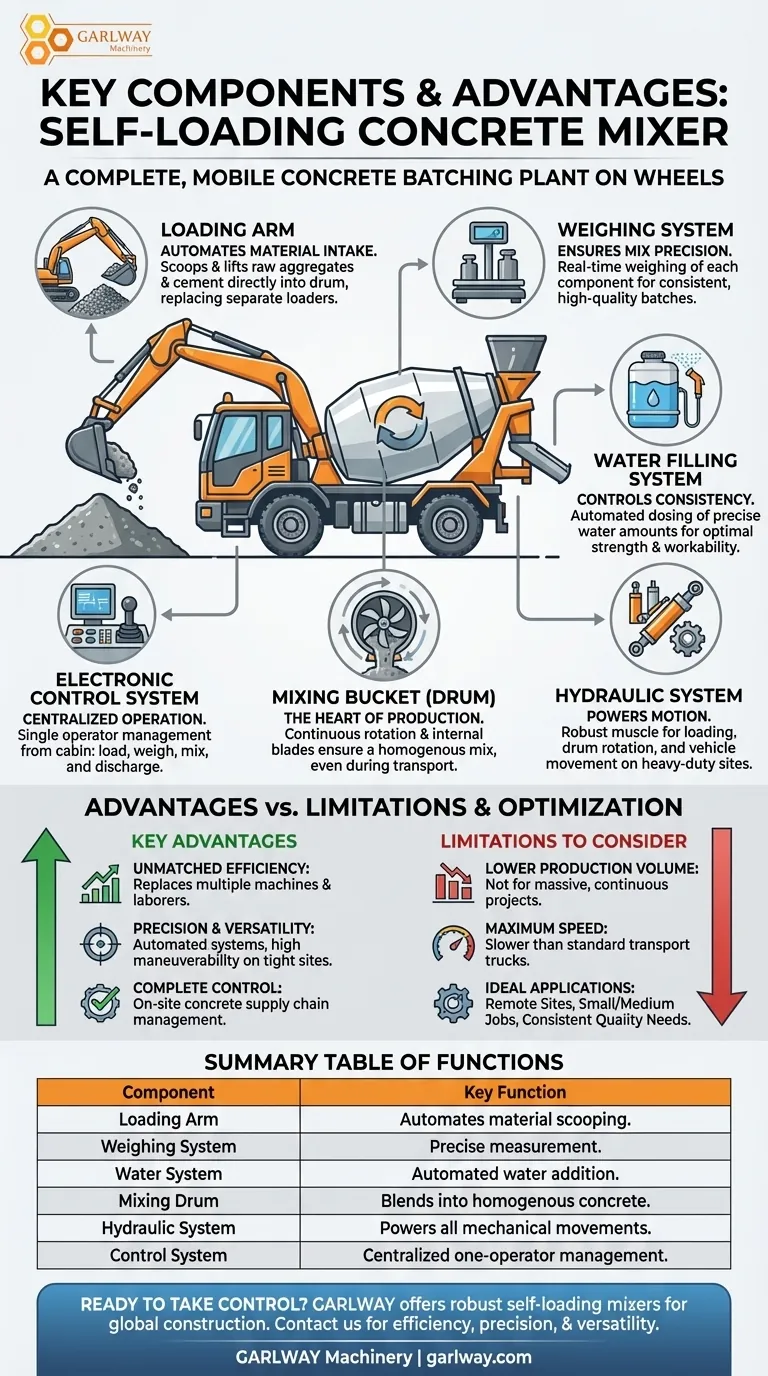
At its core, a self-loading concrete mixer is defined by six primary components working in unison. These are the loading arm for material intake, the weighing system for precision, the water filling system for consistency, the mixing bucket for production, the hydraulic system that powers movement, and an electronic control system for centralized operation.
The critical takeaway is that this machine is not merely a mixer; it is a complete, mobile concrete batching plant. Each component serves a distinct role in automating the entire process, from loading raw materials to discharging ready-to-use concrete.
How the Components Create an Integrated System
Understanding a self-loading mixer requires looking beyond the individual parts and seeing how they create a seamless, automated workflow. This system transforms raw aggregates, cement, and water into precisely mixed concrete directly on the job site.
The Loading System: Automating Material Intake
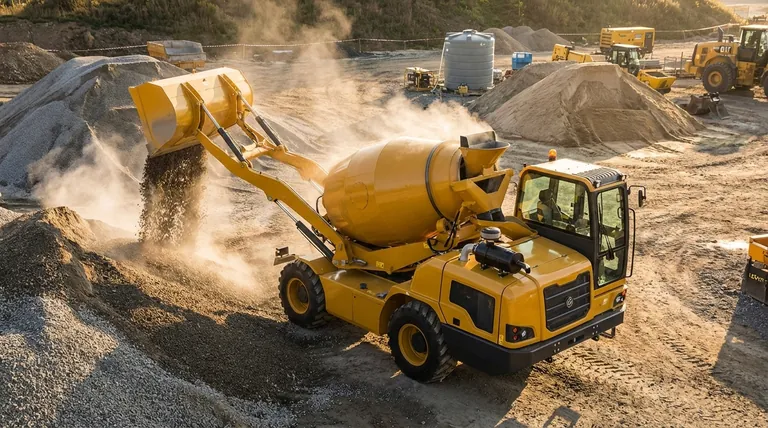
The process begins with the hydraulically operated loading arm and bucket. This component is responsible for scooping raw materials like sand, gravel, and cement from piles. It then lifts and deposits them directly into the mixing drum, eliminating the need for a separate loader and operator.
The Weighing System: Ensuring Mix Precision
As materials are loaded, a built-in, real-time weighing system measures the exact weight of each component. This is one of the machine's most critical features. It ensures that every batch adheres to the specified mix design, guaranteeing concrete quality and consistency.
The Water System: Controlling Consistency
Simultaneously, the water filling system, managed by the electronic controls, adds the precise amount of water required for the mix. This automated dosing system prevents the common errors of adding too much or too little water, which directly impacts the concrete's strength and workability.
The Mixing Drum: The Heart of Production
The mixing bucket or drum is where all the components are blended. It rotates at a controlled speed, using internal blades or paddles to thoroughly agitate the contents. This continuous mixing action ensures a homogenous final product and can continue during transport to the discharge location.
The Hydraulic System: The Power Behind the Motion
The hydraulic system is the machine's muscle. It powers the loading arm, rotates the drum, and enables the vehicle's movement. Its robust design is essential for handling the heavy loads and continuous operation required on a construction site.
The Control System: Centralized Operation
All of these functions are managed from the operator's cabin via the electronic control system. From a single position, one operator can load, weigh, mix, and discharge the concrete. This centralized control is fundamental to the machine's efficiency and reduction in labor requirements.
Understanding the Key Advantages and Trade-offs
The integration of these components delivers significant operational benefits, but it's important to understand the context in which this machine provides the most value.
Unmatched Efficiency and Labor Reduction
The primary advantage is the consolidation of equipment and personnel. A self-loading mixer replaces the need for a separate wheel loader, a traditional mixer, and often a dedicated batching plant operator. This drastically reduces labor costs and streamlines site logistics.
Precision and Versatility On-Site
The automated weighing and water systems deliver a level of precision that is difficult to achieve with manual methods. Furthermore, its typical design—often featuring a narrow body, short wheelbase, and a drum capable of 270-degree rotation—makes it exceptionally maneuverable in constrained or remote project sites.
Potential Limitations to Consider
While highly efficient for specific applications, a self-loading mixer is not a replacement for a large-scale, stationary batching plant. Its production volume per hour is lower, making it less suitable for massive projects like high-rise construction or large-scale paving that require a continuous, high-volume supply of concrete.
Making the Right Choice for Your Goal
Selecting the right equipment depends entirely on your project's scale, location, and operational goals.
- If your primary focus is work on remote or space-constrained sites: The machine's all-in-one design and maneuverability make it an ideal solution.
- If your primary focus is reducing operational costs on small to medium jobs: The ability to replace multiple machines and operators with a single unit delivers a clear financial benefit.
- If your primary focus is ensuring consistent concrete quality without a full batch plant: The automated weighing and water systems provide the necessary process control.
Ultimately, the self-loading concrete mixer's value lies in its ability to give you complete control over your concrete supply chain, right where you need it most.
Summary Table:
| Component | Key Function |
|---|---|
| Loading Arm | Automates the scooping and loading of raw materials. |
| Weighing System | Ensures precise measurement of materials for consistent mix quality. |
| Water System | Automatically adds the correct amount of water for optimal consistency. |
| Mixing Drum | Blends all materials into homogenous, ready-to-use concrete. |
| Hydraulic System | Powers all mechanical movements, including the arm and drum rotation. |
| Control System | Allows one operator to centrally manage the entire process. |
Ready to take control of your concrete production?
GARLWAY specializes in construction machinery, offering robust self-loading concrete mixers designed for construction companies and contractors globally. Our machines deliver the efficiency, precision, and on-site versatility you need to reduce costs and streamline operations.
Contact us today to discuss how a GARLWAY self-loading mixer can be the complete solution for your next project!
Visual Guide
Related Products
- Skid Steer Self Loading Concrete Mixers for Construction
- Belle Mixer Drum Self Loading Mortar Mixers JS3000
- Portable Cement Mixer with Lift Concrete Machine
- Portable Concrete Mixer Machine Equipment for Mixing Concrete
- Portable Ready Mix Concrete Mixer Equipment
People Also Ask
- How does the control system improve production efficiency in a self loading concrete mixer? Automate Mixing for Speed & Quality
- What is the purpose of keeping the drum rotating during transportation in a self loading concrete mixer? Ensure Quality & Consistency
- How does the weighing process work in a self loading concrete mixer? Achieve Precise, On-Site Concrete Batching
- What components are involved in the loading process of a self loading concrete mixer? A Guide to the Key Systems
- How should materials be loaded into a self-loading concrete mixer? Master the Step-by-Step Process