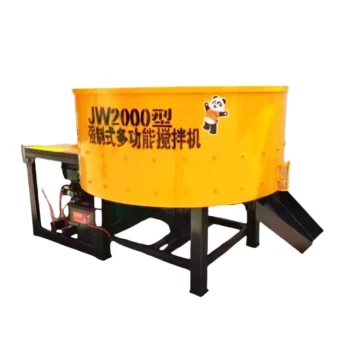
At its core, a pan type mixer is a relatively simple machine built around two fundamental components. It consists of a wide, cylindrical mixing pan and an internal set of mixing blades, often arranged in a star-shaped pattern, that rotate relative to the pan to create a powerful blending action.
The genius of the pan mixer lies not in its individual parts, but in the forced shearing and kneading effect created by the relative motion between the circular pan and the mixing tools, ensuring a fast and homogenous mix.

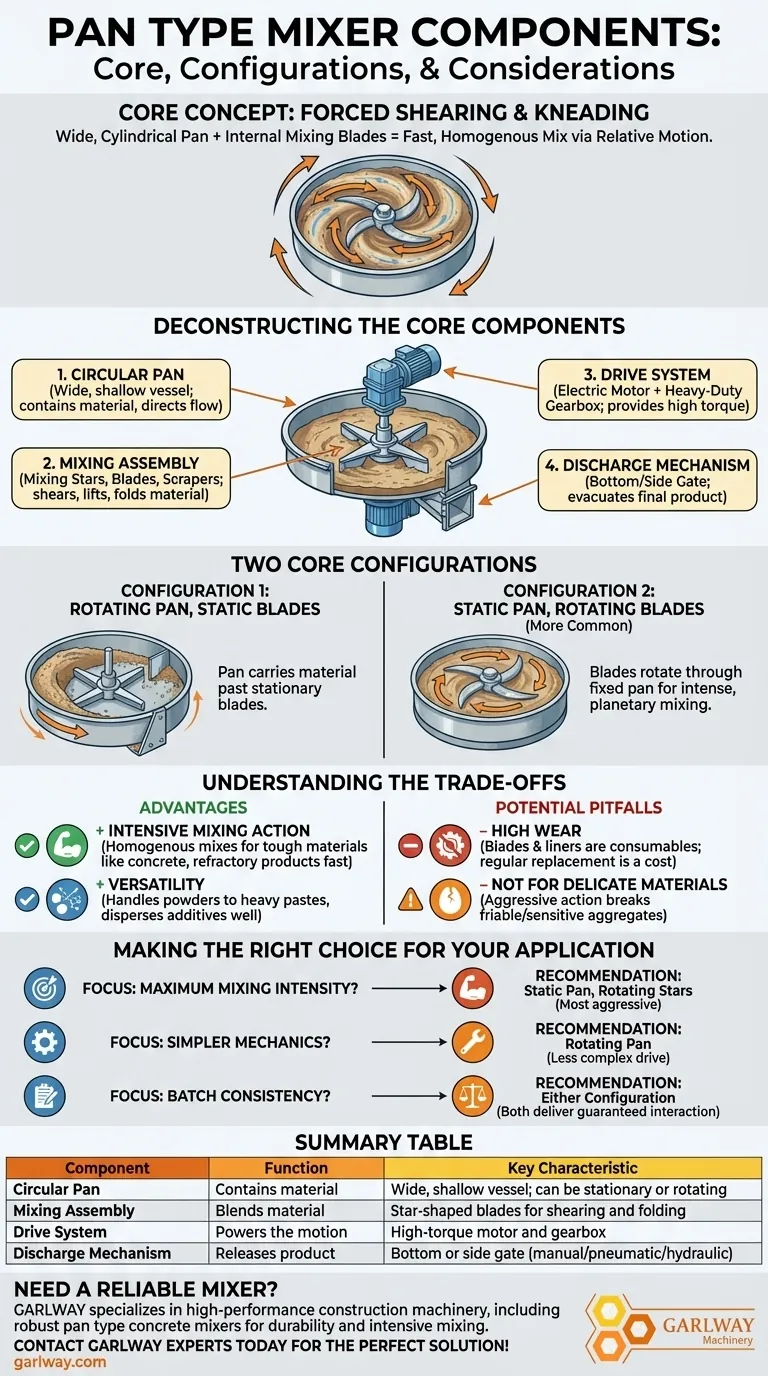
Deconstructing the Core Components
While the pan and blades are the main actors, a complete system requires several key parts to function effectively.
The Circular Pan
The pan is the vessel that contains the material. It is typically wide and relatively shallow, which ensures all the material is constantly forced into the path of the mixing tools. It can be either stationary or designed to rotate.
The Mixing Assembly
This is the heart of the mixer. It consists of one or more "mixing stars" which are assemblies of paddles, blades, and scrapers. These tools are angled precisely to shear, lift, and fold the material, eliminating dead spots and ensuring a consistent mixture.
The Drive System
The relative motion is powered by a robust drive system. This is typically an electric motor connected to a heavy-duty gearbox that provides the high torque needed to move the mixing assembly or the pan, even when fully loaded with dense material.
The Discharge Mechanism
Once the material is mixed, it is evacuated through a discharge gate. This is usually a door located in the bottom or side of the pan that can be opened manually, pneumatically, or hydraulically to release the final product.
The Two Core Configurations: How They Work
The key difference between pan mixer models lies in which primary component moves. This distinction fundamentally changes the mixing dynamics.
Configuration 1: Rotating Pan with Static Blades
In this design, the entire pan rotates, carrying the material with it. The mixing assembly is stationary, and as the material is carried past, the blades shear and blend it. A wall scraper is almost always included to prevent material from building up on the outer wall.
Configuration 2: Static Pan with Rotating Blades
This is a more common configuration. The pan remains fixed while the mixing assembly, or "stars," rotates through the material. This creates an intense, planetary-style mixing action that is highly efficient at breaking down clumps and distributing additives.
Understanding the Trade-offs
While powerful, the pan mixer design has specific strengths and weaknesses to consider.
Key Advantage: Intensive Mixing Action
The forced-action principle is the pan mixer's greatest strength. It excels at producing homogenous, high-quality mixes for tough materials like concrete, mortar, and refractory products in a very short amount of time.
Key Advantage: Versatility
Pan mixers can handle a wide range of materials, from dry powders to heavy, stiff pastes. The powerful shearing is excellent for dispersing pigments, fibers, and other additives thoroughly.
Potential Pitfall: High Wear
The intensive, high-shear action means that the mixing blades and pan liners are high-wear components. They are considered consumables and require regular inspection and replacement, which is a key operational cost.
Potential Pitfall: Not for Delicate Materials
This design is not suitable for friable or delicate materials that can be damaged by the aggressive mixing action. The shearing and smearing forces can break down sensitive aggregates or components.
Making the Right Choice for Your Application
Selecting the right configuration depends entirely on your material and operational needs.
- If your primary focus is maximum mixing intensity for tough materials (like refractory castables): A static pan with rotating mixing stars typically provides the most aggressive and thorough action.
- If your primary focus is simpler mechanics and maintenance: A rotating pan design can sometimes have a less complex gearbox and easier access to the stationary mixing tools.
- If your primary focus is batch consistency: Either configuration will deliver excellent results due to the forced-action principle that guarantees all material interacts with the mixing tools.
Ultimately, understanding these core components and their interaction allows you to evaluate a pan mixer based on its mechanical action, not just its size.
Summary Table:
| Component | Function | Key Characteristic |
|---|---|---|
| Circular Pan | Contains the material | Wide, shallow vessel; can be stationary or rotating |
| Mixing Assembly | Blends the material | Star-shaped blades for shearing and folding |
| Drive System | Powers the motion | High-torque motor and gearbox |
| Discharge Mechanism | Releases the final product | Bottom or side gate (manual/pneumatic/hydraulic) |
Need a reliable and efficient mixer for your construction projects? GARLWAY specializes in high-performance construction machinery, including robust pan type concrete mixers designed for durability and intensive mixing action. Our equipment helps construction companies and contractors globally achieve consistent, high-quality results while minimizing downtime. Contact our experts today to find the perfect mixer for your specific needs and discover the GARLWAY advantage!
Visual Guide
Related Products
- JDC350 Small Cement Concrete Mortar Mixer
- JDY350 Electric Hydraulic Mortar Mud Concrete Mixer
- JS1000 Volumetric Concrete Mortar Mixer for Sale Skid Steer Cement Mixer
- Commercial Construction Mixer Machine for Soil Cement Mixing Concrete
- Shaft Mixer Machine for Cement and Regular Concrete Mixing
People Also Ask
- What are the primary uses of a small cement mixer? Boost Efficiency for Small to Medium Construction Jobs
- What are the physical benefits of using a small cement mixer? Reduce Strain and Prevent Injury
- What are the cost benefits of using a small cement mixer? Save on Labor, Materials & Time
- What makes small cement mixers easy and convenient to use? Boost Productivity on Any Job Site
- What factors should be considered before purchasing a small cement mixer? Find the Perfect Match for Your Project