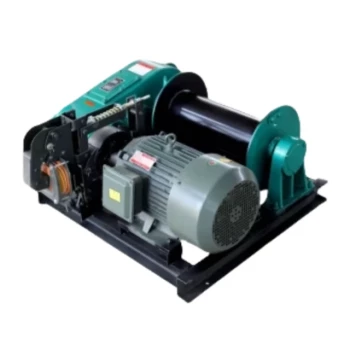
At its core, an electric winch is a motor-driven tool designed for pulling, lifting, and towing heavy loads. It is commonly used for recovering stuck vehicles, hoisting materials on construction sites, loading heavy equipment onto trailers, and managing loads in marine, forestry, and mining operations.
An electric winch translates electrical power into immense mechanical force, offering a safe and efficient solution for pulling and lifting tasks that would be impractical or dangerous to perform manually. Its value lies not in a single function, but in its adaptability across diverse industries and environments.
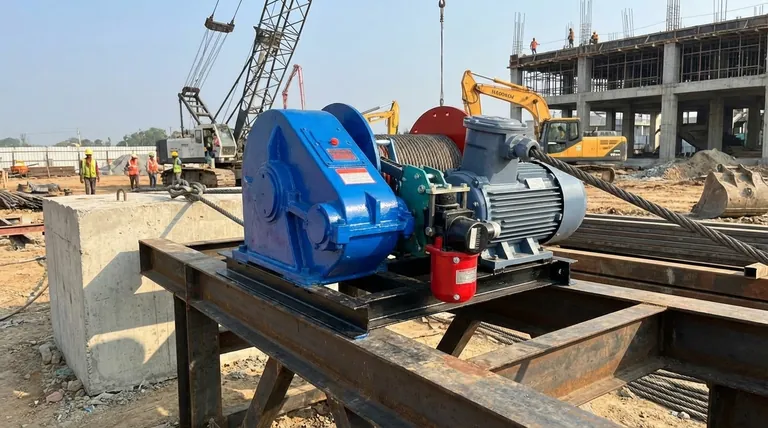
The Principle: How a Winch Amplifies Force
An electric winch is a relatively simple machine that creates a significant mechanical advantage. Understanding its core components clarifies how it performs its work across so many different applications.
The Key Components
An electric motor, powered by a vehicle battery or other electrical source, drives a series of gears. This gear train reduces speed but massively multiplies torque.
This torque is used to turn a cylindrical drum, which winds a steel or synthetic rope. This winding action is what generates the powerful, controlled pull.
Essential Mechanisms for Control
A clutch allows the drum to free-spool, enabling you to pull the rope out by hand quickly. A crucial automatic brake engages the moment the motor stops, preventing the load from slipping backward and ensuring safety.
Core Applications Across Industries
The versatility of the electric winch makes it a standard tool in sectors where heavy objects must be moved with precision and control.
Vehicle Recovery and Off-Roading
This is perhaps the most well-known use. An electric winch mounted to the front of a truck or SUV provides the power to pull the vehicle—or another—out of mud, snow, or a ditch.
Construction and Infrastructure
On job sites, winches are used for both lifting and pulling. They can be standalone units or integrated into larger machinery like cranes to hoist building materials, tools, and structural components.
Forestry and Land Management
In forestry operations, winches are indispensable for dragging heavy logs (skidding) to a central location for processing. They are also used for clearing fallen trees and other heavy debris from paths and roadways.
Marine and Dockside Operations
Winches are used on boats for anchor handling and on trailers for pulling boats out of the water. At wharves and docks, they assist in mooring vessels and moving heavy cargo.
Industrial and Workshop Use
In a workshop or manufacturing setting, an electric winch can be used to pull heavy machinery into position or to load bulky equipment onto transport vehicles and trailers.
Understanding the Trade-offs
While incredibly useful, an electric winch has operational limitations that are critical to understand for safe and effective use.
Power Source Dependency
An electric winch places a significant demand on its power source, typically a vehicle's battery and alternator. Prolonged use without the engine running can quickly drain a battery.
Duty Cycle and Overheating
Electric winch motors generate immense heat and are not designed for continuous operation. They have a limited "duty cycle"—a set period of run time followed by a required cool-down period to prevent motor damage.
Horizontal vs. Vertical Loads
Most vehicle-mounted winches are designed exclusively for pulling (horizontal) loads. Using a standard recovery winch for lifting (vertical) is extremely dangerous, as their braking systems are not designed to safely suspend a load. Only winches specifically rated as hoists should be used for lifting.
Making the Right Choice for Your Goal
Selecting the right winch depends entirely on the task you need to accomplish.
- If your primary focus is vehicle recovery: Choose a winch with a pulling capacity rated for at least 1.5 times your vehicle's gross weight and consider a synthetic rope for lighter weight and safer handling.
- If your primary focus is industrial lifting: You must use a tool specifically rated as an electric hoist, not a recovery winch, to ensure the braking system is designed to safely suspend loads.
- If your primary focus is general utility or workshop tasks: A smaller, portable winch may be more practical and cost-effective for intermittent pulling tasks like loading equipment onto a trailer.
By matching the tool's design to your specific application, you can leverage the electric winch as a powerful asset for safety and efficiency.
Summary Table:
| Application | Primary Use | Key Considerations |
|---|---|---|
| Vehicle Recovery | Pulling stuck vehicles | Requires capacity 1.5x vehicle weight; synthetic rope recommended |
| Construction | Hoisting materials, pulling loads | Can be standalone or integrated into machinery |
| Industrial/Workshop | Moving machinery, loading equipment | Portable models ideal for intermittent tasks |
| Forestry/Marine | Skidding logs, anchor handling | Essential for heavy, controlled pulling in rugged environments |
Need a reliable electric winch for your construction or contracting project?
At GARLWAY, we specialize in high-performance construction machinery, including durable electric winches, concrete mixers, and batching plants. Our solutions are engineered for safety, efficiency, and durability in demanding environments.
Let us help you:
- Select the right winch for your specific pulling or lifting needs
- Enhance on-site productivity with robust, dependable equipment
- Access global support and expertise for construction and industrial applications
Contact GARLWAY today for a consultation and discover how our machinery can power your projects!
Visual Guide

Related Products
- Electric 120V Boat Winch by Badlands
- Small Electric Winch 120V and 240V for Compact Applications
- 12000 lb Electric Boat Trailer Winch with Windlass Anchor Warn
- Electric Hoist Winch Boat Anchor Windlass for Marine Applications
- Electric and Hydraulic Winch for Heavy Duty Applications
People Also Ask
- How do electric boat winches work? Unlock Effortless Launching & Retrieval
- How much current does an electric boat winch draw? Plan Your Electrical System for Peak Performance
- Can I run a winch straight from a battery? Essential Power Setup for Safe Operation
- What are the types of electric winches available? Choose the Right Winch for Your Job
- What are the uses of electric winches in mining and tunneling? Enhance Safety and Efficiency Underground