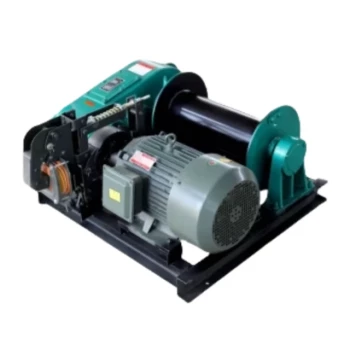
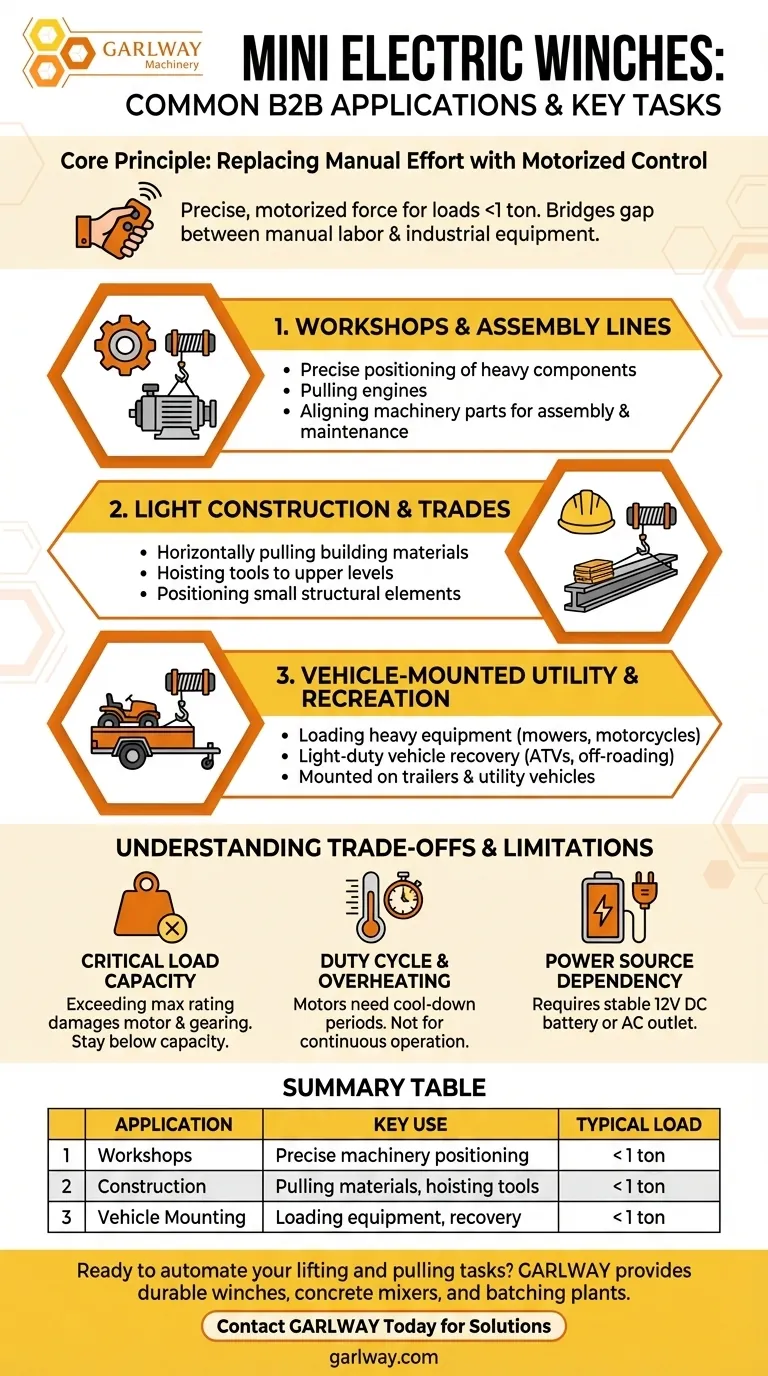
In short, mini electric winches are primarily used for three key tasks: moving machinery in workshops, pulling materials on construction sites, and loading equipment or goods onto vehicles and trailers. Their design excels at controlled, horizontal pulling and light vertical lifting for loads typically under one ton.
The core value of a mini electric winch isn't raw power, but rather its delivery of precise, motorized force in a compact form. It bridges the gap between manual labor and heavy industrial equipment, automating small-scale pulling and lifting tasks that require consistency and control.

The Core Principle: Replacing Manual Effort with Motorized Control
A mini electric winch is fundamentally a force multiplier. It automates tasks that would otherwise require significant physical strain or cumbersome leverage systems like block and tackle.
What Defines a "Mini" Electric Winch?
The "mini" designation refers to its capacity and physical size. These winches are engineered for loads generally under one ton (2,000 lbs). They are powered by an electric motor, often designed to run off a vehicle battery (12V DC) or a standard wall outlet (110V/220V AC).
The Advantage Over Other Methods
Compared to a manual hand winch, an electric model offers greater speed and continuous operation without fatigue. Unlike large, industrial winches, a mini winch provides portability and precision for work in smaller, more confined spaces like a garage or assembly area.
Key Application Environments
The versatility of the mini electric winch allows it to be deployed across several common commercial and recreational scenarios.
Workshops and Assembly Lines
In machine repair shops or small manufacturing settings, these winches are invaluable. They are used for the precise positioning of heavy components, pulling engines, or aligning machinery parts during assembly and maintenance.
Light Construction and Trades
On a construction site, a mini winch can be used to horizontally pull building materials, hoist bundles of tools to an upper level, or help position small structural elements. Its compact size makes it easy to mount on scaffolding or support beams.
Vehicle-Mounted Utility and Recreation
This is one of the most common applications. Mounted on ATVs, utility vehicles, or trailers, these winches are used for loading heavy equipment like mowers or motorcycles. In off-roading, they serve as a critical tool for light-duty vehicle recovery.
Specialized Niche Uses
Beyond the common uses, mini winches are found in specialized fields. They are used in marine science for deploying and retrieving survey equipment, in forestry for dragging small logs, and in renewable energy for light maintenance tasks on turbines or solar arrays.
Understanding the Trade-offs and Limitations
To use a mini electric winch effectively and safely, you must understand its operational limits.
The Critical Load Capacity
The single most important limitation is the maximum weight rating. Exceeding this limit is not only dangerous but will quickly destroy the winch's motor and gearing. Always ensure the load is well below the stated capacity.
Duty Cycle and Overheating
Electric winch motors generate significant heat under load. They are not designed for continuous, non-stop operation. This is known as the duty cycle—a period of use followed by a required cool-down period. Ignoring this can lead to permanent motor damage.
Power Source Dependency
Being electric, these winches are entirely dependent on a stable power source. For a 12V model, this means a healthy vehicle battery, as a struggling battery will severely impact performance. For AC models, you are tethered to the location of a power outlet.
Making the Right Choice for Your Goal
Select a winch based on its intended, primary function.
- If your primary focus is workshop precision: Choose a winch with a lower weight rating and variable speed control for delicate machinery assembly.
- If your primary focus is vehicle-mounted loading: Ensure the winch has a pulling capacity of at least 1.5 times the weight of the object you are loading and includes robust mounting hardware.
- If your primary focus is general job site utility: Prioritize a model with a durable, weather-resistant housing, sufficient cable length, and a simple, reliable remote control.
By respecting its design limitations, you can effectively apply a mini electric winch to save time and manual effort across a wide range of tasks.
Summary Table:
| Application | Key Use | Typical Load |
|---|---|---|
| Workshops | Precise machinery positioning, engine pulling | < 1 ton |
| Construction | Pulling materials, hoisting tools | < 1 ton |
| Vehicle Mounting | Loading equipment, light vehicle recovery | < 1 ton |
Ready to automate your lifting and pulling tasks? A GARLWAY mini electric winch delivers the precise, motorized control you need for workshops, construction sites, and vehicle loading. As a specialist in construction machinery, GARLWAY provides durable winches, concrete mixers, and batching plants trusted by contractors globally. Contact GARLWAY today to find the perfect winch solution for your business!
Visual Guide
Related Products
- Small Electric Winch 120V and 240V for Compact Applications
- Electric 120V Boat Winch by Badlands
- Electric and Hydraulic Winch for Heavy Duty Applications
- Electric Hoist Winch Boat Anchor Windlass for Marine Applications
- 12000 lb Electric Boat Trailer Winch with Windlass Anchor Warn
People Also Ask
- What makes electric winches suitable for off-road use? Key Features for Reliable Vehicle Recovery
- What are the common applications of electric winches? Power Your Lifting & Pulling Tasks
- What are the common uses of an electric winch? A Guide to Safe and Efficient Heavy Lifting
- What are the uses of electric winches in mining and tunneling? Enhance Safety and Efficiency Underground
- How do electric winches contribute to energy savings? Maximize Efficiency and Lower Costs