
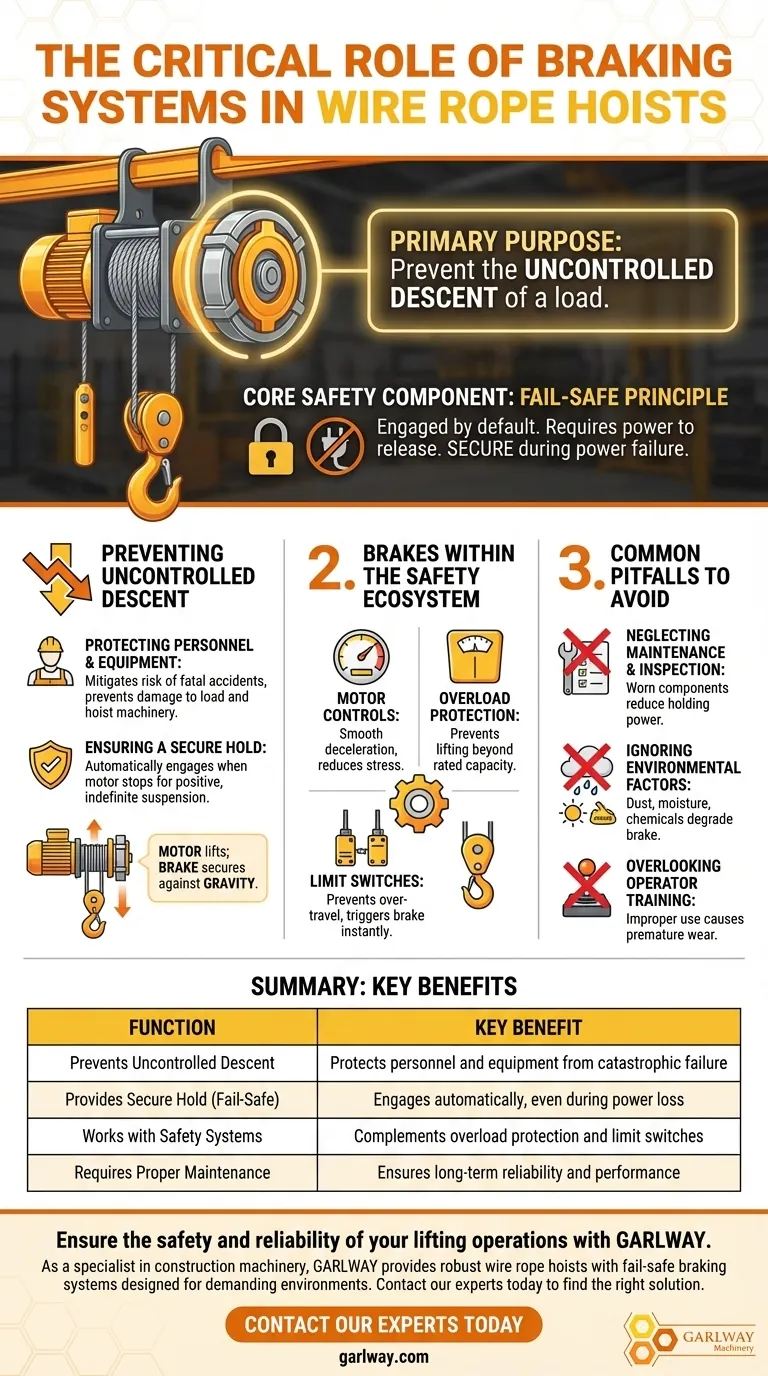
At its core, a wire rope hoist's braking system is its single most critical safety component. It is engineered with one primary purpose: to prevent the uncontrolled descent of a load. This function is the fundamental safeguard that protects personnel from injury, prevents damage to the load and equipment, and ensures operational stability.
A hoist's motor is designed to lift the load, but its braking system is what guarantees that load remains secure against gravity. It is the primary defense against catastrophic failure, transforming a dynamic lifting operation into a controlled, static hold.
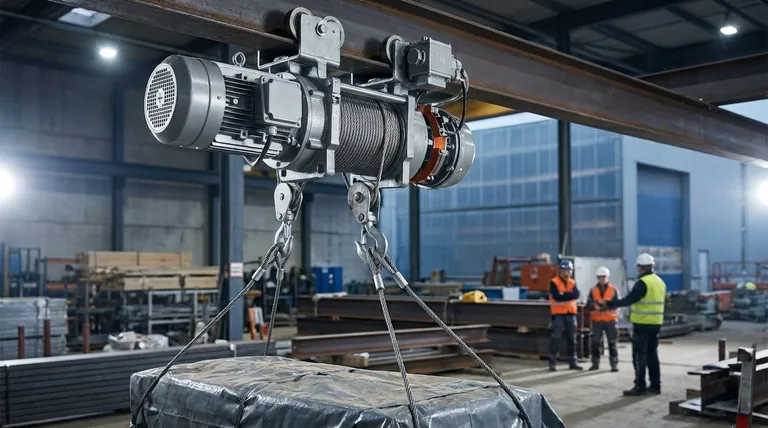
The Primary Role: Preventing Uncontrolled Descent
A hoist's brake is not merely for stopping; it is for holding. Its design is based on a fail-safe principle, meaning it is engaged by default and requires power to be released. This ensures the load is secure even in the event of a power failure.
Protecting Personnel and Equipment
The most severe risk in any lifting operation is a sudden, uncontrolled drop. A reliable braking system directly mitigates this hazard, preventing potentially fatal accidents and protecting operators and other personnel in the vicinity.
Beyond human safety, the brake safeguards valuable assets. It prevents the load from dropping and being damaged, and it protects the hoisting mechanism itself from the immense stress and destructive force of a sudden descent.
Ensuring a Secure Hold
When the hoist motor stops, whether intentionally by the operator or due to a power interruption, the brake automatically engages. This provides a secure, positive hold, allowing the load to be suspended indefinitely without risk of slipping. This function is crucial for positioning tasks and for safety during operational pauses.
Brakes Within the Broader Safety Ecosystem
While the primary brake is the ultimate safeguard, it does not operate in a vacuum. It is a key part of a comprehensive system of safety features that work together to ensure controlled and reliable operation.
Complementing Motor Controls
Modern hoists often feature advanced controls for soft starts, soft stops, and variable speeds. These systems provide smooth deceleration, which reduces mechanical stress on the entire hoist. However, the primary mechanical brake is what provides the final, non-negotiable, secure hold once the motion has ceased.
Working with Overload Protection
Overload protection systems, such as load limiters, prevent the hoist from attempting to lift a weight that exceeds its rated capacity. The brake works in tandem with this system by being engineered to safely hold any load up to that maximum rated capacity.
Integrating with Limit Switches
Limit switches are designed to prevent the hook from traveling too far up or down, which could damage the wire rope or the hoist body. When a limit switch is triggered, it cuts power to the motor, and the primary brake engages instantly to stop all movement and hold the hook securely in its safe terminal position.
Common Pitfalls to Avoid
The effectiveness of a braking system is not absolute. Its reliability is directly dependent on proper application, inspection, and maintenance. Ignoring these factors is the most common point of failure.
Neglecting Maintenance and Inspection
Brakes are mechanical components with parts that are subject to wear. Failure to follow the manufacturer's required inspection and maintenance schedule is the single greatest risk to its function. Worn components can reduce holding power and lead to brake failure.
Ignoring Environmental Factors
The operating environment can significantly impact brake performance. Dust, moisture, grease, and corrosive chemicals can all degrade a brake's effectiveness over time. Specifying a hoist with a braking system appropriate for its working environment is a critical decision.
Overlooking Operator Training
While many braking systems are automatic, operators must understand their function. Improper use of the hoist, such as "inching" or jogging the controls excessively, can cause premature wear on brake components, leading to a shorter service life and increased risk.
How to Apply This to Your Operation
Choosing and maintaining a hoist requires viewing the braking system as the foundation of its safety and reliability.
- If your primary focus is maximum operator and site safety: Prioritize a hoist with a proven, fail-safe braking system and commit to a rigorous, documented maintenance program that exceeds minimum requirements.
- If your primary focus is protecting valuable or sensitive loads: Select a system that pairs a robust primary brake with advanced motor controls for smooth deceleration, preventing shock that could damage the load or the hoist.
- If your primary focus is long-term reliability: View the brake as an integral part of a system that includes overload protection and limit switches, ensuring all components are inspected and maintained as a single cohesive unit.
Ultimately, investing in and maintaining a high-quality braking system is a direct investment in the safety, reliability, and efficiency of your entire lifting operation.
Summary Table:
| Function | Key Benefit |
|---|---|
| Prevents Uncontrolled Descent | Protects personnel and equipment from catastrophic failure |
| Provides Secure Hold (Fail-Safe) | Engages automatically, even during power loss |
| Works with Safety Systems | Complements overload protection and limit switches |
| Requires Proper Maintenance | Ensures long-term reliability and performance |
Ensure the safety and reliability of your lifting operations with GARLWAY.
As a specialist in construction machinery, GARLWAY provides robust wire rope hoists with fail-safe braking systems designed for the demanding environments faced by construction companies and contractors globally. Our hoists, along with our concrete mixers and batching plants, are engineered for maximum safety and long-term durability.
Protect your team and your assets. Contact our experts today to find the right hoist solution for your project's specific safety requirements.
Visual Guide
Related Products
People Also Ask
- How does an electric anchor winch work? Power, Safety, and Reliable Operation Explained
- What are the advantages of installing an electric anchor winch on a boat? Boost Safety & Ease for Boaters
- What are the operational differences between electric hoists and winches? A Guide to Safe Lifting vs. Pulling
- What are the main benefits of a boat anchor winch? Boost Safety & Efficiency for Your Vessel
- How does a boat anchor winch work? A Guide to Reliable Anchor Handling
