
At its core, a non-tilting concrete mixer is defined by its operational axis. The drum rotates continuously on a fixed horizontal plane to mix materials using internal blades and typically discharges the finished concrete by reversing the direction of its spin.
The defining characteristic of a non-tilting mixer is its stability and mechanism. It uses a fixed horizontal drum and reverses its rotation to discharge material, a design principle that makes it exceptionally well-suited for producing large, consistent batches of concrete.
The Mechanics of a Non-Tilting Mixer
To understand the value of a non-tilting mixer, you must first understand its distinct operational process, which differs significantly from its tilting counterparts.
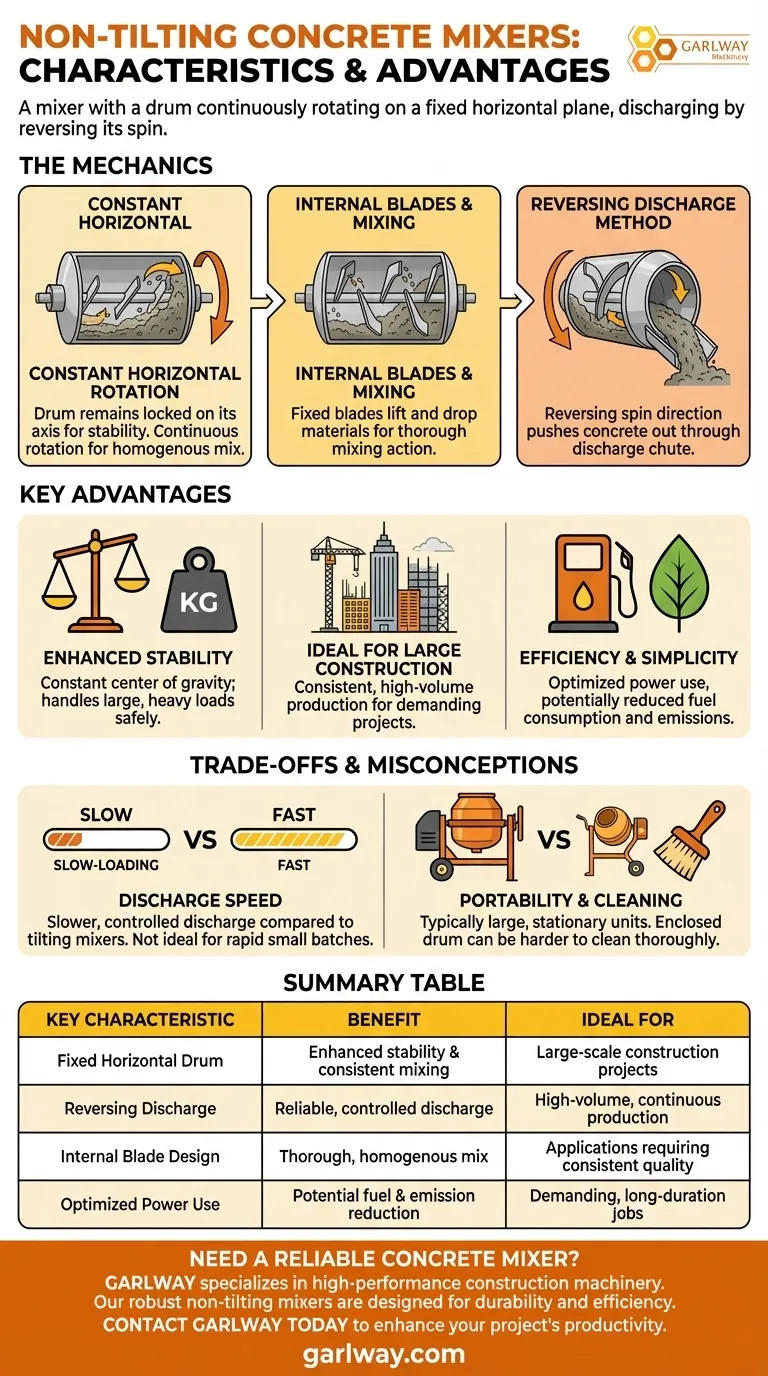
Constant Horizontal Rotation
Unlike a tilting mixer that pivots to discharge its contents, a non-tilting mixer's drum remains locked on its horizontal axis throughout the loading, mixing, and discharging phases. This creates a very stable platform.
The Role of Internal Blades
The inside of the drum is fitted with a series of fixed blades. As the drum rotates in one direction, these blades continuously lift and drop the aggregate, sand, cement, and water, ensuring a thorough and homogenous mix.
The Reversing Discharge Method
When the concrete is ready, the mixer's operation is reversed. The drum begins to spin in the opposite direction. This changes how the blades interact with the mixture, effectively pushing it out of the drum through a dedicated discharge chute.
Key Advantages of the Non-Tilting Design
The specific mechanics of a non-tilting mixer give it several key advantages, particularly in demanding environments.
Enhanced Stability
Because the drum’s center of gravity never changes, these mixers are inherently stable. This stability is critical when dealing with the significant weight and force generated by large volumes of concrete, often around one cubic yard or more.
Ideal for Large Construction
The combination of stability and a continuous operational cycle makes non-tilting mixers the standard for large-scale construction projects where a consistent, high-volume supply of concrete is necessary.
Efficiency and Simplicity
Modern non-tilting mixers are often engineered to optimize engine and hydraulic power. This focus on efficiency can lead to reduced fuel consumption and lower emissions, making them a more sustainable choice for big jobs.
Understanding the Trade-offs and Misconceptions
While powerful, the non-tilting design is not universally superior. Understanding its limitations and how it differs from other common mixers is essential.
Discharge Control vs. Speed
The reversing discharge mechanism is reliable but can be slower than the simple, gravity-assisted dump of a tilting mixer. For jobs requiring many small, rapidly poured batches, a tilting mixer may be more efficient.
Portability is a Separate Feature
The term "non-tilting" describes the mixing mechanism, not the machine's size. While this design is most common in large, stationary units, some smaller models exist.
However, the small, lightweight mixers often advertised for DIY projects are almost always tilting mixers, valued for their portability and ease of use in confined spaces.
Cleaning and Maintenance
The internal blade configuration and enclosed drum of a non-tilting mixer can sometimes make it more difficult to clean thoroughly compared to the open-drum design of a typical tilting mixer.
Making the Right Choice for Your Project
Selecting the right mixer comes down to the scale and specific demands of your work.
- If your primary focus is high-volume, continuous production for a large site: The stability and capacity of a non-tilting reversing drum mixer are unmatched.
- If your primary focus is small-batch work or DIY projects: A compact, portable tilting mixer will be far more practical and easier to manage.
- If your primary focus is maneuverability and varied pour locations: The lightweight and simple design of a portable tilting mixer is the superior choice.
Ultimately, choosing the right equipment begins with a clear understanding of your project's core requirements.
Summary Table:
| Key Characteristic | Benefit | Ideal For |
|---|---|---|
| Fixed Horizontal Drum | Enhanced stability and consistent mixing | Large-scale construction projects |
| Reversing Discharge | Reliable, controlled concrete discharge | High-volume, continuous production |
| Internal Blade Design | Thorough and homogenous concrete mix | Applications requiring consistent quality |
| Optimized Power Use | Potential for reduced fuel consumption & emissions | Demanding, long-duration jobs |
Need a reliable concrete mixer for your large-scale project? GARLWAY specializes in high-performance construction machinery, including robust non-tilting concrete mixers designed for durability and efficiency. Our equipment is trusted by construction companies and contractors globally for demanding jobs. Contact GARLWAY today to discuss how our mixers can enhance your project's productivity and deliver consistent results.
Visual Guide
Related Products
- JDC350 Small Cement Concrete Mortar Mixer
- HZS25 Best Cement Mixer for Quick Mix Concrete at Bunnings
- Portable Cement Mixer with Lift Concrete Machine
- JDY350 Electric Hydraulic Mortar Mud Concrete Mixer
- JZC400 Mobile Small Concrete Mixer Cement Mixer Machine
People Also Ask
- What are the primary uses of a small cement mixer? Boost Efficiency for Small to Medium Construction Jobs
- What are the physical benefits of using a small cement mixer? Reduce Strain and Prevent Injury
- What are the cost benefits of using a small cement mixer? Save on Labor, Materials & Time
- What makes small cement mixers easy and convenient to use? Boost Productivity on Any Job Site
- What factors should be considered before purchasing a small cement mixer? Find the Perfect Match for Your Project





