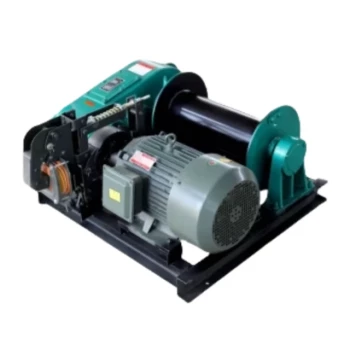
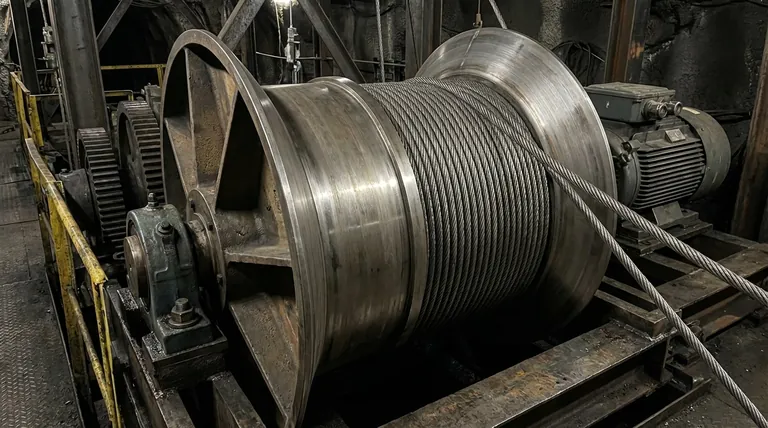
Drum winding is a mechanical process used in hoisting and pulling applications where a rope or cable is wound onto a rotating drum. Its primary characteristics are defined by the geometry of the drum itself, which can be cylindrical, conical, or a hybrid of the two to manage system torque and lifting speed.
The central principle of drum winding is that the drum's shape is not arbitrary; it is a critical engineering choice. A drum's geometry is deliberately designed to manipulate mechanical advantage, balancing the motor's torque output with the demands of the load throughout the entire lifting cycle.
The Core Principle: Managing Mechanical Advantage
Drum winders are fundamental components in systems like cranes, elevators, and mine hoists. Their design directly impacts the efficiency, size, and cost of the required motor and drive system.
Cylindrical Drums
The cylindrical drum is the most common and straightforward design, featuring a constant diameter along its entire length.
This constant radius means that for every rotation of the drum, the same length of rope is wound or unwound. This results in a consistent lifting or pulling speed, assuming the drum's rotational speed is constant.
However, the required motor torque can change, especially in deep hoisting applications where the suspended weight of the rope itself becomes a significant factor.
Conical Drums
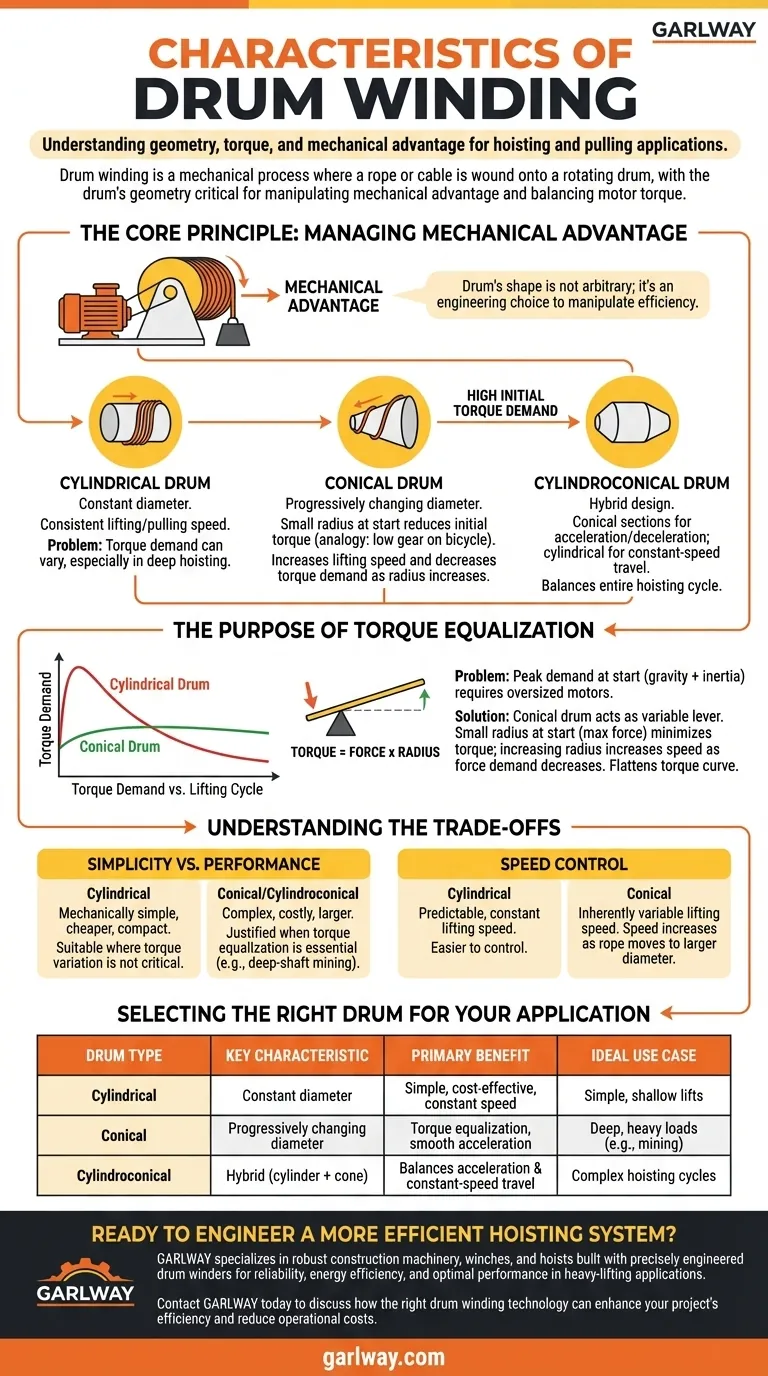
A conical drum features a progressively changing diameter, resembling a cone. This shape is a deliberate engineering solution for a specific problem: high initial torque demand.
The rope begins winding on the smallest diameter of the cone. This occurs at the start of a lift when the force required to accelerate the load from a standstill is at its maximum.
By starting on the smallest radius, the system gains a mechanical advantage, reducing the amount of torque the motor must supply to begin the lift. This is analogous to using a low gear on a bicycle to start moving.
As the load is lifted and inertia is overcome, the rope winds onto progressively larger diameters. This increases the lifting speed while the torque demand on the motor decreases, creating a more balanced and efficient system.
Cylindroconical Drums
This hybrid design combines sections of a cylinder and a cone. It offers a sophisticated approach to managing the entire hoisting cycle.
Typically, the conical sections are used for the acceleration and deceleration phases at the beginning and end of the lift, while the central cylindrical portion provides a long period of constant-speed travel.
The Purpose of Torque Equalization
The primary reason for using a conical drum is to achieve torque equalization, which helps optimize the performance and efficiency of the entire hoisting system.
The Problem: Peak Torque Demand
The greatest demand on a motor occurs when it must lift a heavy, stationary load. It has to overcome both gravity and the load's inertia.
Without a way to manage this peak demand, the system would require a much larger, more powerful, and less efficient motor that is oversized for the rest of the lifting cycle.
The Solution: A Variable Lever Arm
The conical drum acts as a variable lever. The relationship Torque = Force x Radius is key.
At the start of the lift (maximum force), the small radius minimizes the required motor torque. As the lift progresses (force demand decreases), the radius increases, which in turn increases the lifting speed.
This effectively flattens the torque curve, allowing for the use of a smaller, more efficient motor that operates closer to its optimal output throughout the cycle.
Understanding the Trade-offs
Choosing a drum design involves balancing complexity, cost, and performance requirements.
Simplicity vs. Performance
Cylindrical drums are mechanically simple, less expensive to manufacture, and typically more compact. They are perfectly suitable for many applications where torque variation is not a critical concern.
Conical and cylindroconical drums are more complex and costly. Their size and manufacturing requirements are justified only when the benefits of torque equalization—such as in deep-shaft mining—are essential.
Speed Control
A key trade-off with a conical drum is that the lifting speed is inherently variable. As the rope moves to a larger diameter, the load speeds up. This may be undesirable in applications requiring precise, constant velocity.
A cylindrical drum, by contrast, offers a predictable and constant lifting speed, making it easier to control.
Selecting the Right Drum for Your Application
The ideal drum geometry is dictated entirely by the operational goals of the system.
- If your primary focus is cost-effectiveness for simple, shallow lifts: A standard cylindrical drum is the most direct and reliable solution.
- If your primary focus is energy efficiency and smooth acceleration for deep, heavy loads: A conical or cylindroconical drum is essential for balancing the motor torque and reducing peak power demand.
- If your primary focus is precise, constant lifting speed: A single-layer, grooved cylindrical drum will provide the most predictable and consistent performance.
Ultimately, understanding the interplay between drum radius and torque is the key to designing an efficient and appropriately engineered winding system.
Summary Table:
| Drum Type | Key Characteristic | Primary Benefit | Ideal Use Case |
|---|---|---|---|
| Cylindrical | Constant diameter | Simple, cost-effective, constant speed | Simple, shallow lifts |
| Conical | Progressively changing diameter | Torque equalization, smooth acceleration | Deep, heavy loads (e.g., mining) |
| Cylindroconical | Hybrid (cylinder + cone) | Balances acceleration and constant-speed travel | Complex hoisting cycles |
Ready to engineer a more efficient hoisting system?
GARLWAY specializes in providing robust construction machinery, including winches and hoists built with precisely engineered drum winders. Our solutions are designed for construction companies and contractors globally who demand reliability, energy efficiency, and optimal performance for their heavy-lifting applications.
Contact GARLWAY today to discuss how the right drum winding technology can enhance your project's efficiency and reduce operational costs.
Visual Guide
Related Products
- Best 18000 Pound Drum Anchor Trailer Winch
- Concrete Cement Mixer Machine Drum Mixer for Construction
- Belle Mixer Drum Self Loading Mortar Mixers JS3000
- Hydraulic Winding Engine Harbor Freight Winch
People Also Ask
- In what scenarios is a winch particularly useful for trailers? Load Heavy Items Safely & Efficiently
- How do you install a trailer winch? A Step-by-Step Guide for a Safe & Secure Setup
- What should be considered when mounting a winch on a trailer? Ensure a Safe, Aligned Installation
- What are the considerations for equipping a trailer with a winch for hauling a car? A Guide to Safe and Efficient Vehicle Loading
- What are the main types of trailer winches? Choose the Right Power Source for Your Load