At its core, a truck mixer is a specialized vehicle designed to transport and mix concrete, ensuring it arrives at a construction site in a ready-to-pour, perfectly consistent state. Its primary characteristics are a large, rotating drum controlled by the driver and its integration into a ready-mix supply chain, which is essential for delivering high-quality concrete for large-scale projects.
The true value of a truck mixer isn't just transport; it's its function as a mobile mixing and quality control unit, bridging the critical gap between a centralized batching plant and the on-site pour.
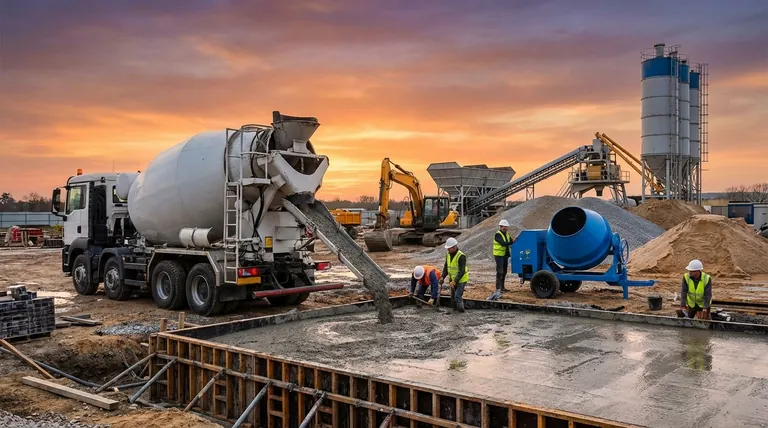
The Core Function: More Than Just Transportation
A truck mixer's design is purpose-built to overcome the primary challenge of concrete: its limited workability time. Every feature is engineered to maintain quality from the moment it leaves the plant.
A Mobile Reversing Drum
The most prominent feature is the reversing drum mixer. This drum constantly rotates to keep the sand, gravel, cement, and water in a homogenous slurry, preventing segregation and premature setting.
Precise Speed Control
The driver has direct control over the drum's rotation speed for two distinct purposes.
- Mixing Speed: A faster rotation, typically around 1.57 rad/s (15 rpm), is used to actively mix the components.
- Agitating Speed: A much slower speed, between 0.2 and 0.6 rad/s (2-6 rpm), is used during transport. This gentle agitation maintains the concrete's consistency without over-mixing it.
The Ready-Mix Supply Chain
Truck mixers are the final, critical link in the ready-mix concrete model. A central batching plant produces large, consistent batches of concrete to exact specifications, which are then dispatched via the mixer fleet to various job sites.
Where Truck Mixers Excel: Project Applications
The efficiency of the truck mixer system makes it the standard for projects that demand large volumes of high-quality, consistent concrete.
Large-Scale Infrastructure
For major civil engineering works, a continuous supply of concrete is non-negotiable. Truck mixers are indispensable for projects like water conservancy, power generation facilities, and bridge construction.
Commercial and Municipal Construction
Truck mixers are the backbone of urban development, delivering commercial-grade concrete for everything from foundations to high-rises. This centralized production supports the rapid pace of municipal projects.
Enabling Mechanized Construction
Modern construction relies on processes like concrete pumping, which requires a steady, uninterrupted flow of material. Truck mixers provide this reliable supply, making such efficient techniques possible.
Understanding the Trade-offs and Limitations
While highly effective, the truck mixer model is part of a larger system and has operational constraints that must be managed.
Dependency on the Batching Plant
The entire operation's efficiency is tied to the output and reliability of the central batching plant. Any delay or issue at the source directly impacts the job site.
Time-Sensitive Delivery
Concrete is a perishable product. The travel time from the plant to the site is a critical factor. Unexpected traffic, distance, or on-site delays can risk compromising the quality of the entire load.
Site Accessibility
These are large, heavy vehicles. They require clear, stable access routes to the pour location. Projects in tight urban spaces or with poor road access may find it difficult to accommodate them.
Making the Right Choice for Your Project
Selecting the right concrete delivery method depends entirely on the scale, location, and technical requirements of your work.
- If your primary focus is large-scale, continuous pours: The truck mixer and ready-mix plant system is the only method that can provide the necessary volume and consistency.
- If your primary focus is centralized quality control: Leveraging truck mixers from a certified ready-mix supplier ensures every batch meets precise engineering specifications.
- If your primary focus is a remote or small-scale project: On-site batching may be more practical, as the logistics and costs of truck mixer delivery might be prohibitive.
Ultimately, understanding the role of the truck mixer is fundamental to planning a successful and efficient construction project.
Summary Table:
| Feature | Purpose | Benefit |
|---|---|---|
| Reversing Drum | Mixes concrete during transport | Prevents segregation and premature setting |
| Variable Speed Control | Agitates or mixes at different speeds | Maintains perfect consistency |
| Ready-Mix Integration | Links batching plant to job site | Ensures high-quality, consistent concrete delivery |
| Large Capacity | Transports significant volumes | Ideal for large-scale infrastructure projects |
Need a reliable concrete solution for your next major project?
GARLWAY specializes in construction machinery, offering high-performance truck mixers, concrete batching plants, and more for construction companies and contractors globally. Our equipment ensures efficient, on-time delivery of high-quality concrete, directly supporting the success of large-scale infrastructure and commercial builds.
Contact GARLWAY today to discuss how our solutions can bring reliability and efficiency to your construction site.
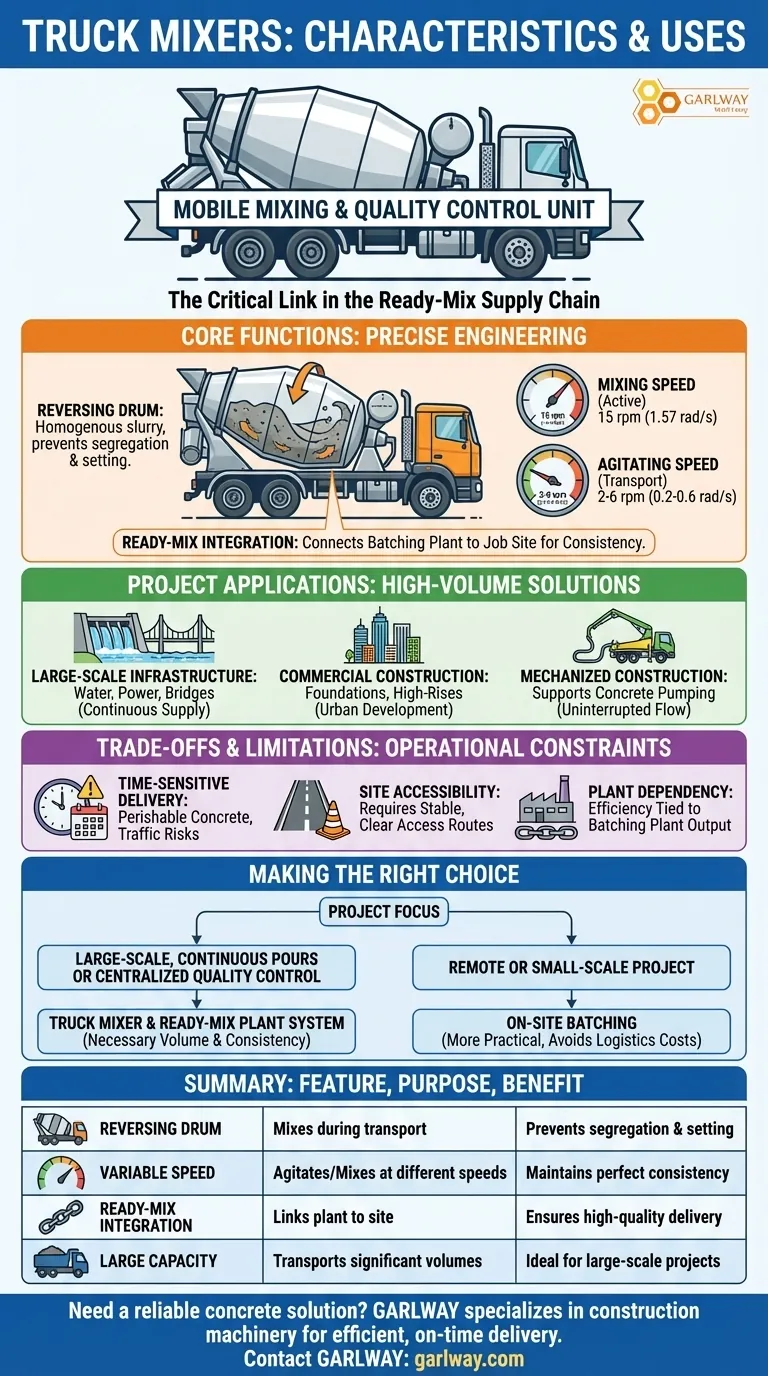
Visual Guide
Related Products
- Mini Cement Mortar Mixer Truck for Construction
- Ready Mixer Machine for Construction Ready Mix Machinery
- JW1000 Mobile Cement Mixer Concrete Mixer Truck and Batching Plant
- Harbor Freight JS1500 On Site Concrete Mixing Volumetric Cement Mixer
- Portable Concrete Mixer Machine Equipment for Mixing Concrete
People Also Ask
- Why might mixing mortar in a cement truck be problematic? Avoid Costly Mixing Mistakes
- What are the main types of construction cement mixers available? Choose the Right Mixer for Your Project
- What are the two primary methods for filling a cement mixer truck? Central vs. Transit Mix Explained
- What are the common uses of cement mixer trucks? Boosting Construction Efficiency and Quality
- What are the primary methods to fill a cement mixer truck? Central Mix vs. Transit Mix Explained