
At its core, a rotary drum mixer achieves a superior blending effect through a sophisticated, multi-axis tumbling action. The gentle rotation of the drum, combined with the precise geometry of internal agitators, continuously lifts, folds, and cross-mixes materials, ensuring every particle interacts without being damaged.
The excellence of a rotary drum mixer isn't just about movement; it's about controlled, gentle chaos. It creates a three-dimensional mixing pattern that ensures high uniformity while preserving the physical integrity of the materials being blended.
The Core Mechanics of Homogenization
To understand why this mixer is so effective, we must look at how its primary components work in concert to manipulate the material batch. It's a system where each part has a distinct and complementary role.
The Role of Drum Rotation
The primary force comes from the slow, constant rotation of the cylindrical drum itself. This action lifts the bulk material up the side of the drum.
Once the material reaches a certain height, gravity takes over, causing it to cascade or tumble back down upon itself. This foundational movement is the first step in breaking up clumps and beginning the blending process.
The Function of Internal Agitators
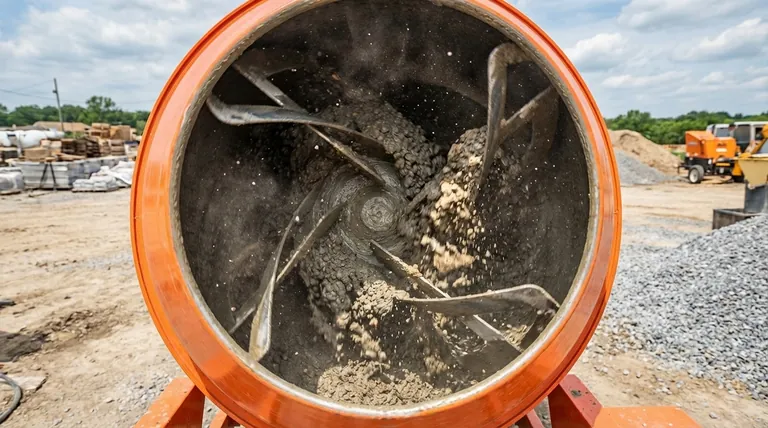
Inside the drum are strategically placed agitators, often in the form of helical ribbons or angled baffles. These are not brute-force paddles.
Their purpose is to guide the tumbling material in a deliberate pattern. As the material cascades down, the agitators direct its flow, preventing it from simply sliding down the surface in a single clump.
Deconstructing the Mixing Action
The combination of drum rotation and internal agitators creates a unique, three-part mixing motion that is key to its high performance.
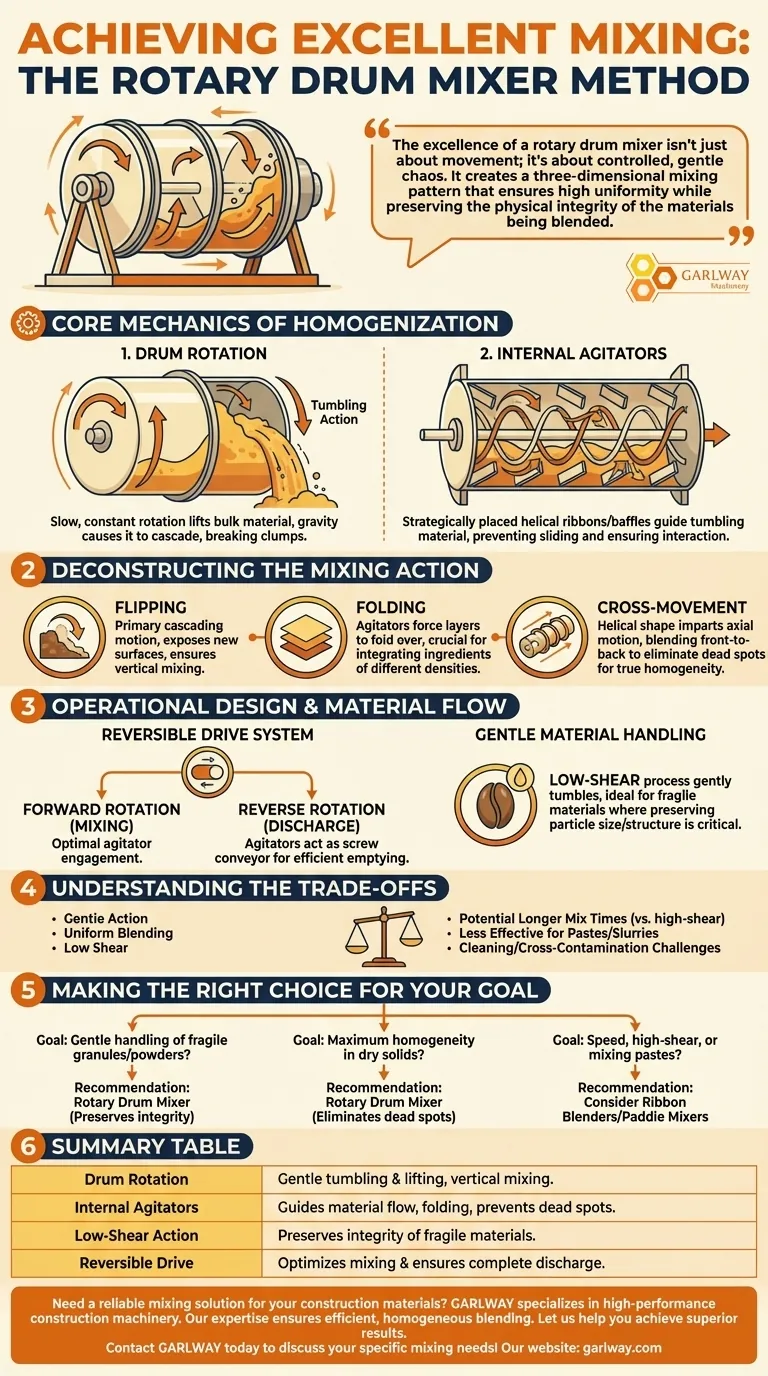
- Flipping: This is the primary tumbling or cascading motion caused by the drum's rotation. It constantly exposes new surfaces and ensures vertical mixing.
- Folding: As the material tumbles, the agitators force layers of material to fold over one another, much like kneading dough. This is crucial for integrating ingredients of different densities.
- Cross-Movement: The helical shape of the internal agitators also imparts an axial (end-to-end) motion to the material. This ensures that particles from the front of the mixer are blended with particles from the back, eliminating "dead spots" and achieving true homogeneity throughout the entire batch.
Operational Design and Material Flow
The mechanical design is elegantly simple and highly effective, often including features that streamline the entire production process.
The Reversible Drive System
Many rotary drum mixers are engineered for dual-purpose rotation. Rotating in one direction engages the agitators for optimal mixing.
Reversing the direction of rotation changes the angle at which the helical agitators interact with the material, effectively turning them into a screw conveyor that efficiently and completely discharges the final blend.
Gentle Material Handling
The tumbling, folding action is a low-shear process. Unlike high-speed mixers that can smash or grind particles, the rotary drum mixer gently tumbles them.
This makes it ideal for fragile materials like coffee beans, breakfast cereals, or coated granules where preserving particle size and structure is critical.
Understanding the Trade-offs
No single technology is perfect for every application. Objectivity requires acknowledging the limitations of this design.
Potential for Longer Mix Times
The same gentle action that protects materials can sometimes result in longer mixing cycles compared to more aggressive, high-shear mixers. This is a trade-off between speed and material integrity.
Limitations with Certain Materials
Rotary mixers are less effective for creating high-viscosity pastes or slurries. They also may struggle with blending materials that have vastly different particle sizes, densities, or characteristics, which can lead to segregation if not managed correctly.
Cleaning and Cross-Contamination
The internal baffles and agitators that create the excellent mixing action can also make the drum more difficult to clean thoroughly between batches. This is a key consideration in applications with strict allergen controls or frequent product changeovers.
Making the Right Choice for Your Goal
Selecting the right mixer depends entirely on the characteristics of your material and your desired outcome.
- If your primary focus is gentle handling of fragile granules or powders: The low-shear, tumbling action of a rotary drum mixer is an ideal choice to preserve product integrity.
- If your primary focus is achieving maximum homogeneity in dry solids: The three-dimensional mixing pattern effectively eliminates dead spots and ensures a consistent, uniform blend.
- If your primary focus is speed, high-shear applications, or mixing pastes: You should consider alternative technologies like ribbon blenders or paddle mixers.
Ultimately, understanding the fundamental principles of how a mixer works is the first step toward making an informed decision for your process.
Summary Table:
| Key Feature | Impact on Mixing Effect |
|---|---|
| Drum Rotation | Creates a gentle tumbling and lifting motion for vertical mixing. |
| Internal Agitators | Guides material flow for folding and prevents dead spots. |
| Low-Shear Action | Preserves the integrity of fragile materials like granules and powders. |
| Reversible Drive | Optimizes mixing in one direction and ensures complete discharge in the other. |
Need a reliable mixing solution for your construction materials?
GARLWAY specializes in high-performance construction machinery. Our expertise in equipment like concrete mixers ensures efficient, homogeneous blending for your projects. Let us help you achieve superior results with the right technology.
Contact GARLWAY today to discuss your specific mixing needs!
Visual Guide
Related Products
- Belle Mixer Drum Self Loading Mortar Mixers JS3000
- Concrete Cement Mixer Machine Drum Mixer for Construction
- JS1000 Volumetric Concrete Mortar Mixer for Sale Skid Steer Cement Mixer
- Harbor Freight JS1500 On Site Concrete Mixing Volumetric Cement Mixer
- Shaft Mixer Machine for Cement and Regular Concrete Mixing
People Also Ask
- What are the features of mobile transporting in a self loading mixer? Boost On-Site Efficiency
- Why is timely cleaning important for a self loading mixer? Prevent Costly Downtime and Mix Failure
- How is discharging accomplished in a self loading mixer? Master Precise Concrete Placement
- What is the purpose of keeping the drum rotating during transportation in a self loading concrete mixer? Ensure Quality & Consistency
- What components are involved in the loading process of a self loading concrete mixer? A Guide to the Key Systems


