The loading period is critical because the sequence in which you add ingredients to a concrete mix fundamentally alters the chemical reactions between them. This directly impacts the efficiency of admixtures and the final properties of the concrete, such as workability and strength.
The core takeaway is that concrete mixing is not just about combining ingredients; it's about controlling chemistry. The loading sequence—specifically when you add admixtures relative to water and cement—is a powerful tool to maximize performance and reduce costs.
The Chemistry of the First 60 Seconds
The Initial Cement-Water Reaction
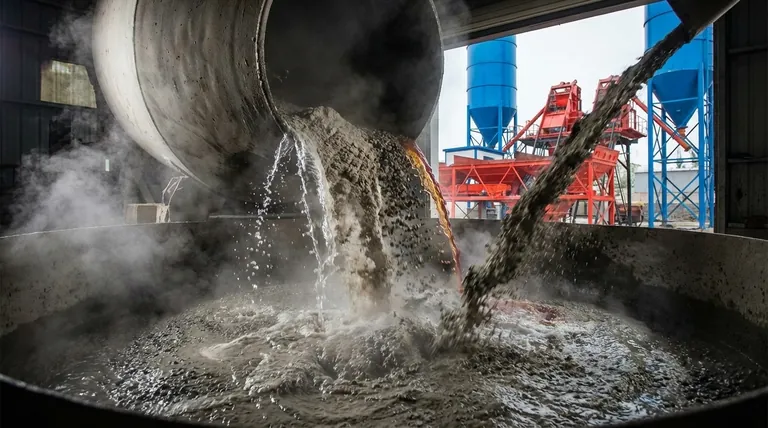
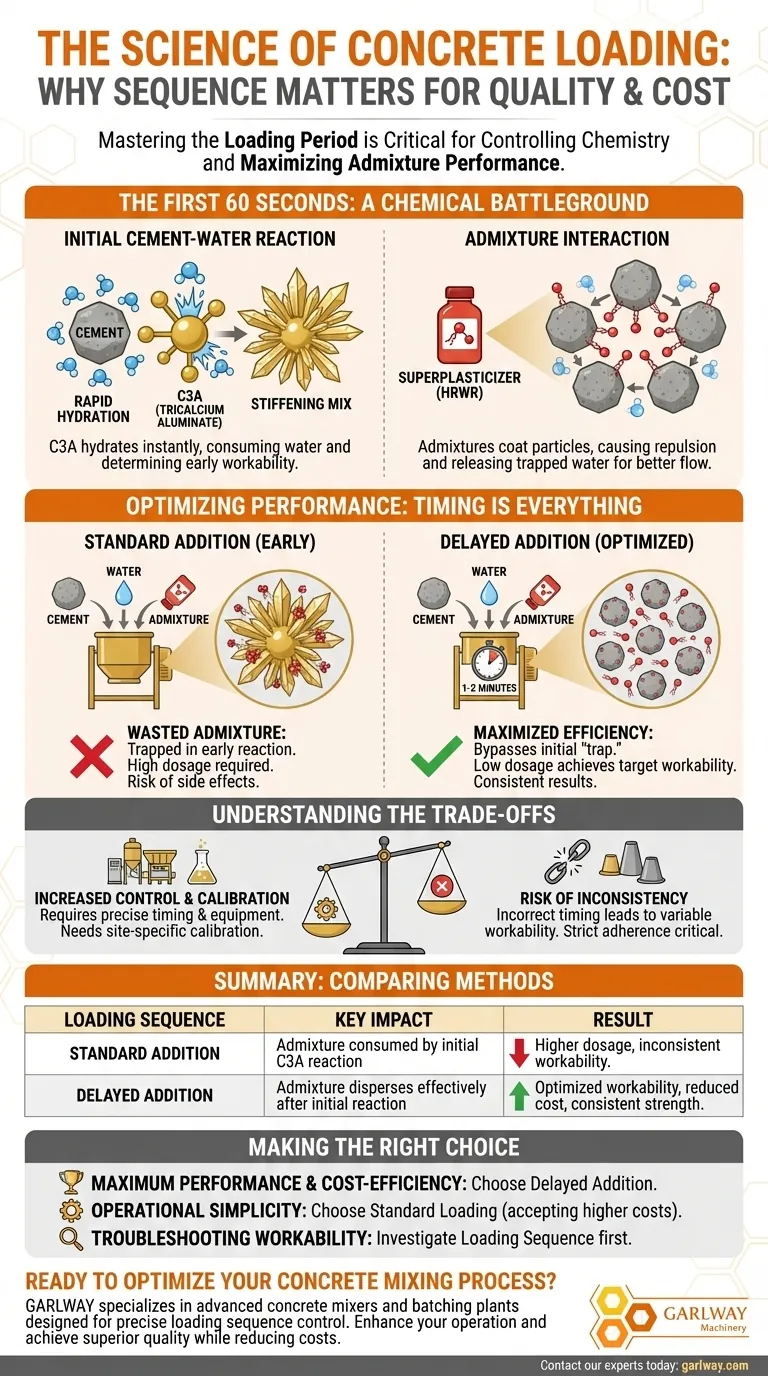
When water and cement first make contact, a rapid and aggressive chemical reaction begins. This initial hydration process is dominated by a compound in the cement known as tricalcium aluminate (C3A).
C3A hydrates almost instantly, consuming water and forming crystalline products. This initial reaction plays a significant role in determining the early workability and stiffening characteristics of the concrete.
How Admixtures Interact with This Reaction
Many chemical admixtures, like superplasticizers (High-Range Water Reducers or HRWRs), are designed to adsorb onto the surface of cement particles.
This adsorption process coats the particles, causing them to repel each other and release trapped water. The result is a much more fluid, workable mix without adding more water.
Optimizing Admixture Performance
The Problem with Early Addition
If you add a superplasticizer into the mixer at the same time as the initial mix water, a large portion of it gets immediately consumed by the highly reactive C3A.
The admixture becomes trapped within the early hydration products. It is essentially wasted, never getting a chance to disperse the bulk of the cement particles.
The Power of Delayed Addition
The industry-standard best practice is delayed addition. In this method, the cement, aggregates, and a portion of the water are mixed first.
After a minute or two, once the initial C3A reaction has subsided, the superplasticizer is added with the remaining water.
By waiting, the admixture can bypass the initial chemical "trap." It remains free to adsorb onto the entire surface of the cement grains, resulting in far more effective dispersion and dramatically improved workability.
The Practical Benefit: Efficiency
This improved dispersion means you can achieve the target workability with a significantly lower dosage of the expensive superplasticizer.
This not only saves money but also reduces the risk of negative side effects associated with overdosing admixtures, such as excessive retardation or segregation.
Understanding the Trade-offs
Increased Process Control
Implementing a delayed addition protocol requires a more sophisticated batching plant. You need the equipment and control systems to accurately time and sequence the addition of liquids.
This adds a layer of complexity compared to simply adding all ingredients at the start.
The Need for Calibration
The ideal delay time is not universal. It can vary based on the specific cement chemistry, the type of admixture used, and the ambient temperature.
Achieving consistent results requires testing and calibration to determine the optimal mixing sequence for your specific materials.
Risk of Inconsistency
If the timing of the delayed addition is not precisely controlled from one batch to the next, the workability of the concrete can vary significantly.
This makes strict adherence to the established mixing procedure absolutely critical for producing uniform, high-quality concrete.
Making the Right Choice for Your Process
- If your primary focus is maximum performance and cost-efficiency: Implementing a delayed admixture addition protocol is the most effective approach to optimize workability and reduce admixture consumption.
- If your primary focus is operational simplicity: A standard loading sequence may be sufficient, but you must accept that you are likely using more admixture than necessary to achieve your target slump.
- If you are troubleshooting workability problems: The loading sequence should be one of the first things you investigate, as incorrect timing can easily lead to a loss of workability.
Mastering the loading sequence gives you a precise lever to control the quality and cost of your concrete.
Summary Table:
| Loading Sequence | Key Impact | Result |
|---|---|---|
| Standard Addition | Admixture consumed by initial C3A reaction | Higher admixture dosage, potential for inconsistent workability |
| Delayed Addition | Admixture disperses effectively after initial reaction | Optimized workability, reduced admixture cost, consistent strength |
Ready to optimize your concrete mixing process? GARLWAY specializes in construction machinery, offering advanced concrete mixers and batching plants designed for precise loading sequence control. Our equipment helps construction companies and contractors globally achieve superior concrete quality while reducing material costs. Contact our experts today to discuss how we can enhance your operation!
Visual Guide
Related Products
- Portable Concrete Mixer Machine Equipment for Mixing Concrete
- Construction Products Concrete Plant Machine Mixing Concrete Mixer
- Portable Electric Concrete Mixer Machine for Cement Mixing
- JZC400 Mobile Small Concrete Mixer Cement Mixer Machine
- Hydraulic Concrete Mixer Machine Cement Mixing Equipment for Mixture Concrete
People Also Ask
- Why is it necessary to use a portable concrete mixer? Gain Total Control & Efficiency
- How much concrete can you pour with a portable mixer? Find the Perfect Fit for Your Project
- What types of projects are portable concrete mixers suitable for? Ideal for DIY & Small-Scale Construction
- How much does a portable concrete mixer hold? A Guide to Choosing the Right Capacity
- What types of portable concrete mixers exist? Find the Perfect Mixer for Your Project