
At its core, a windlass automates the strenuous and often hazardous task of raising a heavy anchor and its rode. It is a mechanical winch that transforms anchoring from a physically demanding chore into a controlled, efficient, and significantly safer process, making it one of the most valuable upgrades for any cruising boat.
A windlass is not simply a convenience; it is a critical tool for safety and vessel preservation. By removing the physical struggle of anchor handling, it allows a skipper to anchor more frequently, more precisely, and with far less risk of injury or equipment damage.

The Primary Benefits: More Than Just Lifting
A windlass provides clear, immediate advantages that enhance nearly every aspect of the anchoring process. Its value is recognized the first time you retrieve an anchor in choppy seas or from a deep anchorage.
Effortless and Controlled Operation
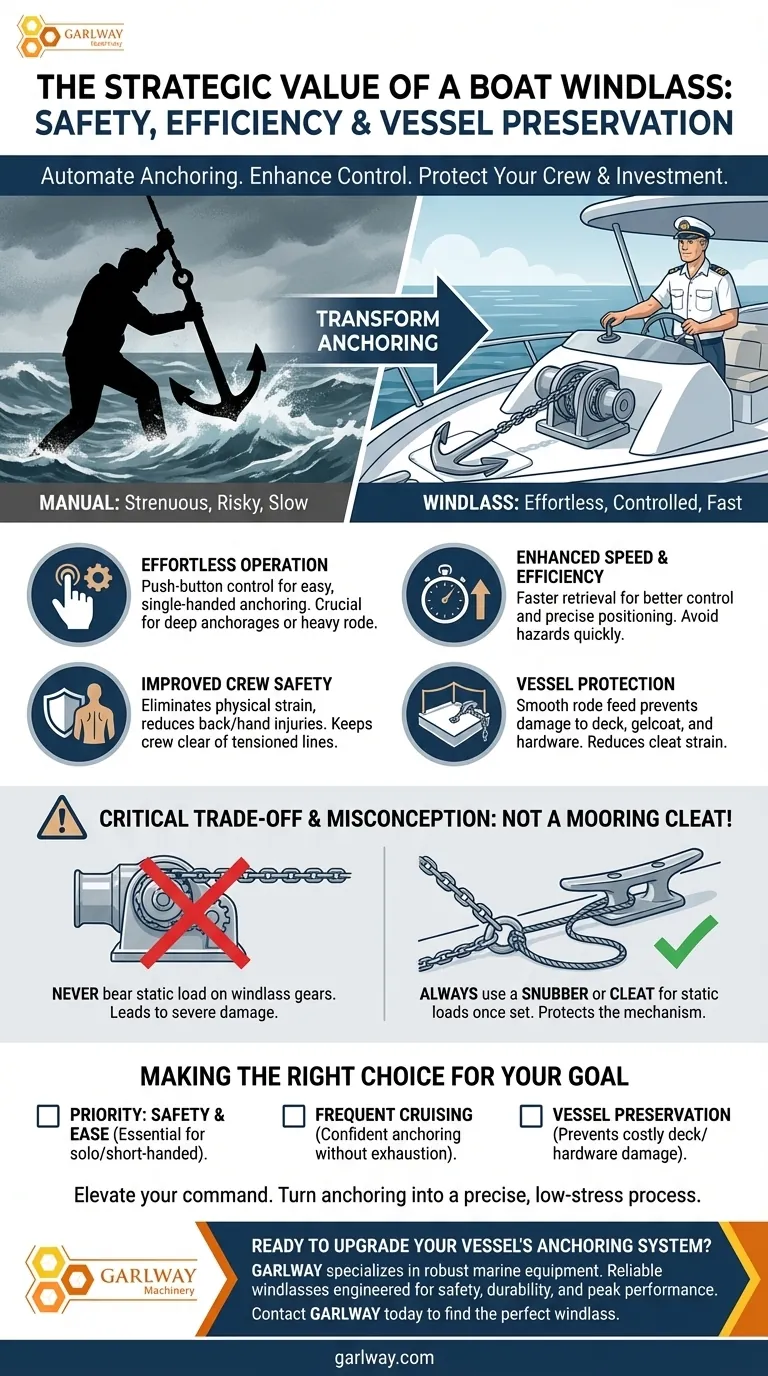
A windlass eliminates the back-breaking labor of manually hauling a heavy anchor and chain. This allows a single person to manage the anchor with the simple push of a button, freeing up crew to handle other tasks.
This mechanical advantage is crucial in deep anchorages or when using heavy all-chain rode, where the weight can be unmanageable by hand.
Enhanced Speed and Efficiency
Anchoring becomes a much faster process. A windlass can retrieve rode significantly quicker than a person can by hand, which is a major safety factor if you need to weigh anchor quickly to avoid a hazard or reset a dragging anchor.
This speed allows for more precise positioning and quicker adjustments, giving the captain better control over the vessel.
Improving Safety and Protecting Your Vessel
Beyond convenience, the most important benefits of a windlass relate to safety for both the crew and the boat itself. It systematizes a process that, when done manually, is fraught with potential risks.
Reducing the Risk of Crew Injury
Manually hauling an anchor, especially in poor weather, is a leading cause of back strain, muscle pulls, and hand injuries on a boat. A windlass removes this physical risk entirely.
It also keeps the crew safely away from a tensioned anchor line or chain that could snap or run out of control, preventing more serious accidents.
Minimizing Wear on the Boat
A windlass is designed to feed the anchor rode smoothly into the anchor locker. This prevents the chain from scraping against the deck, gelcoat, or toerail, which is a common source of cosmetic and structural damage.
By providing a stable and purpose-built point of contact, it also reduces strain on cleats and other deck hardware that are not designed for the specific loads of anchor retrieval.
Understanding the Critical Trade-offs and Misconceptions
While a windlass is incredibly powerful, its primary function is strictly for lifting and lowering. Misunderstanding its limitations is the most common cause of premature failure and costly damage.
A Windlass Is Not a Mooring Cleat
The single most important rule is to never let a windlass bear the static load of a boat at anchor. The internal gears, motor, and mounting bolts are not designed to withstand the shock loads from waves, wind, and changing tides.
Leaving the boat's weight on the windlass will lead to severe damage, including stripped gears, a bent mainshaft, or even the unit being ripped from the deck.
The Essential Role of a Snubber or Cleat
Once the anchor is set, the load must be transferred from the windlass to the boat's structural strong points.
For an all-chain rode, a snubber line with a chain hook is attached to the chain and led back to a robust mooring cleat. For a rope rode, the line is simply cleated off directly. This action correctly secures the vessel and protects the windlass mechanism.
Making the Right Choice for Your Goal
Deciding to install a windlass is a decision to prioritize safety, control, and preservation of your vessel.
- If your primary focus is safety and ease of use: A windlass is an essential upgrade that makes solo or short-handed anchoring manageable and removes the primary source of physical strain associated with boating.
- If you frequently cruise or anchor overnight: A windlass gives you the confidence to anchor properly and securely in various conditions without physical exhaustion, making your time on the water more enjoyable.
- If your priority is vessel preservation: A properly used windlass is the best tool to prevent costly damage to your deck, hardware, and topsides caused by a mishandled anchor chain.
Ultimately, installing a windlass elevates your command of the boat, turning anchoring into a precise and low-stress part of your journey.
Summary Table:
| Benefit | Key Advantage |
|---|---|
| Effortless Operation | Push-button control for easy, single-handed anchoring. |
| Enhanced Safety | Reduces risk of crew injury from manual anchor hauling. |
| Vessel Protection | Prevents damage to deck, gelcoat, and hardware. |
| Speed & Efficiency | Faster anchor retrieval for better control and positioning. |
Ready to upgrade your vessel's anchoring system?
GARLWAY specializes in robust marine equipment, offering reliable windlasses and winches for boat builders and marine operators globally. Our solutions are engineered for safety, durability, and peak performance, ensuring your vessel is equipped for any condition.
Contact GARLWAY today to find the perfect windlass for your boat and experience the difference professional-grade equipment makes.
Visual Guide
Related Products
- Electric Hoist Winch Boat Anchor Windlass for Marine Applications
- Quick Windlass Portable Winch for Truck and Boat Best Boat Winch
- Heavy Duty Electric Boat Winch Windlass Anchor
- Warn Winch Windlass Boat Trailer Winch
- 12000 lb Electric Boat Trailer Winch with Windlass Anchor Warn
People Also Ask
- How does an electric anchor winch work? Power, Safety, and Reliable Operation Explained
- What are the advantages of installing an electric anchor winch on a boat? Boost Safety & Ease for Boaters
- What are the operational differences between electric hoists and winches? A Guide to Safe Lifting vs. Pulling
- What are the main benefits of a boat anchor winch? Boost Safety & Efficiency for Your Vessel
- How does a boat anchor winch work? A Guide to Reliable Anchor Handling


