The primary benefit of a rounded bucket on a self-loading mixer is its superior efficiency in both loading and discharging materials. Its smooth, curved shape features an arc transition between the bottom and side plates, which significantly reduces material sticking and allows for a faster, cleaner transfer of aggregates into the mixing drum.
The geometry of a self-loading mixer's bucket is not an aesthetic choice; it is a critical engineering decision. A rounded design directly minimizes material waste and reduces cycle time, which translates to faster and more consistent on-site concrete production.
How Bucket Design Influences the Workflow
The bucket and its loading arm are the heart of a self-loading mixer's automation. This system is responsible for accurately gathering raw materials and feeding them into the mixing tank, a process that is heavily influenced by the bucket's physical design.
The Mechanics of Loading and Discharging
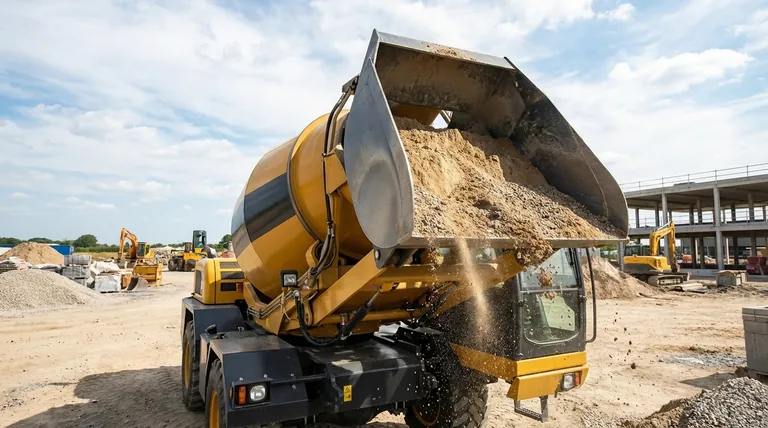
The self-loading mixer's robotic arm, controlled by the operator, scoops materials like sand, cement, and stone. It then lifts and tilts the bucket over the drum's opening, allowing the contents to slide into the mixing chamber. The efficiency of this entire cycle hinges on how quickly and completely the bucket can be filled and emptied.
Why a Rounded Shape is More Efficient
A traditional, box-shaped bucket has sharp 90-degree corners. These corners become "dead zones" where damp sand, cement powder, and other materials can easily get stuck. A rounded bucket, with its smooth arc transition, eliminates these corners. This simple change allows gravity to do its job more effectively, ensuring materials flow out smoothly and completely.
The Impact on Speed and Cycle Time
Because less material sticks to the inside of a rounded bucket, the discharging process is faster. The operator spends less time shaking or repositioning the bucket to dislodge stubborn aggregates. This small time savings on each load accumulates significantly over a workday, leading to more batches produced.
Ensuring Mix Consistency
When material gets left behind in the bucket, it throws off the precise ratios of the concrete mix design. By ensuring a more complete discharge on every load, the rounded bucket helps guarantee that the intended amount of each aggregate makes it into the drum, leading to higher-quality, more consistent concrete.
Understanding the System's Trade-offs
While the rounded shape offers clear advantages, it is one component of a larger, integrated system. Its effectiveness is linked to the machine's overall design and capabilities.
Capacity is a Balancing Act
The bucket's capacity, such as the 0.7 cubic meters mentioned in reference designs, must be matched to the mixer's overall size and the power of its hydraulic motors. A larger bucket is not inherently better if the machine's arm cannot lift it efficiently or if it compromises the vehicle's stability.
The Bucket Works with the Loading Mechanism
The efficiency gains of a rounded bucket are maximized when paired with a powerful hydraulic system and a well-designed loading arm. A pulley-driven hopper or a slow hydraulic arm can become a bottleneck, negating the speed advantages of the bucket's shape.
Maintenance and Durability Remain Key
Even the best-designed bucket requires proper maintenance. Modern systems often feature bolted, replaceable wear parts and robust sealing systems. These features are just as important as the bucket's shape for ensuring long-term reliability and performance in demanding job site conditions.
Making the Right Choice for Your Project
When evaluating a self-loading mixer, consider how the bucket design aligns with your primary operational goals.
- If your primary focus is throughput and speed: Look for the rounded bucket design, as its faster and cleaner discharge cycle directly contributes to producing more concrete per hour.
- If your primary focus is mix quality and consistency: Prioritize the rounded bucket for its ability to minimize material sticking, ensuring more accurate batching for every load.
- If your primary focus is operational ease: The self-cleaning nature of the rounded shape reduces operator effort and the downtime needed to clear the bucket between loads.
Ultimately, the rounded bucket is a crucial feature that enhances the core function of the entire self-loading concrete production process.
Summary Table:
| Benefit | Impact on Operation |
|---|---|
| Reduced Material Sticking | Faster, cleaner discharge; less waste. |
| Increased Cycle Speed | More batches produced per hour. |
| Improved Mix Consistency | Accurate batching for higher-quality concrete. |
| Enhanced Operational Ease | Less operator effort and downtime. |
Ready to boost your project's efficiency with a superior self-loading mixer?
GARLWAY specializes in construction machinery, offering robust self-loading mixers with advanced rounded bucket designs for construction companies and contractors globally. Our machines are engineered to deliver faster cycle times, consistent mix quality, and maximum on-site productivity.
Contact us today to find the perfect solution for your concrete production needs!
Visual Guide

Related Products
- Belle Mixer Drum Self Loading Mortar Mixers JS3000
- Skid Steer Self Loading Concrete Mixers for Construction
- Portable Cement Mixer with Lift Concrete Machine
- Portable Concrete Mixer Machine Equipment for Mixing Concrete
- Portable Ready Mix Concrete Mixer Equipment
People Also Ask
- What are the features of mobile transporting in a self loading mixer? Boost On-Site Efficiency
- Why is timely cleaning important for a self loading mixer? Prevent Costly Downtime and Mix Failure
- How is discharging accomplished in a self loading mixer? Master Precise Concrete Placement
- What is the purpose of keeping the drum rotating during transportation in a self loading concrete mixer? Ensure Quality & Consistency
- What components are involved in the loading process of a self loading concrete mixer? A Guide to the Key Systems