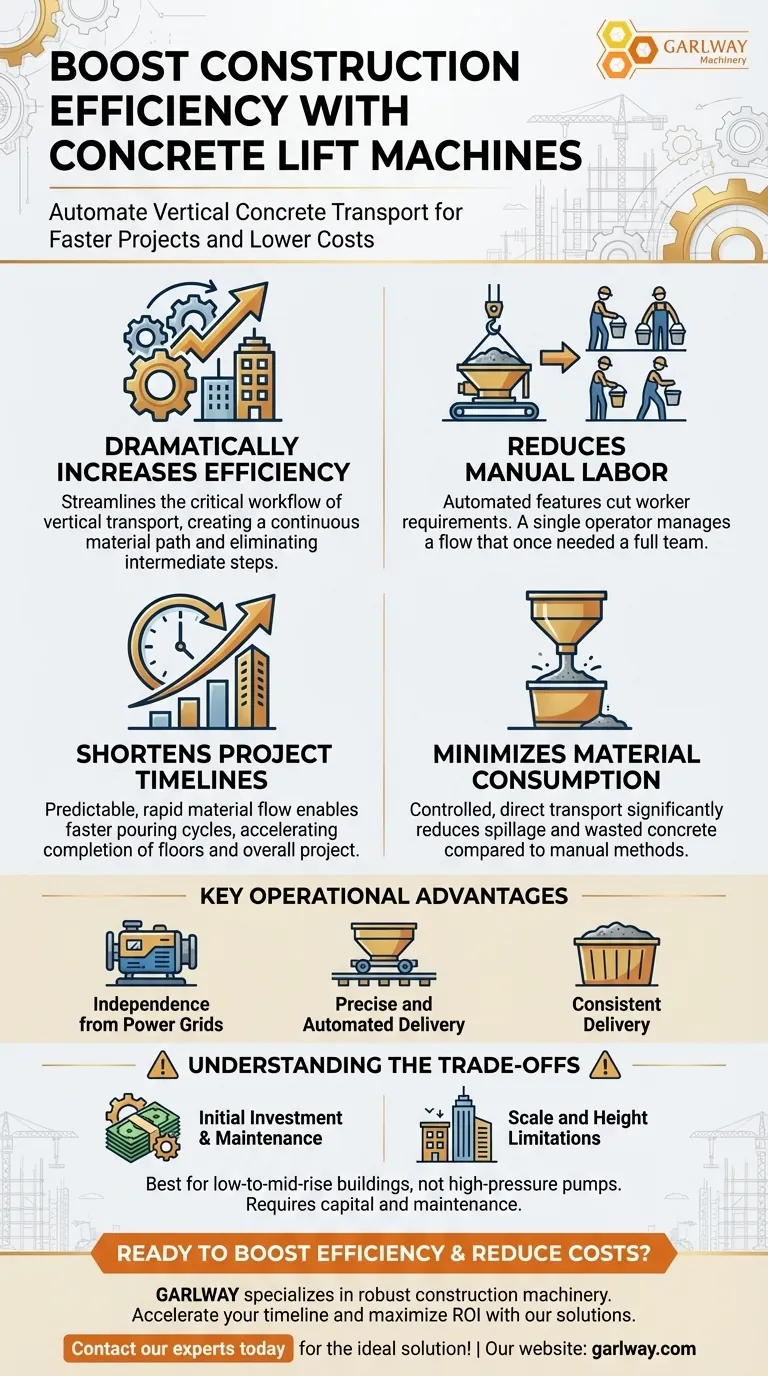
At its core, a concrete lift machine provides four primary advantages: it dramatically increases construction efficiency, shortens project timelines, reduces the need for manual labor, and minimizes material consumption. It achieves this by automating the difficult and time-consuming process of transporting concrete vertically on a job site.
A concrete lift machine solves one of the most fundamental logistical challenges in construction: moving heavy material to upper floors. By replacing manual labor with a reliable mechanical system, it directly translates into significant savings in time, money, and materials.
How Concrete Lifts Drive Project Efficiency
The primary value of a concrete lift machine is its ability to streamline a critical construction workflow. It introduces mechanical consistency to a process that is otherwise physically demanding and inefficient.
Streamlining Vertical Transport
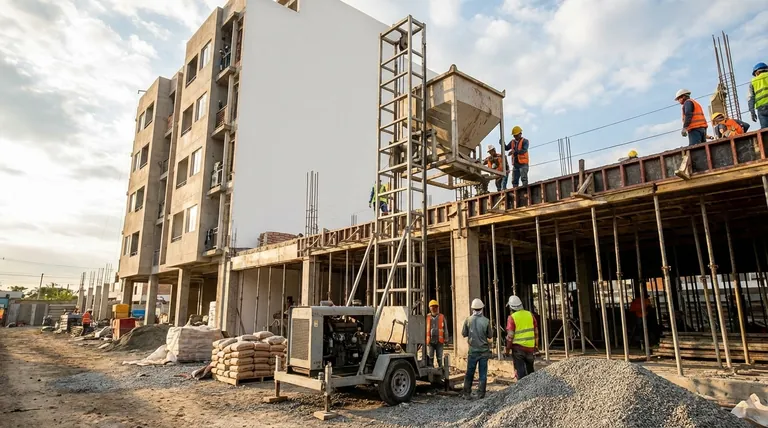
A concrete lift utilizes a hoisting mechanism, a carriage or hopper, and a ladder-like frame to move material. This creates a direct and continuous path for concrete to travel from the ground to the required floor, eliminating intermediate steps.
Reducing Labor Requirements
The system's straightforward operation and automated features drastically cut down on the number of workers needed for material transport. A single operator can manage a flow of concrete that would otherwise require a full team to haul bucket by bucket.
Accelerating Construction Timelines
By creating a predictable and rapid flow of material, the machine enables faster pouring cycles. This acceleration means crews can complete floors more quickly, shortening the overall project timeline and reducing associated overhead costs.
Key Operational Advantages
Beyond general efficiency, specific features of these machines offer distinct benefits that are valuable in various construction environments.
Independence from Power Grids
Many concrete lifts are designed to operate without being tied to an electrical grid, often using diesel or gasoline engines. This makes them invaluable on new sites where power infrastructure has not yet been established.
Precise and Automated Delivery
The machine moves a hopper along a fixed rail system, ensuring consistent delivery to the same point every time. Features like an automatic door-opening mechanism ensure the material is discharged smoothly into the mixing drum or distribution point without manual intervention.
Minimizing Material Waste
The controlled, direct transport from the ground to the pour site significantly reduces spillage. This controlled process leads to a direct reduction in wasted material compared to less precise manual methods.
Understanding the Trade-offs
While highly effective, concrete lift machines are specialized pieces of equipment with specific limitations that must be considered.
Initial Investment and Maintenance
These machines represent an upfront capital cost. Like any mechanical equipment, they also require regular maintenance to ensure reliability and prevent breakdowns that could cause project delays.
Scale and Height Limitations
Concrete lifts are most effective for low-to-mid-rise buildings. They are not a substitute for high-pressure concrete pumps used in the construction of skyscrapers or large-scale commercial structures, which require much greater vertical reach and volume capacity.
Site Logistics
The machine requires a stable, level base and a clear vertical path for operation. On a crowded or complex job site, finding the optimal placement can be a logistical challenge.
Making the Right Choice for Your Project
To determine if a concrete lift is the right solution, evaluate your project's primary constraints and goals.
- If your primary focus is cost and labor reduction on smaller projects: This machine offers a clear return on investment by directly replacing the high cost of manual material hauling.
- If your primary focus is speed and timeline certainty: The lift provides a consistent, mechanical pace that removes the variability and fatigue associated with human labor.
- If your primary focus is site flexibility in early-stage construction: A model that is independent of the electrical grid provides maximum operational freedom.
Ultimately, a concrete lift machine is a powerful tool for boosting productivity on the right scale of project.
Summary Table:
| Advantage | Key Benefit |
|---|---|
| Increased Efficiency | Automates vertical transport, streamlining workflow. |
| Reduced Labor | Cuts manual hauling, requiring fewer workers. |
| Faster Timelines | Enables rapid, predictable pouring cycles. |
| Minimized Waste | Controlled delivery reduces material spillage. |
| Site Flexibility | Many models operate independently of power grids. |
Ready to boost your construction efficiency and reduce costs?
GARLWAY specializes in providing robust construction machinery, including concrete batching plants and mixers, perfectly suited for contractors and construction companies. A GARLWAY concrete lift machine can be the key to accelerating your project timeline and maximizing your ROI.
Contact our experts today to find the ideal lifting solution for your next project!
Visual Guide
Related Products
- Portable Cement Mixer with Lift Concrete Machine
- Portable Electric Small Cement Mixer Concrete Machine
- Hydraulic Concrete Mixer Machine Cement Mixing Equipment for Mixture Concrete
- Portable Concrete Mixer Machine Equipment for Mixing Concrete
- Auto Concrete Cement Mixer Machine New
People Also Ask
- What are the size and portability options for portable cement mixers? Find Your Perfect Match for Any Job
- Why is it necessary to use a portable concrete mixer? Gain Total Control & Efficiency
- How much concrete can you pour with a portable mixer? Find the Perfect Fit for Your Project
- What is a portable cement mixer? Achieve Consistent, On-Demand Concrete Mixing
- What are the power sources for portable cement mixers? Choose the Right Power for Your Job Site