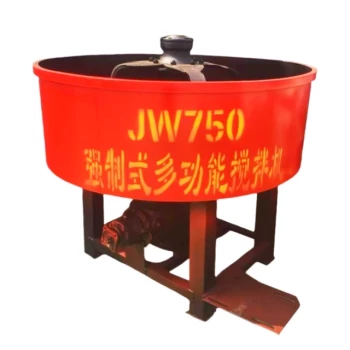
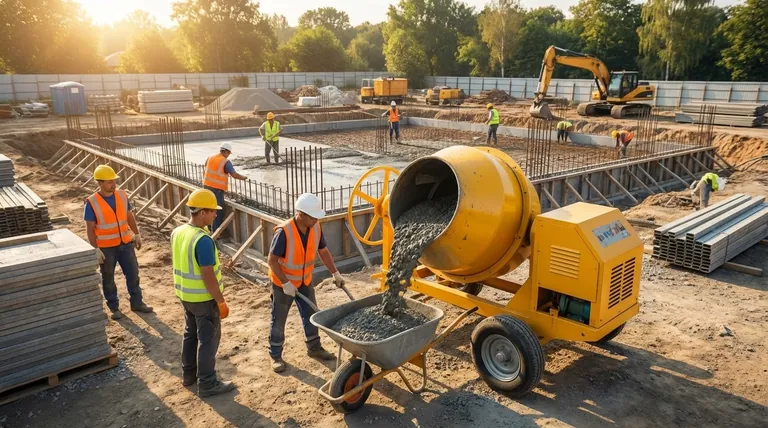
The primary advantages of small and medium-sized concrete mixing stations are their significantly lower initial investment and reduced requirements for effort and resources compared to their large commercial counterparts. This makes them a more accessible and flexible solution for a wide range of specific construction projects.
The choice between a small, medium, or large concrete station is not about which is inherently "better," but about matching the scale of the equipment to the scope of the project. Smaller stations prioritize cost-effectiveness and on-site flexibility, while large stations are built for massive, centralized production efficiency.
The Core Distinction: Project Scale and Purpose
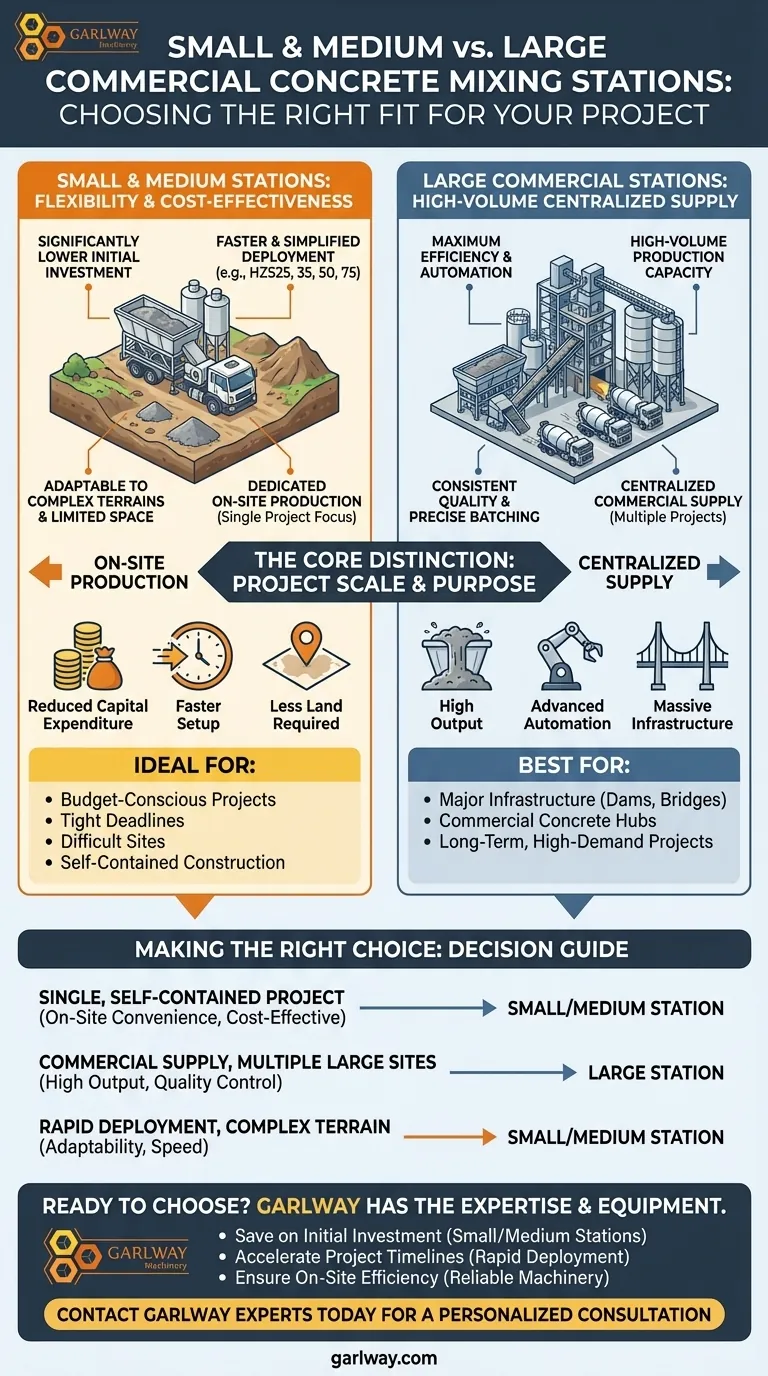
To understand the advantages of each, it's essential to first define their intended roles. The fundamental difference lies in their operational philosophy: on-site production versus centralized supply.
Defining Small and Medium-Sized Stations
These stations, with common models like HZS25, 35, 50, and 75, are designed for dedicated, on-site use.
Their primary function is to serve a single, specific building project, providing concrete directly where it's needed. This localized approach eliminates many logistical challenges.
Defining Large Commercial Stations
Large stations are industrial-scale production facilities. They are typically used for major infrastructure projects like dams, bridges, and power plants or for supplying commercial concrete to multiple projects across a region.
These stations are complex, consisting of integrated systems for mixing, weighing, conveying, storage, and control to handle enormous volumes consistently.
Key Advantages of Small & Medium Stations
For projects where a large commercial station is overkill, smaller stations offer clear and compelling benefits.
Lower Initial Investment
The most significant advantage is the reduced capital expenditure. The cost to purchase and install a small or medium-sized station is substantially lower, making it a viable option for companies without the budget for a massive plant.
Reduced Site and Resource Requirements
These stations require less land and less complex foundation work. Their design, often featuring high-quality steel structures, can be adapted to more difficult or varied terrains where a large plant would be impractical.
Simplified and Faster Deployment
Models like the HZS75 are noted for their straightforward construction process. This simplicity means they can be set up and made operational much faster, which is a critical advantage for projects with tight deadlines.
Understanding the Trade-offs
Choosing a smaller station is not without its limitations. True understanding comes from acknowledging what you gain and what you give up.
The Power of High Production: Why Large Stations Exist
Large stations are built for a different purpose: maximum efficiency at scale.
Their highly mechanized and automated systems ensure exceptional productivity and consistent concrete quality, which helps reduce overall cement consumption through precise batching. They are essential for projects with immense concrete demands.
The Limits of Smaller Stations
The main trade-off is lower output capacity. A small station cannot sustain the volume needed for a massive infrastructure project or serve as a commercial hub for a bustling city.
Their control systems may also be less sophisticated, requiring more manual oversight compared to their fully automated larger counterparts.
The Burden of Large Stations
While powerful, large stations lack flexibility. They require a long-term, high-volume demand to justify their significant initial cost, extensive site preparation, and complex installation. They are a poor fit for short-term or moderately sized projects.
Making the Right Choice for Your Project
The decision ultimately depends on your specific operational goals and project constraints.
- If your primary focus is a single, self-contained construction project: A small or medium station offers the best balance of on-site convenience and cost-effectiveness.
- If your primary focus is supplying concrete commercially to multiple large sites: A large station is necessary to achieve the required output, quality control, and operational efficiency.
- If your primary focus is rapid deployment on a project with complex terrain: The adaptability and simpler installation of a small or medium station is a major strategic advantage.
Choosing the right mixing station is about precisely matching the scale of your equipment to the scope of your ambition.
Summary Table:
| Advantage | Key Benefit | Ideal For |
|---|---|---|
| Lower Investment | Significantly reduced capital expenditure | Budget-conscious projects |
| Flexible Deployment | Faster setup, adaptable to complex terrain | Tight deadlines, difficult sites |
| On-Site Production | Direct concrete supply, fewer logistics | Single, self-contained construction projects |
| Reduced Footprint | Less land and foundation work required | Projects with limited space |
Ready to Choose the Right Concrete Mixing Station for Your Project?
GARLWAY specializes in providing the perfect concrete mixing solution for construction companies and contractors. Whether your project requires the cost-effective flexibility of a small/medium station or the high-volume power of a large batching plant, we have the expertise and equipment to match your needs.
We help you:
- Save significantly on initial investment with our range of small and medium stations (like HZS25, HZS35, HZS50, HZS75).
- Accelerate your project timeline with equipment designed for rapid, straightforward deployment.
- Ensure on-site efficiency with reliable machinery built for performance in varied conditions.
Let's discuss your project requirements and find the optimal solution.
➡️ Contact GARLWAY Experts Today for a Personalized Consultation
Visual Guide
Related Products
- HZS35 Small Cement Concrete Mixing Batch Plant
- JDC350 Small Cement Concrete Mortar Mixer
- Portable Electric Small Cement Mixer Concrete Machine
- JZC400 Mobile Small Concrete Mixer Cement Mixer Machine
- Commercial Electric Concrete Mixer Machine HZS 50 Small Batch Plant for Sale
People Also Ask
- Why buy concrete batch plant parts only from the manufacturer? Protect Your Investment and Maximize Uptime
- Why is proper maintenance important for a concrete batch mix plant? Maximize Uptime & Profitability
- What is the advantage of a mobile concrete batching plant? Achieve On-Site Production & Total Control
- What are the advantages and disadvantages of concrete batching plants? Maximize Quality & Efficiency
- What are the two methods of material charging in a concrete mixing station? Single vs. Multiple Charging Explained