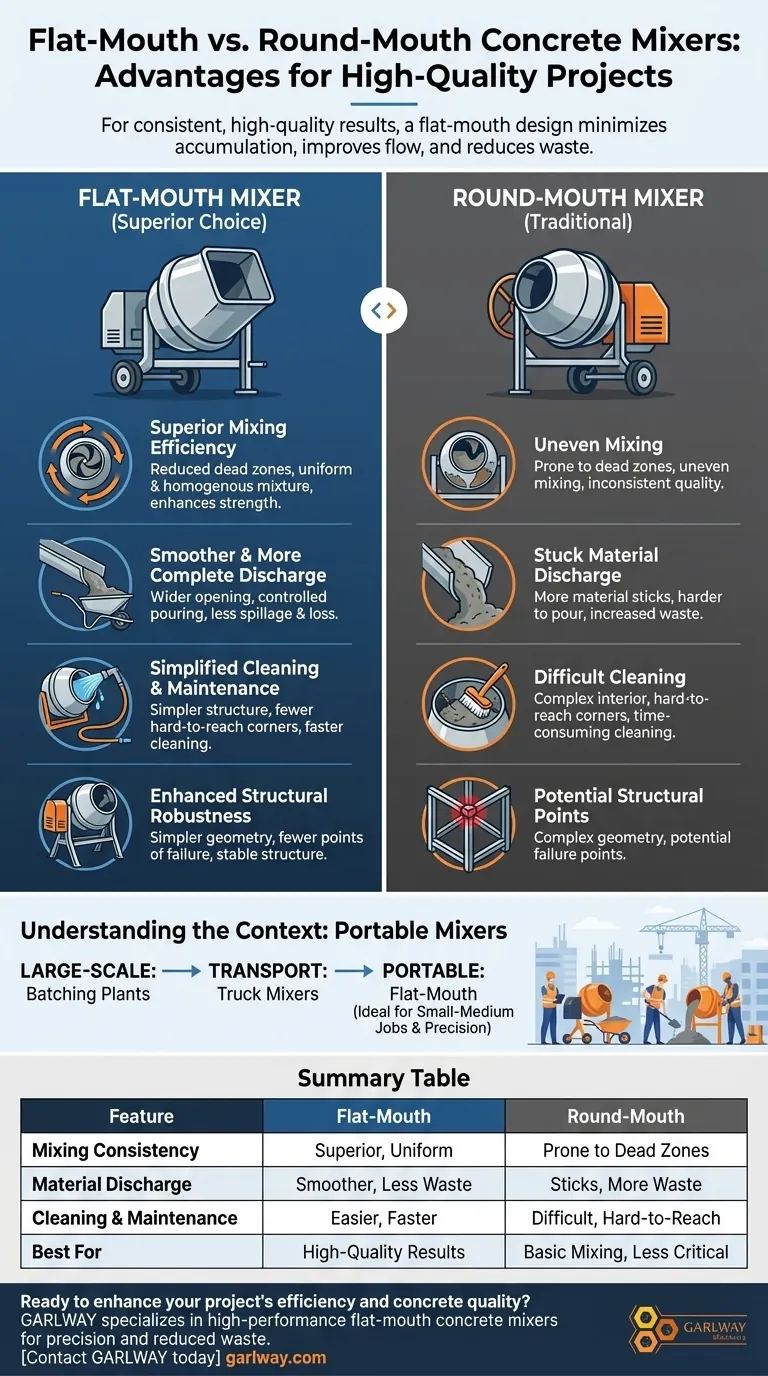
For projects requiring consistent, high-quality results, a flat-mouth concrete mixer offers significant advantages over the traditional round-mouth design. Its primary benefits stem from a more efficient mixing process, smoother material discharge, and greater operational ease, directly impacting the quality of the final concrete and reducing material waste.
The core difference is simple: the flat-mouth design is engineered to minimize material accumulation and improve flow, leading to a more uniform concrete mix, easier cleaning, and less waste compared to its round-mouth counterpart.
Key Advantages of the Flat-Mouth Design
The choice between a flat or round mouth seems minor, but it fundamentally alters the mixer's performance. The flat-mouth geometry is a direct response to the common challenges of portable concrete mixing.
Superior Mixing Efficiency
A flat-mouth mixer's design significantly reduces the dead zones where concrete can accumulate during rotation. This ensures all components—cement, aggregate, and water—are continuously folded into the mix.
The result is a more uniform and homogenous mixture. This consistency is critical for enhancing the strength and quality of the finished concrete.
Smoother and More Complete Discharge
The wider, flatter opening allows for a much smoother and more controlled discharge of the mixed concrete. This makes it easier to pour into wheelbarrows or forms with less spillage.
This efficient process also reduces concrete loss, as less material remains stuck inside the drum after pouring.
Simplified Cleaning and Maintenance
The internal structure of a flat-mouth mixer is simpler, with fewer hard-to-reach corners where wet concrete can harden. This makes the cleaning process faster and more thorough.
Because they are easier to maintain, these mixers can be kept in good working condition for longer, ensuring reliable performance over time.
Enhanced Structural Robustness
While both types can be durable, the simpler geometry of the flat-mouth design often contributes to a more robust and stable structure. This straightforward engineering reduces potential points of failure.
Understanding the Broader Context
While the flat-mouth design offers clear benefits, it's important to understand where these mixers fit within the wider range of available equipment. The "flat-mouth" vs. "round-mouth" distinction typically applies to portable drum or batch mixers.
Mixer Types for Different Scales
The construction industry uses various mixers tailored to specific job sizes. These include large-scale batching plants, mobile truck mixers for transport, and smaller portable mixers.
Flat-mouth mixers excel in the portable category, making them ideal for small to medium-sized construction sites, renovations, and DIY projects where precision and quality are needed in smaller batches.
The Value of Portability
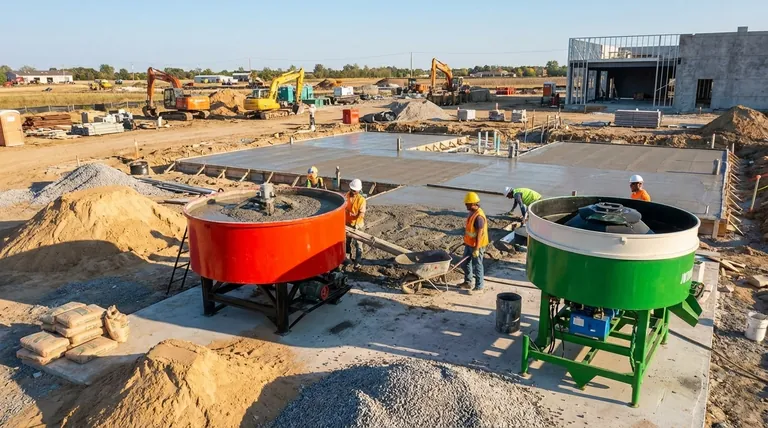
Portable mixers are specifically designed to be moved easily around a job site. Their utility is in providing freshly mixed concrete exactly where it's needed for tasks like setting posts, pouring small slabs, or repair work.
Within this category, the flat-mouth design enhances the core benefits of portability by adding a layer of efficiency and quality control that is often difficult to achieve with traditional models.
Making the Right Choice for Your Needs
Selecting the correct mixer depends entirely on the requirements of your project.
- If your primary focus is high-quality, consistent batches for smaller jobs: The flat-mouth mixer is the superior choice for its uniform mixing, reduced waste, and ease of operation.
- If your primary focus is mixing basic concrete where absolute consistency is not critical: A traditional round-mouth mixer may be a sufficient, and sometimes more economical, option.
- If your project is large-scale and requires continuous high-volume output: Neither of these portable options is appropriate; you should be looking at truck mixers or on-site batching plants.
Ultimately, choosing a mixer with a flat-mouth design is an investment in better material quality and a more efficient workflow on your job site.
Summary Table:
| Feature | Flat-Mouth Mixer | Traditional Round-Mouth Mixer |
|---|---|---|
| Mixing Consistency | Superior, more uniform mix | Prone to dead zones and uneven mixing |
| Material Discharge | Smoother, more complete, less waste | More material can stick inside the drum |
| Cleaning & Maintenance | Easier and faster due to simpler geometry | More difficult, with hard-to-reach corners |
| Best For | Small to medium projects requiring high-quality results | Basic mixing where absolute consistency is less critical |
Ready to enhance your project's efficiency and concrete quality?
GARLWAY specializes in providing robust construction machinery, including high-performance flat-mouth concrete mixers, designed for construction companies and contractors who value precision and reduced waste. Our mixers deliver the uniform mixing and easy cleaning you need for superior results on every job.
Contact GARLWAY today to find the perfect mixer for your specific project requirements and experience the GARLWAY difference in durability and performance.
Visual Guide
Related Products
- HZS25 Best Cement Mixer for Quick Mix Concrete at Bunnings
- JDC350 Small Cement Concrete Mortar Mixer
- Portable Concrete Mixer Machine Equipment for Mixing Concrete
- JDY350 Electric Hydraulic Mortar Mud Concrete Mixer
- Portable Ready Mix Concrete Mixer Equipment
People Also Ask
- How do cement mixers enhance safety on construction sites? Reduce Strain, Hazards, and Accidents
- What are the main components of a cement mixer? A Guide to Core Parts & Functions
- What are some tips for using a cement mixer effectively? Maximize Your Mixer's Performance & Concrete Quality
- How does cleaning a cement mixer after use benefit its performance? Maximize Lifespan and Mix Quality
- Why is it important to clean the cement mixer after use? Prevent Costly Damage and Ensure Quality Concrete