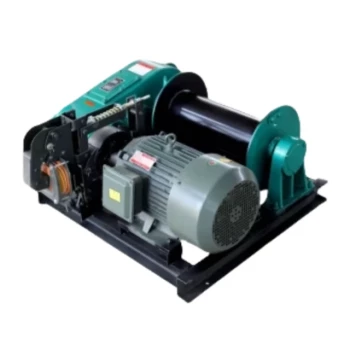
Beyond vehicle recovery, a winch is a powerful force multiplier for a wide range of utilitarian tasks across land management, construction, and logistics. Its fundamental ability to apply immense and controlled pulling force makes it invaluable for moving logs, uprooting stumps, and loading heavy equipment onto trailers.
The true value of a winch lies in seeing it not just as an off-road accessory, but as a portable tool for applying controlled force. Understanding its application in horizontal dragging and material handling unlocks its potential for work, property management, and industrial tasks.
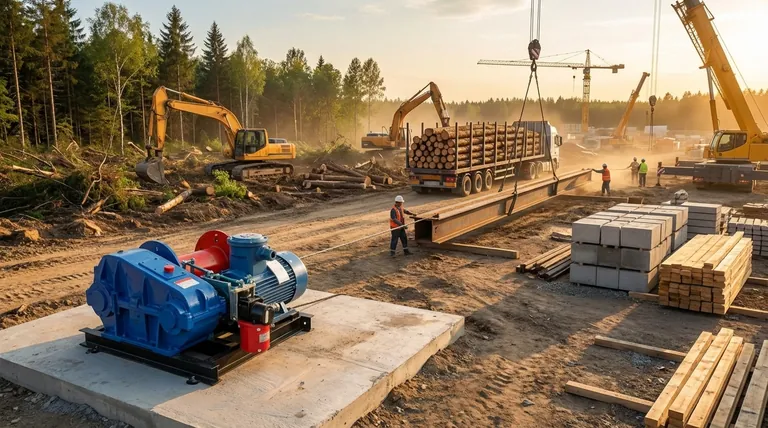
The Winch as a Land Management Tool
A winch provides the raw power needed to reshape and maintain property, turning labor-intensive jobs into manageable tasks.
Clearing and Forestry Operations
A winch is an essential tool in the woods. It allows a single operator to move downed trees, clear trails of heavy logs, or drag timber for processing.
This controlled force is also perfect for uprooting stubborn shrubs or small stumps, clearing land far more efficiently than manual methods.
Ranch and Farm Utility
On a farm or ranch, a winch can be used to move heavy equipment, tension fence lines, or pull hay bales into a barn.
It provides a mobile power source for situations where a tractor may not be practical or available, making it a versatile problem-solver for daily work.
The Winch in Logistics and Construction
Beyond the field, the winch is a foundational tool for moving heavy objects with precision and safety.
Loading Vehicles and Equipment
One of the most common non-recovery uses is loading a non-operational vehicle, ATV, or piece of equipment onto a trailer.
This same principle applies to positioning heavy machinery, pulling small aircraft or helicopters into hangars, or moving any heavy object that can be rolled or dragged.
Industrial and Job Site Applications
In a more industrial context, electric winches are core components in larger machinery like cranes and mine hoisting systems.
They are widely used on construction sites, wharves, and in water conservancy projects for material lifting and flat dragging, often as part of a modern, automated operation line.
Understanding the Trade-offs and Safety Risks
Using a winch for utility work introduces different risks than vehicle recovery. Understanding these is critical for safe operation.
The Danger of Extreme Forces
A winch line under load stores a tremendous amount of kinetic energy. A failure of the line or an anchor point can be catastrophic.
Always use a line dampener, wear heavy-duty gloves, and ensure no one is standing in the danger zone aligned with the pull.
Matching the Winch to the Task
A winch rated for vehicle recovery may not have the appropriate duty cycle or braking system for lifting materials vertically or for prolonged industrial use.
Always verify the winch's load rating and intended application. Using the wrong tool for the job can lead to premature failure and significant danger.
The Critical Role of the Anchor Point
A winch is only as strong as its anchor. Whether it's a tree, a dedicated ground anchor, or another vehicle, the anchor point must be able to withstand the entire load.
An insecure anchor is one of the most common points of failure in any winching operation. Always inspect your anchor point thoroughly before applying force.
How to Apply This to Your Project
To get the most from a winch, align its capabilities with your primary goal.
- If your primary focus is property management: Select a winch with a good duty cycle for repeated tasks like clearing brush and moving logs, and consider a portable setup for maximum versatility.
- If your primary focus is loading equipment: Ensure your winch provides a smooth, controlled pull and is mounted securely to a trailer or vehicle to handle consistent, predictable loads safely.
- If your primary focus is industrial work: You must use a winch specifically rated for commercial or overhead lifting applications, adhering to strict regulatory and safety standards.
By understanding its core principles, you can safely leverage your winch as a powerful solution for virtually any heavy-pulling challenge.
Summary Table:
| Application | Key Use Case | Key Consideration |
|---|---|---|
| Land Management | Clearing logs, uprooting stumps, fence tensioning | Requires good duty cycle for repeated tasks |
| Logistics & Construction | Loading equipment, material handling, industrial lifting | Must be rated for commercial use and secure mounting |
| Safety & Selection | Matching winch to task, anchor point integrity | Always use a line dampener and inspect anchors |
Ready to harness the power of a winch for your projects? At GARLWAY, we specialize in providing robust construction machinery, including high-performance winches, concrete mixers, and batching plants tailored for construction companies and contractors worldwide. Our solutions are engineered for durability, safety, and efficiency in demanding environments. Contact us today to discuss how our equipment can optimize your land management, logistics, or construction operations!
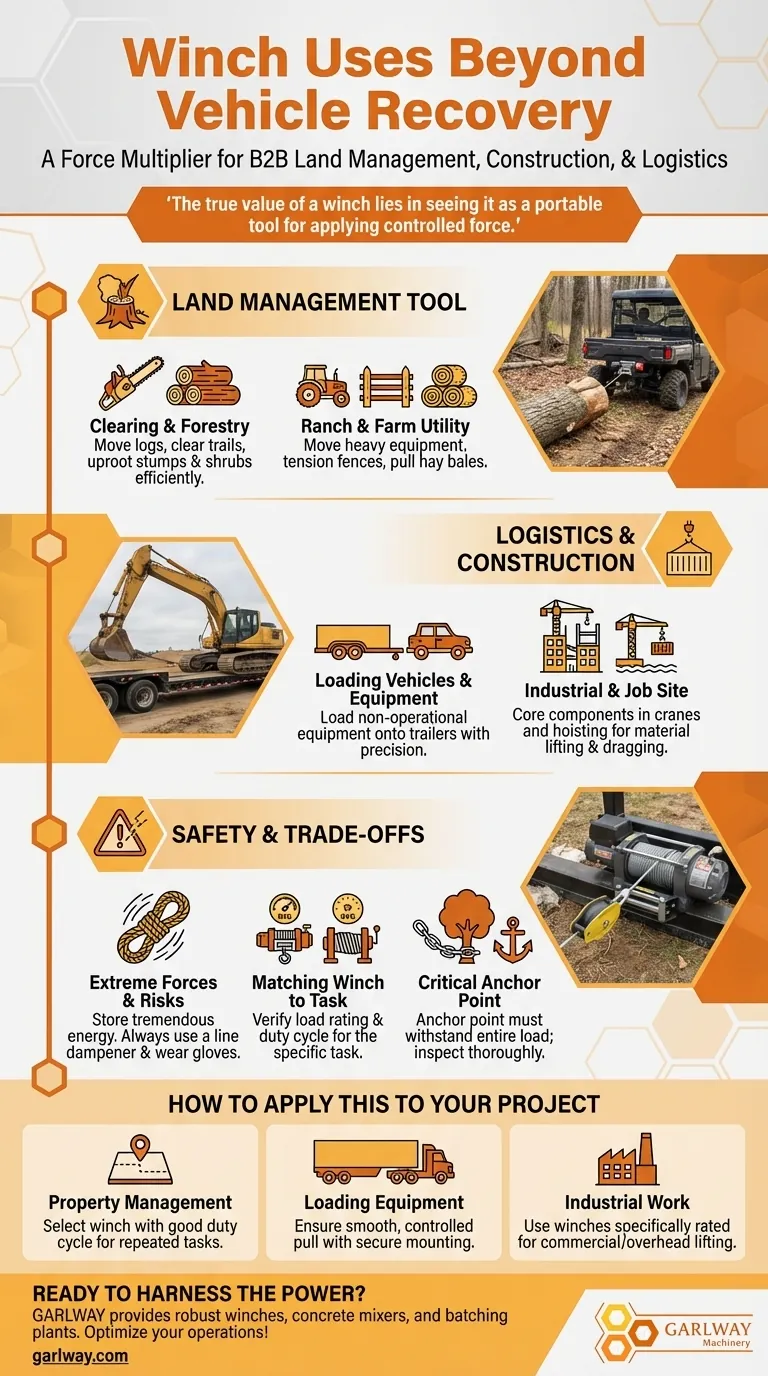
Visual Guide
Related Products
- Warn Winch Windlass Boat Trailer Winch
- Electric and Hydraulic Winch for Heavy Duty Applications
- Small Electric Winch 120V and 240V for Compact Applications
- 12000 lb Electric Boat Trailer Winch with Windlass Anchor Warn
- Quick Windlass Portable Winch for Truck and Boat Best Boat Winch
People Also Ask
- What are the main components of a boat trailer winch? A Guide to Safe & Efficient Boat Loading
- What factors should be considered when choosing a boat trailer winch? Ensure Safe and Effortless Boat Loading
- What is the purpose of boat trailer winches? Safely and Efficiently Load Your Boat
- What are the two main types of boat trailer winches? Manual vs. Electric Explained
- How often should a boat trailer winch be replaced? Your Guide to Safety and Longevity