
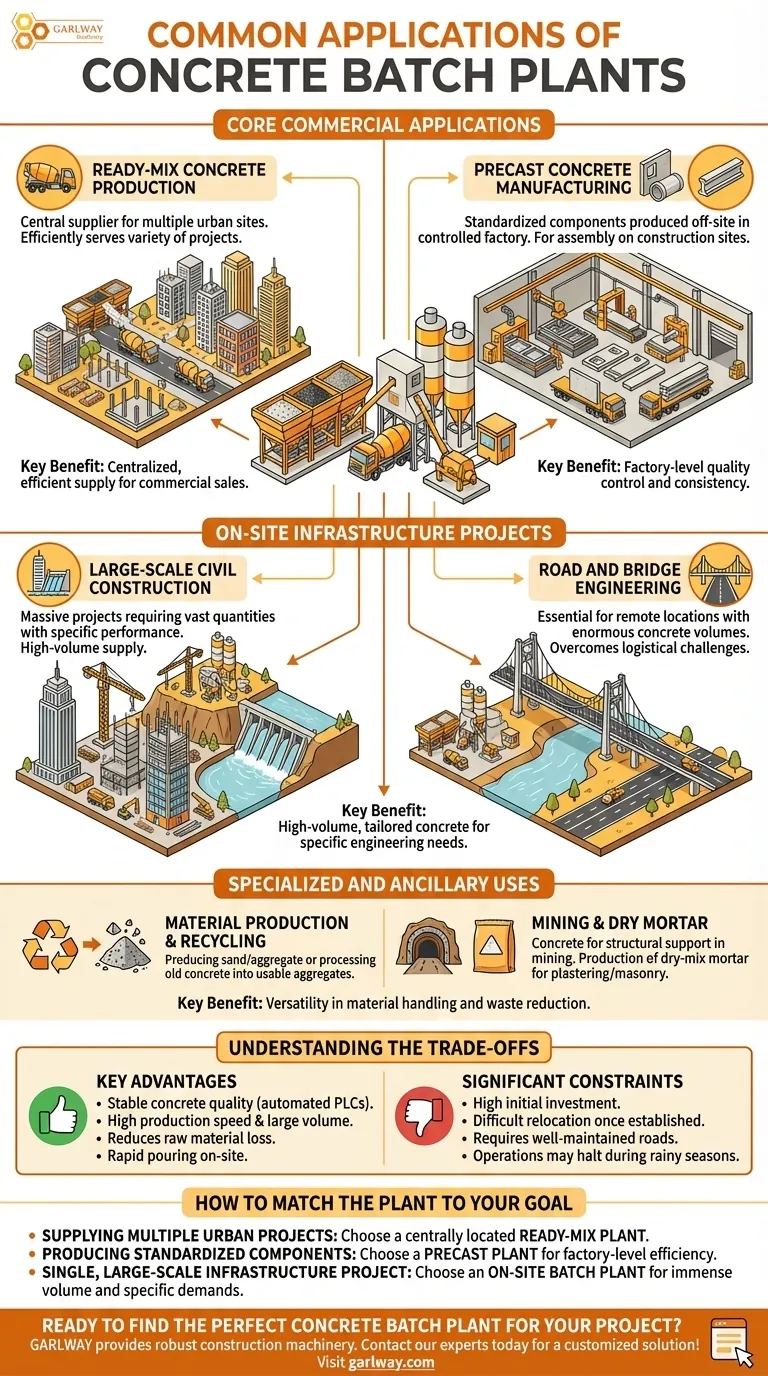
At its core, a concrete batch plant is a factory designed for one purpose: to produce high-quality concrete in large volumes with precision and consistency. Its applications span nearly every facet of modern construction, including commercial concrete sales (ready-mix), the manufacturing of standardized precast elements, and dedicated support for massive civil infrastructure projects like roads, bridges, and large buildings.
The specific application of a concrete batch plant is determined not just by the need for concrete, but by the project's demand for scale, quality control, and logistical efficiency—whether that means supplying a city with ready-mix or producing thousands of identical components in a factory.

Core Commercial Applications
The most common uses for concrete batch plants are commercial, serving either as a central supplier for a region or as a manufacturing hub for standardized products.
Ready-Mix Concrete Production
A ready-mix plant produces concrete that is then sold and transported to multiple construction sites. These are typically located in or near urban centers to efficiently supply a variety of projects, from small foundations to large commercial buildings.
Precast Concrete Manufacturing
Precast plants produce specific, standardized concrete components off-site in a controlled factory environment. These elements, such as wall panels, pipes, and beams, are then transported to the construction site for assembly. This method is common in transportation and water conservancy projects.
On-Site Infrastructure Projects
For large-scale, singular projects, a dedicated concrete batch plant is often established directly on the construction site. This approach ensures a constant, high-volume supply of concrete tailored to the project's specific engineering demands.
Large-Scale Civil Construction
Massive projects like skyscrapers, dams, and industrial facilities require vast quantities of concrete with specific performance characteristics. An on-site plant provides the necessary productivity and quality control to meet these demands without relying on external suppliers.
Road and Bridge Engineering
Highway and bridge construction consumes enormous volumes of concrete, often in remote locations. A dedicated, on-site plant is essential for producing the durable, thick concrete required for these structures and overcoming the logistical challenges of transportation.
Specialized and Ancillary Uses
Beyond direct construction, concrete batch plants play a role in material processing and specialized production, leveraging their core technology for different outputs.
Material Production and Recycling
Some plants are configured for producing sand and aggregate. Additionally, they can be adapted for construction waste recycling, processing old concrete and other materials into usable aggregates for new batches.
Mining and Dry Mortar
In mining operations, batch plants are used to create concrete for structural support and other needs. They can also be adapted to produce dry-mix mortar, a related cementitious product used for plastering and masonry.
Understanding the Trade-offs
While powerful, concrete batch plants are a significant investment with clear operational constraints. Understanding these is critical to their proper application.
Key Advantages
The primary benefits are stable concrete quality due to automated control systems (PLCs), high production speed, and the ability to produce large volumes. This reduces raw material loss and allows for rapid pouring on-site.
Significant Constraints
The main drawbacks are the high initial investment and the difficulty of relocation once established. They require well-maintained roads for material delivery and transport and are often forced to halt operations during rainy seasons.
How to Match the Plant to Your Goal
Choosing the right application depends entirely on your primary objective.
- If your primary focus is supplying multiple projects in an urban area: A centrally located ready-mix plant is the most effective model for commercial sales.
- If your primary focus is producing standardized, high-quality components: A precast plant allows for factory-level quality control and efficiency.
- If your primary focus is a single, large-scale infrastructure project: An on-site batch plant is necessary to meet the immense volume and specific engineering demands.
Ultimately, a concrete batch plant is a strategic tool for turning raw materials into the foundational element of modern infrastructure at an industrial scale.
Summary Table:
| Application | Primary Use Case | Key Benefit |
|---|---|---|
| Ready-Mix Production | Supplying multiple urban construction sites | Centralized, efficient supply for commercial sales |
| Precast Manufacturing | Producing standardized components (e.g., panels, beams) | Factory-level quality control and consistency |
| On-Site Infrastructure | Large-scale projects like bridges, dams, and skyscrapers | High-volume, tailored concrete for specific engineering needs |
| Material Recycling & Specialized Uses | Processing aggregates or producing dry mortar | Versatility in material handling and waste reduction |
Ready to find the perfect concrete batch plant for your project?
At GARLWAY, we specialize in providing robust construction machinery—including high-performance concrete batching plants, winches, and mixers—to construction companies and contractors worldwide. Whether you need a solution for ready-mix sales, precast manufacturing, or a large-scale infrastructure project, our expertise ensures you get reliable equipment tailored to your demands.
Boost your productivity and concrete quality—contact our experts today for a customized solution!
Visual Guide
Related Products
- HZS35 Small Cement Concrete Mixing Batch Plant
- HZS120 Ready Mix Concrete Batching Plant Commercial Mud Cement Mixer
- HZS75 Concrete Batching Plant Cement Mixer Price Concrete Mixer Bunnings Mixing Plant
- Commercial Electric Concrete Mixer Machine HZS 50 Small Batch Plant for Sale
- HZS180 Ready Mix Concrete Plant for Foundations with Sand and Cement
People Also Ask
- Why buy concrete batch plant parts only from the manufacturer? Protect Your Investment and Maximize Uptime
- Why is proper maintenance important for a concrete batch mix plant? Maximize Uptime & Profitability
- What is the advantage of a mobile concrete batching plant? Achieve On-Site Production & Total Control
- What are the advantages and disadvantages of concrete batching plants? Maximize Quality & Efficiency
- What are the two methods of material charging in a concrete mixing station? Single vs. Multiple Charging Explained





