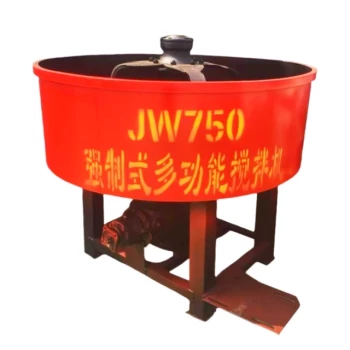
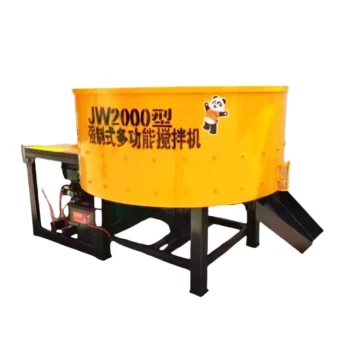
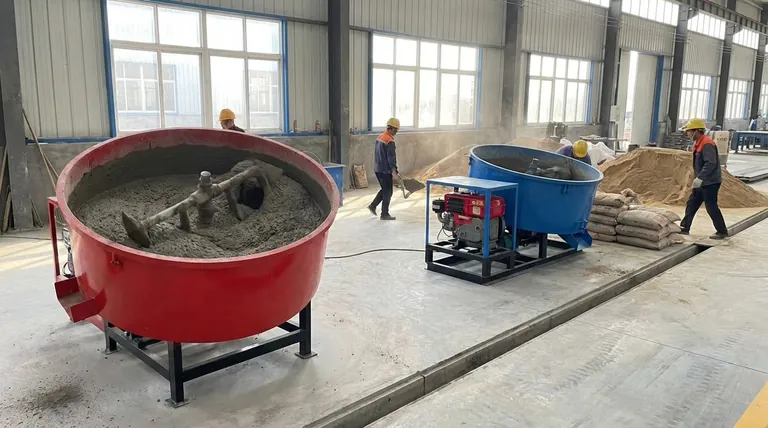
At their core, pan mixers are specifically designed for the intensive and efficient mixing of fine-grained materials. Their unique mechanical action ensures a highly uniform and consistent mixture, making them ideal for applications where the quality and homogeneity of the final product are paramount, especially in small to medium-sized batches.
Choosing the right mixer depends less on volume and more on the required quality of the mix. Pan mixers are the definitive choice when the goal is a perfectly homogeneous mixture of fine materials, prioritizing quality over sheer output speed.
How Pan Mixers Achieve an Intensive Mix
The effectiveness of a pan mixer comes directly from its simple yet powerful design. Understanding this mechanism clarifies why it excels at its specific tasks.
The Core Mechanical Design
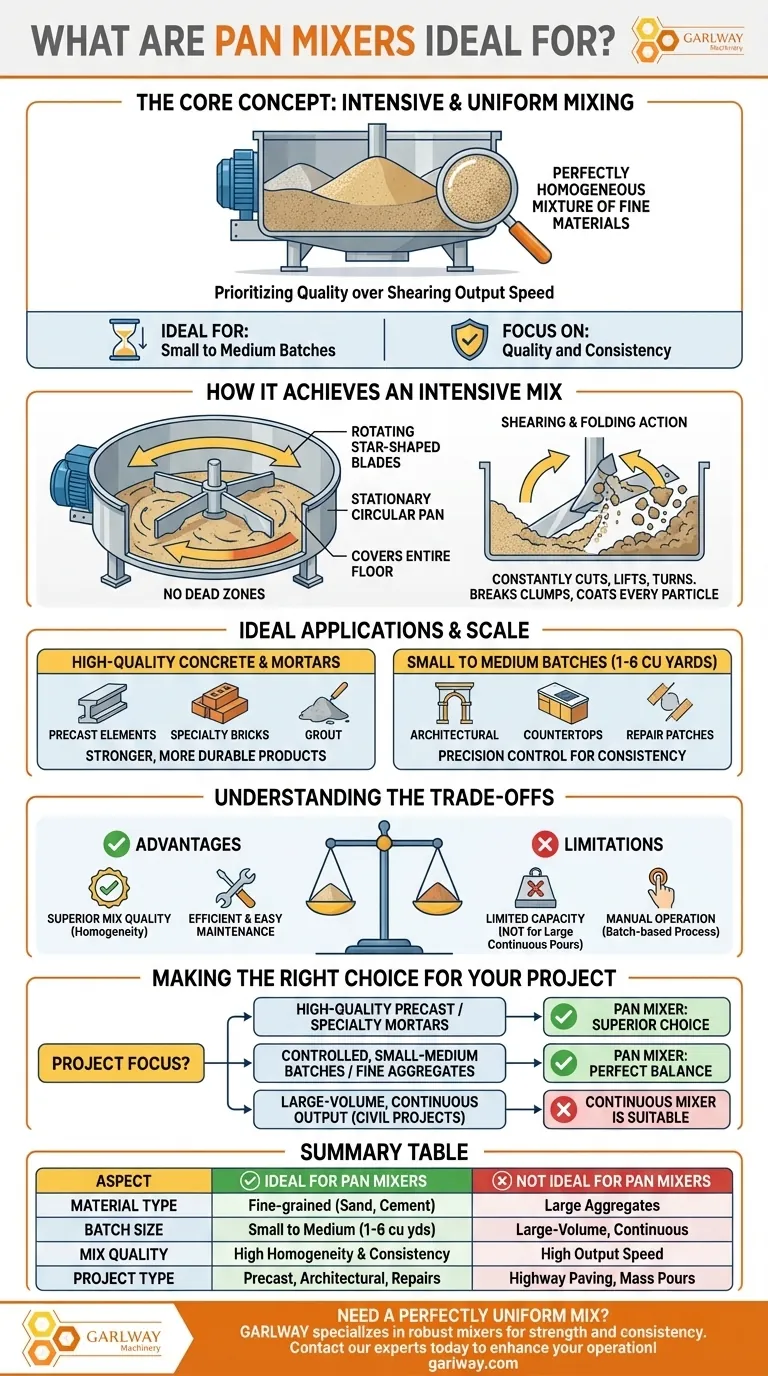
A pan mixer consists of a stationary circular pan that holds the material. Inside, a set of rotating, star-shaped blades or paddles moves through the batch.
This design forces the mixing tools to cover the entire floor of the pan with every rotation, leaving no "dead zones" where material can sit unmixed.
The Shearing and Folding Action
As the blades rotate, they create an intense shearing and folding effect. They constantly cut through the material, lift it, and turn it over on itself.
This action is crucial for fine-grained materials like sand and cement, as it breaks down any clumps and ensures every single particle is evenly coated with binder and water.
Ideal Applications and Scale
Pan mixers are not a one-size-fits-all solution. They are specialized tools best suited for specific project types and scales.
High-Quality Concrete and Mortars
The intensive mixing is perfect for producing high-quality precast concrete, specialty mortars, and grouts. The consistency it achieves leads to stronger and more durable end products.
Small to Medium Batches
Pan mixers are batch mixers, meaning they mix one specific quantity at a time, typically between 1 and 6 cubic yards. This makes them perfect for projects where control over each batch is critical.
They provide the precision needed for architectural precast elements, concrete countertops, or repair mortars where consistency from one batch to the next is essential.
Understanding the Trade-offs
To make an informed decision, you must weigh the distinct advantages of a pan mixer against its inherent limitations.
Advantage: Superior Mix Quality
For fine materials, the quality of a mix from a pan mixer is often superior to that of other types, like drum mixers. The intensive action guarantees a level of homogeneity that is difficult to achieve otherwise.
Advantage: Efficiency and Maintenance
Their relatively simple design makes pan mixers highly efficient for their size and generally easy to clean and maintain.
Limitation: Limited Capacity
The primary trade-off is capacity. Pan mixers are not designed for large-scale, continuous pours. Projects like soil stabilization or highway paving require continuous mixers that can handle massive volumes without interruption.
Limitation: Manual Operation
The batch-based process often requires manual loading of materials and unloading of the finished product for each cycle. This can create a bottleneck in high-volume production environments.
Making the Right Choice for Your Project
Your project's specific requirements for mix quality, volume, and material type will determine if a pan mixer is the right tool.
- If your primary focus is high-quality precast products or specialty mortars: The intensive, homogeneous mix from a pan mixer is the superior choice for ensuring strength and consistency.
- If your primary focus is controlled, small-to-medium batches with fine aggregates: A pan mixer offers the perfect balance of efficiency and quality control for this scale.
- If your primary focus is large-volume, continuous output for civil projects: A continuous mixer is far more suitable, as a pan mixer's batch operation would be inefficient.
Ultimately, selecting a pan mixer is a strategic choice for projects where the quality and consistency of the mix are the most critical factors for success.
Summary Table:
| Aspect | Ideal for Pan Mixers | Not Ideal for Pan Mixers |
|---|---|---|
| Material Type | Fine-grained materials (sand, cement, mortar) | Large aggregates, continuous feed materials |
| Batch Size | Small to medium batches (1-6 cubic yards) | Large-volume, continuous output projects |
| Mix Quality | High homogeneity and consistency is critical | High output speed is the primary goal |
| Project Type | Precast concrete, architectural elements, repairs | Highway paving, soil stabilization, mass pours |
Need a perfectly uniform mix for your precast concrete or specialty mortar project?
At GARLWAY, we specialize in providing robust and efficient construction machinery, including concrete mixers and batching plants, for contractors and construction companies worldwide. Our pan mixers are engineered to deliver the intensive, high-quality mixing your projects demand, ensuring strength and consistency in every batch.
Contact our experts today to discuss how a GARLWAY pan mixer can enhance your operation's quality and efficiency!
Visual Guide
Related Products
- Portable Concrete Mixer Machine Equipment for Mixing Concrete
- Commercial Construction Mixer Machine for Soil Cement Mixing Concrete
- HZS25 Best Cement Mixer for Quick Mix Concrete at Bunnings
- Hydraulic Concrete Mixer Machine Cement Mixing Equipment for Mixture Concrete
- Concrete Cement Mixer Machine Drum Mixer for Construction
People Also Ask
- Why is it necessary to use a portable concrete mixer? Gain Total Control & Efficiency
- How much concrete can you pour with a portable mixer? Find the Perfect Fit for Your Project
- What types of projects are portable concrete mixers suitable for? Ideal for DIY & Small-Scale Construction
- How much does a portable concrete mixer hold? A Guide to Choosing the Right Capacity
- What types of portable concrete mixers exist? Find the Perfect Mixer for Your Project