When it comes to ensuring your anchor deploys without a hitch, the most direct mechanical alternative to a swivel is a drop-through ramp insert. This simple, static component is installed in the bow roller or pulpit and is designed to angle the anchor shank at approximately 45 degrees. This specific geometry forces the anchor to roll into the correct orientation and self-launch cleanly, removing the need for a complex, moving part like a swivel.
The core issue is ensuring correct anchor orientation at the bow roller. While swivels introduce a mechanical point of failure to solve this, a simpler and more reliable approach is to use passive geometry—like a ramp insert or a well-designed roller—to guide the anchor into the right position.

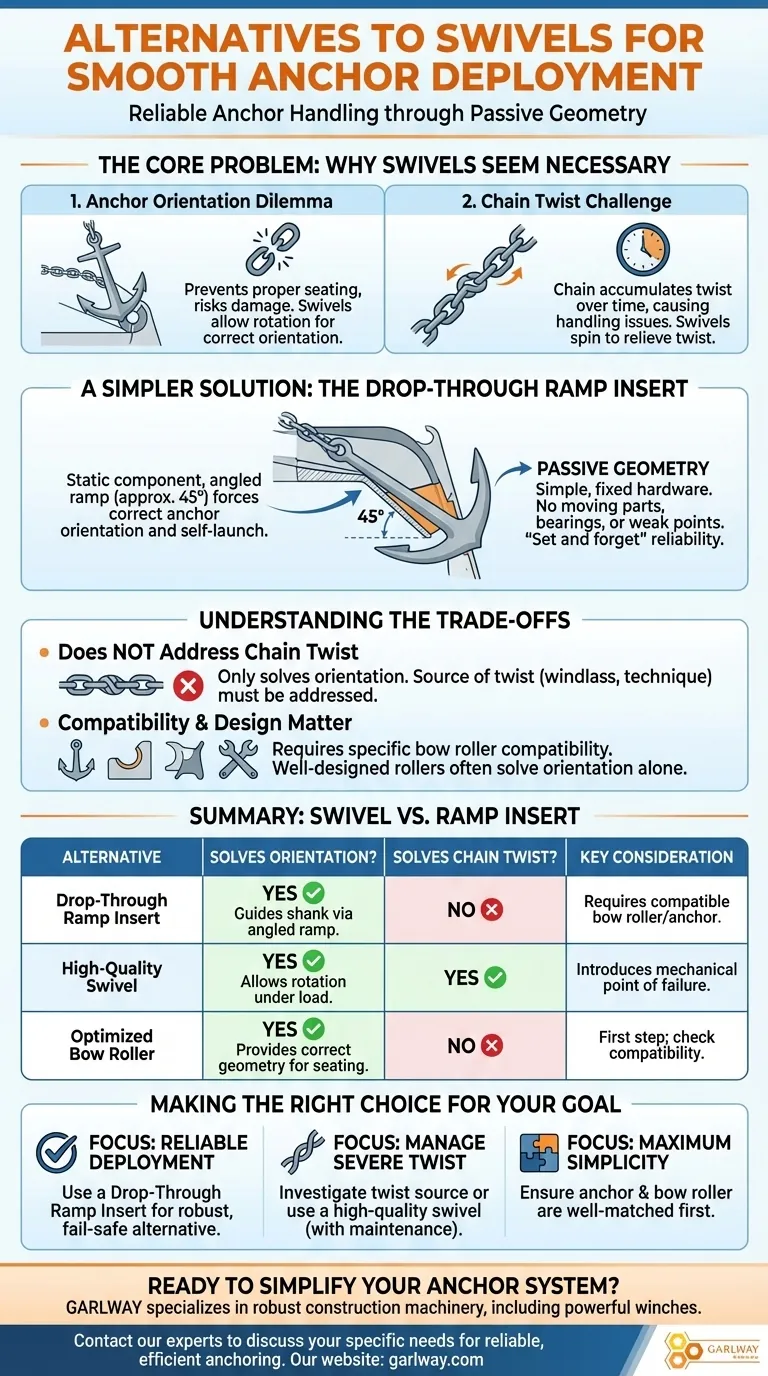
The Core Problem: Why Swivels Seem Necessary
To understand the alternatives, we must first appreciate the two problems swivels are intended to solve. Many boaters install them without fully considering if they are the right tool for the job.
The Anchor Orientation Dilemma
The most common issue is that an anchor, upon retrieval, arrives at the bow roller upside down or sideways. This prevents it from seating properly and can damage the roller, pulpit, or gelcoat.
A swivel is often used to allow the anchor to rotate freely and find its correct orientation just before it comes home into the roller.
The Chain Twist Challenge
As a boat swings at anchor, the chain rode can accumulate twist. Over time, this can cause the chain to kink and handle poorly, especially when feeding into the anchor locker.
A swivel is also intended to spin under load and relieve this accumulated twist, though their effectiveness in this role is often debated.
A Simpler Solution: The Drop-Through Ramp Insert
For boaters primarily concerned with anchor orientation, a static hardware solution offers a more robust alternative to a swivel.
How It Works
A drop-through ramp insert is a fixed piece of metal or high-density plastic. It creates an angled ramp inside the bow roller assembly.
As the anchor shank is pulled into the roller, this ramp forces the shank to tilt to a 45-degree angle. This controlled tilt ensures the anchor consistently rolls over and self-launches or seats correctly every time.
The Benefit of Passive Geometry
This solution relies on simple, unmoving geometry rather than a mechanical joint. There are no bearings to seize, pins to shear, or side-loading forces to worry about.
It is a "set and forget" solution that removes a known weak point from the ground tackle system.
Understanding the Trade-offs
While effective, this alternative is not a universal solution and comes with important limitations. Objectivity requires acknowledging what it can and cannot do.
It Does Not Address Chain Twist
This is the most critical distinction. A ramp insert solves the anchor orientation problem at the bow roller, but it does absolutely nothing to relieve twist that has accumulated in the anchor chain.
If chain twist is your primary problem, a ramp insert is not the correct tool. The source of the twist—often the windlass gypsy or anchoring technique—must be addressed directly.
Compatibility is Key
Ramp inserts are not a universal fit. They are designed for specific bow roller styles, typically those where the anchor shank "drops through" an opening in the pulpit.
They must be matched to your specific anchor and roller combination to be effective, which may require custom fabrication or careful selection.
Proper Bow Roller Design is a Factor
In many cases, a well-designed, modern bow roller can solve the orientation problem on its own. A roller that is long enough and properly shaped for the anchor can often guide it into the correct position without any extra hardware.
Before adding components, evaluate if your core problem is simply a poorly matched anchor and roller.
Making the Right Choice for Your Goal
Your decision should be based on the specific problem you are trying to solve with your ground tackle.
- If your primary focus is fail-safe, reliable anchor deployment: A drop-through ramp insert is an excellent, robust alternative to a swivel, provided your bow hardware is compatible.
- If your primary focus is managing severe chain twist: A ramp insert will not help; investigate the source of the twist or consider using a high-quality, load-rated swivel with a full understanding of its maintenance needs and risks.
- If your primary focus is maximum simplicity: First, ensure your anchor and bow roller are well-matched, as this pairing alone often solves most orientation issues without any additional components.
Ultimately, achieving reliable anchor handling is about creating the right geometry at the bow, not just adding more hardware to the system.
Summary Table:
| Alternative | Primary Function | Solves Orientation? | Solves Chain Twist? | Key Consideration |
|---|---|---|---|---|
| Drop-Through Ramp Insert | Guides anchor shank via angled ramp | Yes | No | Requires compatible bow roller/anchor |
| High-Quality Swivel | Allows rotation under load | Yes | Yes | Introduces a mechanical point of failure |
| Optimized Bow Roller | Provides correct geometry for seating | Yes | No | First step; check anchor/roller compatibility |
Ready to Simplify Your Anchor System?
GARLWAY specializes in robust construction machinery, including powerful winches ideal for marine and industrial applications. Our expertise in durable, reliable equipment can help you build a safer, more efficient anchoring setup.
Contact our experts today to discuss your specific needs and discover how GARLWAY's solutions can bring reliability and peace of mind to your operations.
Visual Guide
Related Products
- HZS35 Small Cement Concrete Mixing Batch Plant
- Auto Concrete Cement Mixer Machine New
- HZS180 Ready Mix Concrete Plant for Foundations with Sand and Cement
- Commercial Electric Concrete Mixer Machine HZS 50 Small Batch Plant for Sale
- Small Electric Winch 120V and 240V for Compact Applications
People Also Ask
- Why buy concrete batch plant parts only from the manufacturer? Protect Your Investment and Maximize Uptime
- Why is proper maintenance important for a concrete batch mix plant? Maximize Uptime & Profitability
- What is the advantage of a mobile concrete batching plant? Achieve On-Site Production & Total Control
- What are the advantages and disadvantages of concrete batching plants? Maximize Quality & Efficiency
- What are the two methods of material charging in a concrete mixing station? Single vs. Multiple Charging Explained