
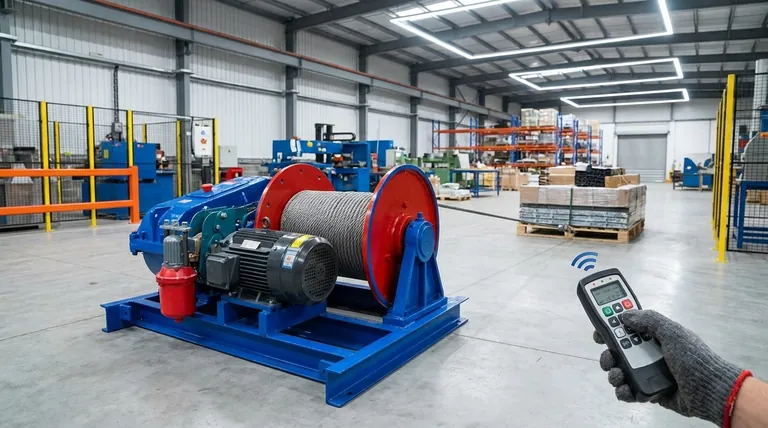
At their core, electric winches offer superior control through precision, programmability, and remote operation. Advanced electronic systems, such as variable frequency drives (VFDs), allow operators to manage load speed and direction with exceptional accuracy. This ensures safer, more predictable maneuvering of heavy loads compared to less sophisticated alternatives.
The fundamental advantage isn't just that the winch is motorized; it's that the electric motor can be governed by intelligent control systems. This translates raw power into precise, repeatable, and safe work.
The Foundation of Electric Winch Control
The control capabilities of an electric winch stem directly from its core components and how they interact. Unlike hydraulic or manual systems, the power source is inherently electronic, opening the door for sophisticated management.
The Role of the Electric Motor
An electric winch is driven by an electric motor, often managed through advanced control systems. This is the heart of its precision.
The most significant control element is the Variable Frequency Drive (VFD). A VFD allows the operator to minutely adjust the motor's speed and torque, enabling smooth starts, stops, and variable speeds during operation.
Precision in Speed and Direction
This electronic management provides exact control over the winching process. Operators can dial in the perfect speed for the task, preventing sudden jerks that could damage the load or create a safety hazard.
The ability to precisely reverse the motor's direction is also critical for fine-tuning the position of a load.
Programmable and Automated Functions
Modern electric winches can offer programmable logic. This allows users to set specific stop positions or repeatable speed profiles for routine tasks.
This level of automation increases efficiency and significantly reduces the potential for human error in repetitive lifting or pulling operations.
Practical Advantages of Enhanced Control
These technical capabilities deliver tangible benefits in safety, convenience, and operational effectiveness across various applications.
Remote Operation for Safety
One of the most significant advantages is the ability to operate the winch remotely. This allows the operator to stand at a safe distance with a clear line of sight to the load.
In hazardous situations like off-road vehicle recovery, remote operation is a non-negotiable safety feature, keeping the operator out of the direct path of a snapping cable or shifting load.
Power-Out for Controlled Unloading
Many electric winches feature a power-out option. Instead of relying on a brake or free-spooling, the motor actively pays out the line in reverse.
This provides maximum control when lowering a heavy object or launching a boat on a steep ramp, preventing uncontrolled movement.
Quiet and Clean Operation
Electric winches are significantly quieter than hydraulic systems and produce no fluid leaks. A quieter work environment reduces operator distraction and improves communication, indirectly contributing to safer and more controlled operations.
Understanding the Trade-offs
While offering superior control, electric winches are not without their limitations. Objectivity requires acknowledging these factors.
Dependency on Electrical Power
The most obvious constraint is the need for a reliable electrical source. A dead battery or power failure renders the winch inoperable, which can be a critical issue in remote recovery situations.
System Complexity
The advanced electronics that provide precise control, such as VFDs and remote receivers, add complexity. Troubleshooting and repair can be more involved than with a purely mechanical system.
Initial Cost of Advanced Features
While basic electric winches can be cost-effective, models with highly advanced programmable controls and VFDs carry a higher initial purchase price. This investment must be weighed against the required level of precision and safety for the task.
Making the Right Choice for Your Application
The ideal winch depends entirely on the control requirements of your specific goal.
- If your primary focus is industrial precision: Seek out a winch with a Variable Frequency Drive (VFD) and programmable stop positions for unmatched accuracy.
- If your primary focus is off-road safety and convenience: A model with a durable, responsive remote control is the most critical feature.
- If your primary focus is controlled lowering, like boat launching: Ensure the winch has a true "power-out" feature for safe, motorized unloading.
Ultimately, the control advantages of an electric winch empower you to manage heavy loads with greater safety and confidence.
Summary Table:
| Control Feature | Key Benefit | Ideal For |
|---|---|---|
| Variable Frequency Drive (VFD) | Precise speed & torque control | Industrial precision tasks |
| Remote Operation | Enhanced operator safety | Off-road recovery, hazardous areas |
| Programmable Logic | Automated, repeatable cycles | Repetitive lifting/pulling operations |
| Power-Out Function | Controlled lowering of loads | Boat launching, unloading heavy objects |
Need precise control for your heavy lifting?
GARLWAY specializes in high-performance electric winches for construction companies and contractors globally. Our winches feature advanced VFDs and remote controls to ensure your projects are completed with maximum safety and efficiency.
Contact GARLWAY today to find the perfect electric winch for your specific control needs!
Visual Guide

Related Products
- Electric 120V Boat Winch by Badlands
- Electric and Hydraulic Winch for Heavy Duty Applications
- Small Electric Winch 120V and 240V for Compact Applications
- 12000 lb Electric Boat Trailer Winch with Windlass Anchor Warn
- Electric Hoist Winch Boat Anchor Windlass for Marine Applications
People Also Ask
- How do electric boat winches work? Unlock Effortless Launching & Retrieval
- How much current does an electric boat winch draw? Plan Your Electrical System for Peak Performance
- Can I run a winch straight from a battery? Essential Power Setup for Safe Operation
- What are the types of electric winches available? Choose the Right Winch for Your Job
- What are the uses of electric winches in mining and tunneling? Enhance Safety and Efficiency Underground





