
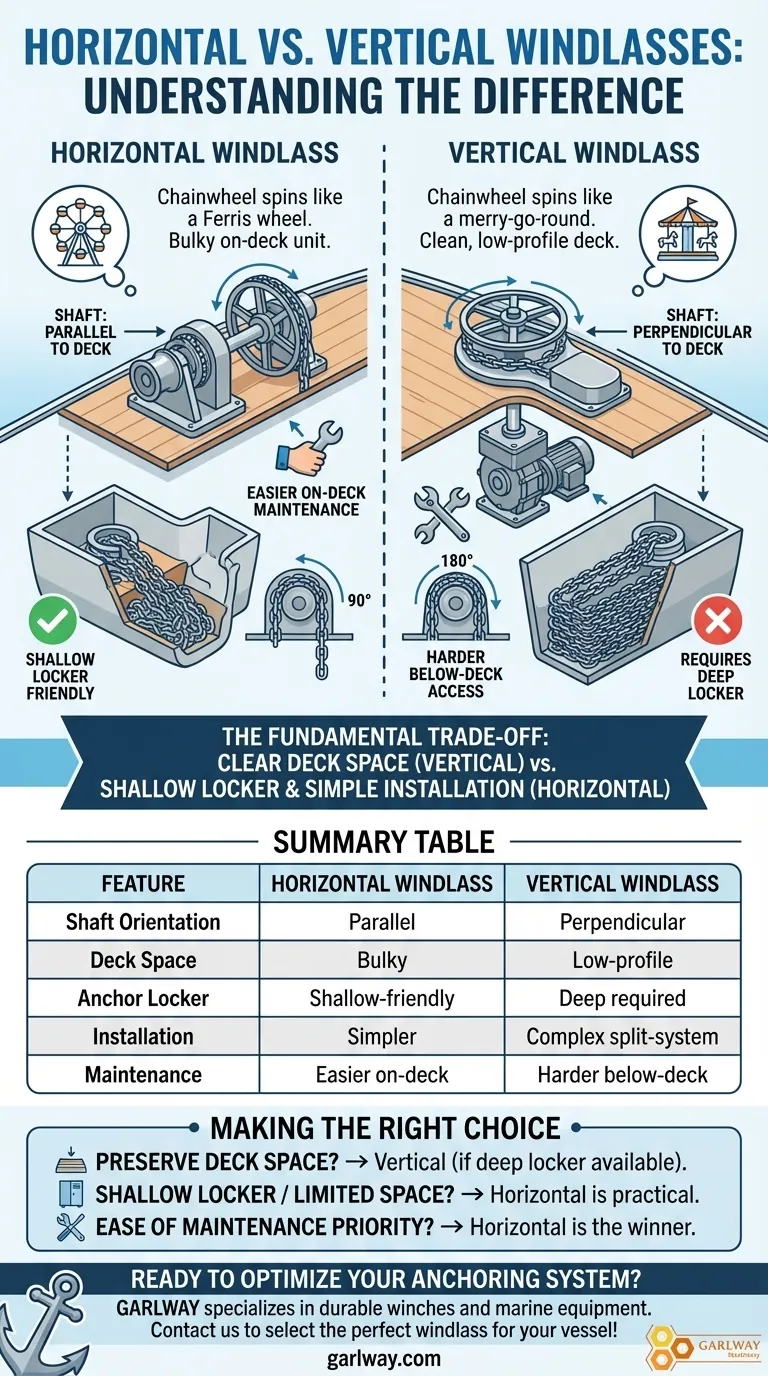
At its core, the difference is simple. The terms "horizontal" and "vertical" refer directly to the orientation of the main shaft that drives the chainwheel. A horizontal windlass has its shaft parallel to the deck, making the chainwheel spin like a Ferris wheel. A vertical windlass has its shaft perpendicular to the deck, so the chainwheel spins like a merry-go-round.
The choice between a horizontal and vertical windlass is not about which is inherently better, but about a fundamental trade-off. It's a decision between prioritizing clear on-deck space (vertical) versus accommodating a shallow anchor locker and simplifying installation (horizontal).
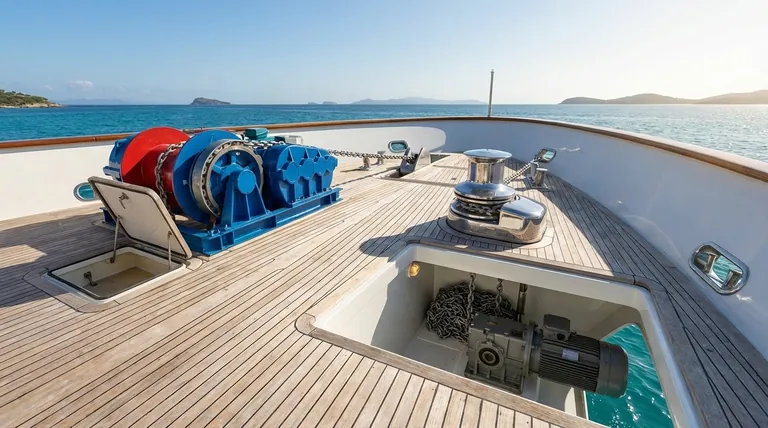
How Each Design Impacts Your Boat
The orientation of the shaft dictates the entire form factor of the windlass, which has significant implications for how it fits on your vessel.
The Horizontal Windlass: An On-Deck Unit
A horizontal windlass is a self-contained unit where the motor, gearbox, and chainwheel (gypsy) are all enclosed in a single housing mounted entirely on the deck.
This design is often bulkier on deck, consuming more visible space.
The Vertical Windlass: A Split-System Design
A vertical windlass features a low-profile chainwheel on the deck, while the motor and gearbox are installed below the deck.
This creates a cleaner, less cluttered foredeck but requires a significant amount of space directly beneath the unit inside the anchor locker.
Understanding the Trade-offs in Installation and Performance
Beyond aesthetics, the two designs present critical differences in how they handle the anchor rode and what they demand from your boat's structure.
Chain Locker Requirements
This is often the most critical deciding factor. A vertical windlass drops the chain straight down the hawsepipe, requiring a deep chain locker to allow gravity to stack the chain correctly and prevent it from bunching up.
Conversely, a horizontal windlass has the chain feed off the side of the gypsy, making it far more suitable for boats with shallow anchor lockers where there is not much vertical fall.
Rode Handling and Alignment
A vertical windlass wraps the anchor chain around nearly 180 degrees of the chainwheel, providing more contact area and a secure grip. This design is also more forgiving of the entry angle from the bow roller.
A horizontal windlass typically engages the chain for only 90 degrees. This requires more careful alignment between the bow roller and the windlass to ensure the chain feeds smoothly without jumping.
Maintenance and Accessibility
Because the entire mechanism of a horizontal windlass is on the deck, it is generally much easier to access for routine service and troubleshooting.
The motor and electrical components of a vertical windlass are located in the anchor locker, a space that is often damp, confined, and difficult to work in.
Making the Right Choice for Your Vessel
Your boat's specific deck layout and anchor locker configuration will ultimately guide your decision.
- If your primary focus is preserving clear deck space: A vertical windlass is the superior choice, provided you have ample room below deck for the motor and a deep fall for the chain.
- If you have a shallow anchor locker or limited below-deck space: A horizontal windlass is the most practical and often the only viable option.
- If ease of installation and maintenance is your top priority: The self-contained, on-deck nature of a horizontal windlass makes it the clear winner.
Choosing the right windlass is about matching the equipment's design to the physical realities of your vessel.
Summary Table:
| Feature | Horizontal Windlass | Vertical Windlass |
|---|---|---|
| Shaft Orientation | Parallel to deck | Perpendicular to deck |
| Deck Space | Bulky on deck | Clean, low-profile |
| Anchor Locker Needs | Shallow locker friendly | Requires deep locker |
| Installation | Simpler, self-contained | Complex, split-system |
| Maintenance | Easier on-deck access | Harder below-deck access |
Ready to optimize your vessel's anchoring system? GARLWAY specializes in marine and construction machinery, offering durable winches and reliable equipment for boat builders, marine contractors, and global operators. Our experts can help you select the perfect windlass for your deck layout and locker configuration. Contact us today to discuss your needs and enhance your boat's performance and safety!
Visual Guide
Related Products
- Quick Windlass Portable Winch for Truck and Boat Best Boat Winch
- Warn Winch Windlass Boat Trailer Winch
- Electric Hoist Winch Boat Anchor Windlass for Marine Applications
- Heavy Duty Electric Boat Winch Windlass Anchor
- 12000 lb Electric Boat Trailer Winch with Windlass Anchor Warn
People Also Ask
- What features were incorporated into the upgraded portable winch system? Boost Your Recovery Power & Safety
- What are some uses mentioned for portable winches beyond vehicle recovery? Essential Versatility for Property & Work
- How could the twisting issue with a portable winch be mitigated? Achieve Safe, Centered Pulls with Proper Rigging
- What are the primary uses of a portable winch for a truck? Boost Your Truck's Capability and Self-Reliance
- What is the single rope traction force of the quick winch without a pulley block? 0.5 to 40 Tons Explained


