
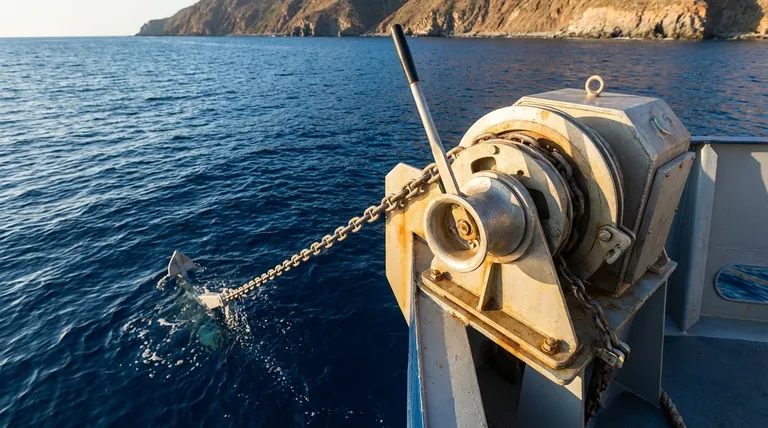
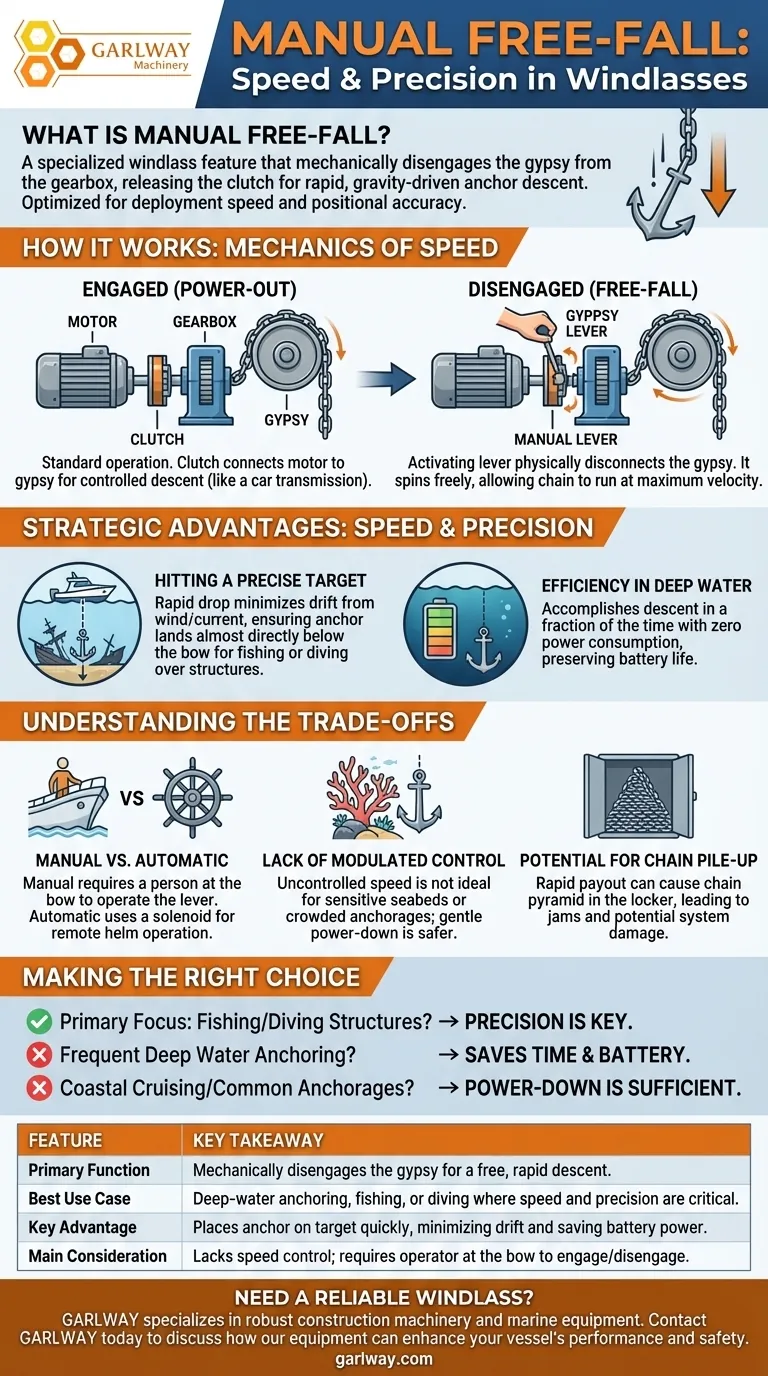
Manual Free-Fall is a specialized windlass feature that mechanically disengages the gypsy from the gearbox. This action releases the clutch, allowing the anchor and chain to drop freely and rapidly, limited only by gravity. It is designed specifically for scenarios where deployment speed and positional accuracy are the highest priorities.
The core purpose of Manual Free-Fall is to trade controlled, powered descent for maximum drop speed. This enables an operator to place an anchor on a precise target with minimal drift from wind or current, a critical capability for deep-water anchoring and fishing.
How Manual Free-Fall Works
To understand the value of this feature, it's essential to grasp the simple mechanics behind it. The system is intentionally straightforward, prioritizing reliability and speed over complexity.
The Role of the Gypsy and Clutch
A windlass gypsy is the notched wheel that grips the anchor chain. In a standard power-out operation, the gypsy is connected to the motor via a clutch and gearbox, which controls the speed of descent.
Think of the clutch in a windlass like the clutch in a manual transmission car. When engaged, it transfers power from the motor to the gypsy.
Disengaging for Speed
The Manual Free-Fall mechanism introduces a lever or handle on the windlass itself. Activating this lever physically disengages the clutch.
With the clutch disengaged, the gypsy is completely disconnected from the motor and gearbox. It can now spin freely on its axis, allowing the anchor chain to run out at maximum velocity.
Re-engaging to Retrieve
Once the anchor is set on the seabed and sufficient scope is paid out, you must manually re-engage the clutch. This reconnects the gypsy to the gearbox, allowing you to use the windlass motor to haul the anchor back up.
The Strategic Advantage: Speed and Precision
Choosing a windlass with this feature is about solving specific operational challenges where traditional power-down methods fall short.
Hitting a Precise Target
When fishing or diving over a specific underwater structure like a wreck or reef, accuracy is everything. A boat is always being moved by wind and current.
A slow, powered descent gives the boat several minutes to drift off the mark. A rapid free-fall drop minimizes this time, ensuring the anchor lands almost directly below the bow at the moment of release.
Efficiency in Deep Water
Powering out hundreds of feet of chain is a slow process that places a significant and prolonged drain on your vessel's batteries.
Manual Free-Fall accomplishes the same task in a fraction of the time with zero power consumption, preserving battery life for other critical systems.
Understanding the Trade-offs
While powerful, Manual Free-Fall is not the ideal solution for every situation. Its primary benefit—uncontrolled speed—is also its main drawback.
Manual vs. Automatic Free-Fall
It's crucial to distinguish between manual and automatic systems. Manual Free-Fall requires a person to be at the bow to operate the release lever on the windlass.
Automatic Free-Fall uses an electrical solenoid to disengage the clutch, allowing you to drop anchor with the press of a button from the helm. This offers the same speed benefit but with remote convenience.
Lack of Modulated Control
The defining feature is the lack of speed control. In a crowded anchorage or over a sensitive seabed (like coral or sea grass), a gentle, controlled power-down is often preferable to avoid damage or startling other boaters.
Potential for Chain Pile-up
The sheer speed at which the chain pays out can cause it to form a pyramid-like pile in the anchor locker. If not managed, this can lead to a jam that abruptly stops the anchor's descent and can damage the system.
Making the Right Choice for Your Goal
Selecting a windlass depends entirely on your primary boating activity. This feature is a tool designed for a specific job.
- If your primary focus is fishing or diving over specific structures: The precision of a free-fall system is a significant advantage that can make or break your day.
- If you frequently anchor in deep water (e.g., over 150 feet): Manual Free-Fall dramatically reduces anchoring time and saves considerable battery power.
- If your primary focus is coastal cruising in moderate depths and common anchorages: A standard power-down windlass is often sufficient, safer, and offers more control for placing your anchor gently.
Ultimately, choosing a windlass with Manual Free-Fall is a deliberate decision to prioritize speed and positional accuracy for demanding anchoring challenges.
Summary Table:
| Feature | Key Takeaway |
|---|---|
| Primary Function | Mechanically disengages the gypsy for a free, rapid descent. |
| Best Use Case | Deep-water anchoring, fishing, or diving where speed and precision are critical. |
| Key Advantage | Places anchor on target quickly, minimizing drift and saving battery power. |
| Main Consideration | Lacks speed control; requires operator at the bow to engage/disengage. |
Need a reliable windlass for your demanding anchoring needs?
GARLWAY specializes in robust construction machinery and marine equipment. Our expertise in durable winches and gear systems translates directly to reliable windlasses built for professionals. Whether you're a commercial fishing operation or a serious diving charter, we can provide a solution that ensures rapid, precise anchor deployment.
Contact GARLWAY today to discuss how our equipment can enhance your vessel's performance and safety.
Visual Guide
Related Products
- Quick Windlass Portable Winch for Truck and Boat Best Boat Winch
- Electric Hoist Winch Boat Anchor Windlass for Marine Applications
- Heavy Duty Electric Boat Winch Windlass Anchor
People Also Ask
- What features were incorporated into the upgraded portable winch system? Boost Your Recovery Power & Safety
- What are some uses mentioned for portable winches beyond vehicle recovery? Essential Versatility for Property & Work
- How could the twisting issue with a portable winch be mitigated? Achieve Safe, Centered Pulls with Proper Rigging
- What are the primary uses of a portable winch for a truck? Boost Your Truck's Capability and Self-Reliance
- What is the single rope traction force of the quick winch without a pulley block? 0.5 to 40 Tons Explained


