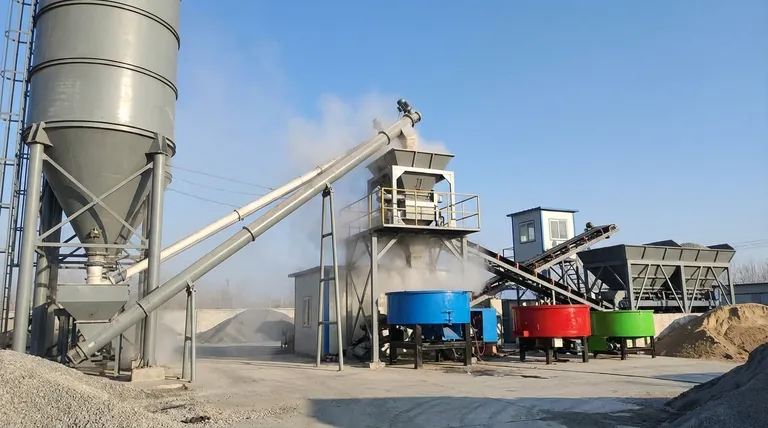
At its core, a screw conveyor in a concrete batching plant is a specialized transport system for fine powders. It uses a rotating helical screw, known as an auger, inside a tube to move precise amounts of materials like cement and fly ash from a storage silo directly to the weigh batcher or mixer.
The screw conveyor is more than just a delivery tube; it is a critical instrument for ensuring the accuracy and consistency of every concrete batch. Its controlled operation is fundamental to translating a mix design recipe into a high-quality final product.
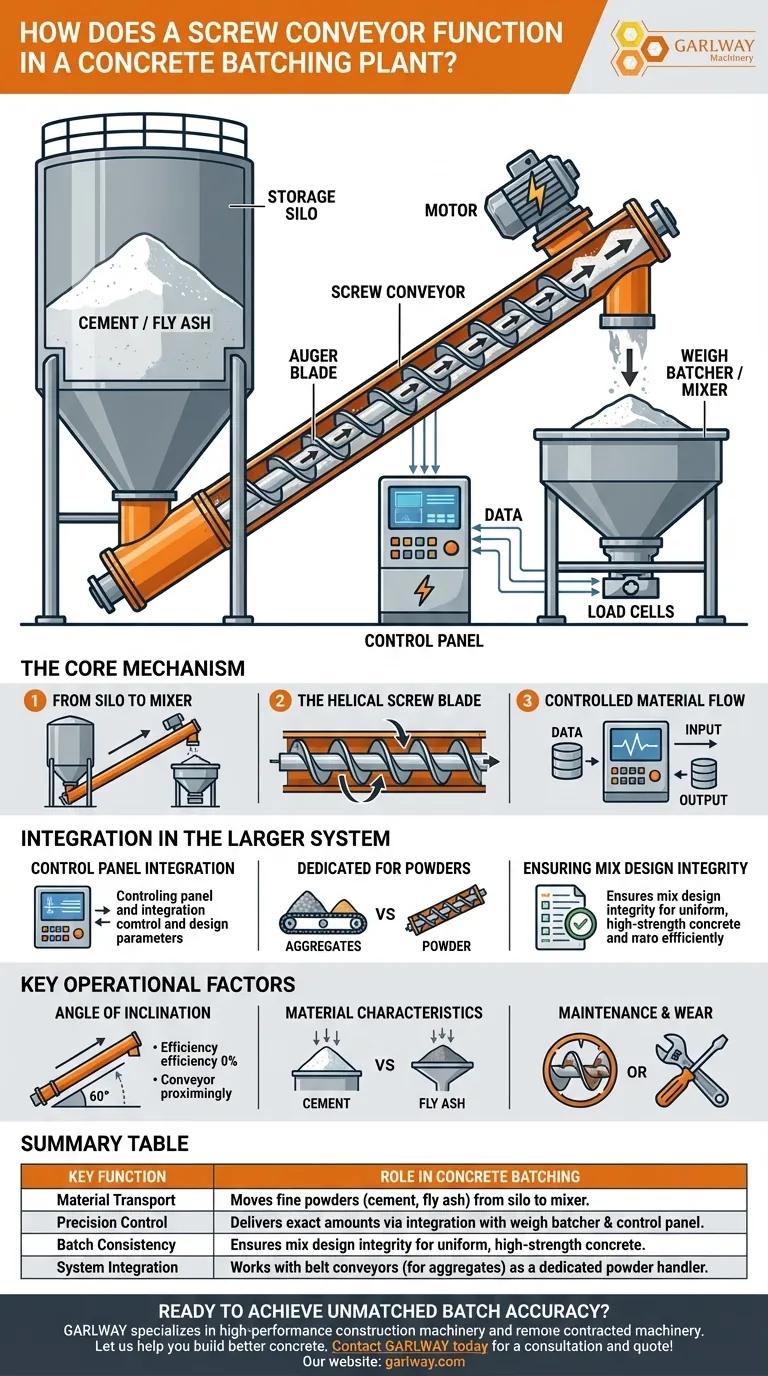
The Core Mechanism: How It Works
A screw conveyor operates on a principle that has been in use for centuries, refined for the demands of modern concrete production. Its simplicity is key to its reliability.
From Storage Silo to Mixer
The process begins at the base of a large storage silo, where cement or another powder is stored. The screw conveyor's inlet is connected here, and its outlet is positioned over the weigh hopper or directly into the plant's main mixer.
The Helical Screw Blade
The "engine" of the conveyor is the helical screw blade, or auger. As an electric motor turns this screw, the blade scoops up the material and pushes it forward along the length of the trough or tube. This provides a continuous, steady flow of material.
Controlled Material Flow
The entire operation is governed by the plant's central control panel. The system calculates the exact weight of cement or fly ash needed for a recipe and runs the conveyor's motor until that target is reached. This precise control is what enables accurate batching.
The Screw Conveyor's Role in the Larger System
While the screw conveyor has a simple function, it does not work in isolation. It is a vital link in a chain of automated processes designed for precision.
Integration with the Control Panel
The plant's control panel acts as the brain of the operation. It sends start and stop signals to the conveyor's motor based on real-time data from load cells in the weigh batcher, ensuring the exact amount of material specified in the recipe is delivered.
A Dedicated Tool for Powders
A concrete plant uses different conveyors for different materials. While a belt conveyor typically moves sand and aggregates, the enclosed screw conveyor is specifically designed for fine, dusty, and moisture-sensitive powders like cement, preventing waste and contamination.
Ensuring Mix Design Integrity
The final strength and quality of concrete depend entirely on the correct ratio of its ingredients. By delivering a precise, repeatable quantity of cementitious material, the screw conveyor ensures that the integrity of the mix design is maintained from one batch to the next.
Understanding the Key Operational Factors
To rely on a screw conveyor for precision, you must understand the factors that affect its performance. Mismanagement here can lead to inconsistent batches and maintenance issues.
Angle of Inclination
The angle at which the conveyor is installed has a significant impact on its efficiency. A steeper angle requires more power to move material and can decrease the flow rate. The system must be designed to account for this angle to maintain accuracy.
Material Characteristics
Different powders have different densities and flow characteristics. The system must be calibrated for the specific material it is handling—cement will flow differently than fly ash. This calibration is critical for accurate weighing.
Maintenance and Wear
Cement and other powders are abrasive. Over time, this can cause wear on the screw's helical blades and the inside of the tube. Regular inspection and maintenance are essential to prevent diminished performance and eventual failure.
Making the Right Choice for Your Goal
To ensure your screw conveyor is supporting your plant's objectives, focus on how it integrates with your overall process.
- If your primary focus is batch accuracy: Prioritize the seamless integration between the conveyor's motor controls, the weigh batcher's load cells, and the main control panel.
- If your primary focus is production speed: Ensure the conveyor's diameter, pitch, and motor speed are correctly sized to meet the plant's target cycle times without sacrificing precision.
- If your primary focus is long-term reliability: Implement a strict preventative maintenance schedule focusing on bearings, seals, and auger flighting to prevent costly unplanned downtime.
Ultimately, a well-maintained and properly calibrated screw conveyor is fundamental to the consistent production of quality concrete.
Summary Table:
| Key Function | Role in Concrete Batching |
|---|---|
| Material Transport | Moves fine powders (cement, fly ash) from silo to mixer. |
| Precision Control | Delivers exact amounts via integration with weigh batcher & control panel. |
| Batch Consistency | Ensures mix design integrity for uniform, high-strength concrete. |
| System Integration | Works with belt conveyors (for aggregates) as a dedicated powder handler. |
Ready to Achieve Unmatched Batch Accuracy?
Your concrete's quality depends on the precision of your batching equipment. A reliable screw conveyor is fundamental to delivering consistent mix designs and maximizing your plant's productivity.
GARLWAY specializes in high-performance construction machinery, including robust screw conveyors, concrete mixers, and complete batching plants designed for construction companies and contractors who demand reliability and accuracy.
Let us help you build better concrete. Our experts can provide a solution tailored to your specific production goals.
Contact GARLWAY today for a consultation and quote!
Visual Guide
Related Products
- HZS120 Ready Mix Concrete Batching Plant Commercial Mud Cement Mixer
- HZS90 Large Multiquip Concrete Mixers for Construction
- HZS180 Ready Mix Concrete Plant for Foundations with Sand and Cement
- HZS35 Small Cement Concrete Mixing Batch Plant
- Construction Products Concrete Plant Machine Mixing Concrete Mixer
People Also Ask
- What is a ready mix concrete batching plant? The Engine of Modern Construction
- What is the name of the machine used in ready mix? Unpacking the Complete Concrete System
- What is the core component of a concrete batching plant? The Mixer Unit Defines Your Concrete Quality
- What are the types of concrete mixers used in batching plants? Choose the Right Mixer for Your Project
- What are the advantages and disadvantages of concrete batching plants? Maximize Quality & Efficiency