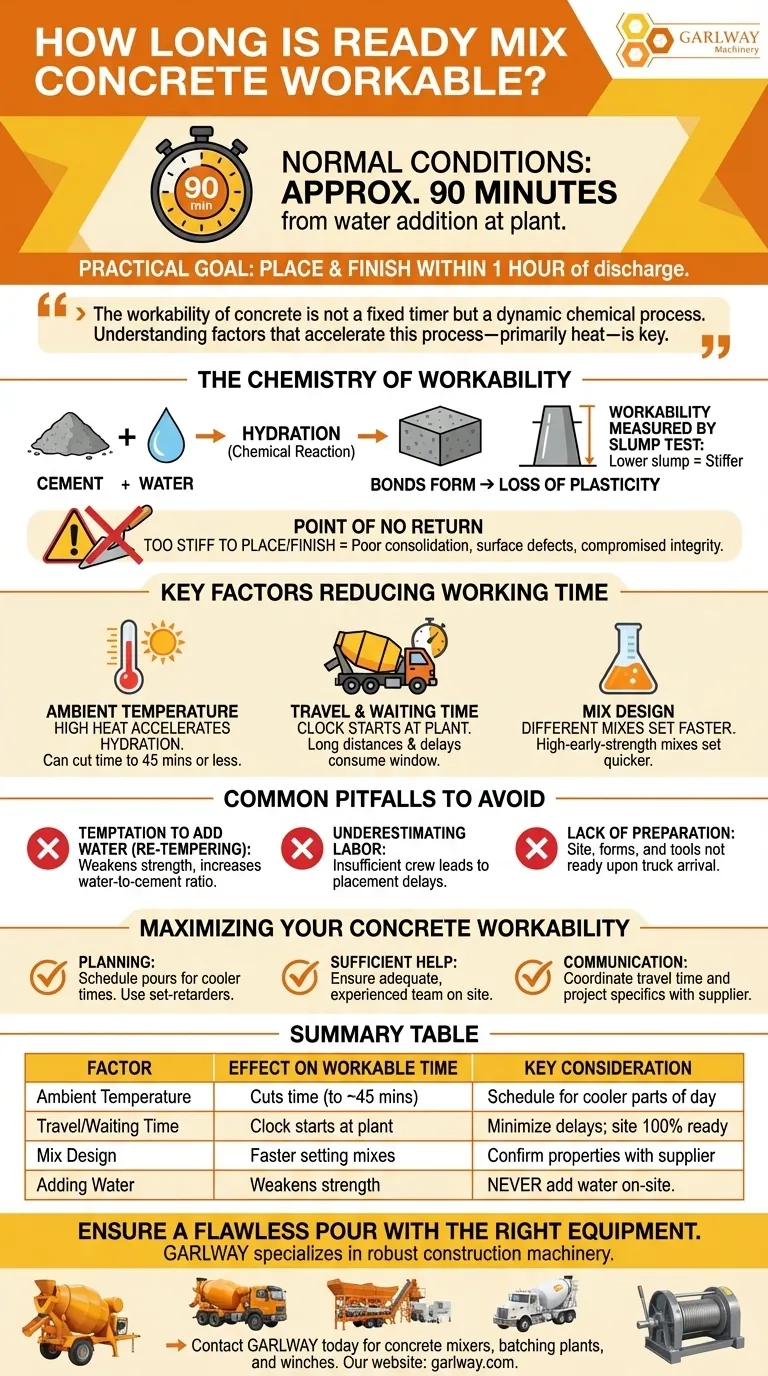
Under normal conditions, ready-mix concrete has a usable life of approximately 90 minutes from the time water is added to the mix. However, this is a highly variable window, and for practical purposes, you should aim to have the concrete placed and completely finished within one hour of its discharge from the truck.
The workability of concrete is not a fixed timer but a dynamic chemical process. Understanding the factors that accelerate this process—primarily heat—is the single most important element for planning a successful concrete pour.
The Chemistry of Workability
Ready-mix concrete arrives on-site in a plastic, workable state. This is a temporary condition. The clock starts ticking the moment water is introduced to the cement at the batching plant, initiating a chemical reaction called hydration.
The Hydration Process
Hydration is the reaction between cement particles and water that forms the bonds that give concrete its strength. As these bonds form, the mix gradually stiffens and loses its plasticity.
What is "Workability"?
Workability refers to the ease with which fresh concrete can be mixed, placed, consolidated, and finished without segregation. It's often measured by a "slump test," where a lower slump indicates a stiffer, less workable mix.
The Point of No Return
Once the concrete becomes too stiff to place and finish properly, it has reached the end of its workable life. Attempting to work with it beyond this point will result in poor consolidation, surface defects, and compromised structural integrity.
Key Factors That Reduce Your Working Time
The 90-minute rule of thumb applies only to ideal conditions (around 70°F or 21°C). Several factors can significantly shorten this window, and you must account for them in your planning.
Ambient Temperature
Heat is the number one accelerator of the hydration process. On a hot summer day, the workable time can easily be cut in half, from 90 minutes down to 45 minutes or less. Direct sunlight on the forms and subgrade will also speed up setting.
Travel and Waiting Time
The clock starts at the plant, not when the truck arrives. Long travel distances or delays in accessing the site consume a significant portion of your workable window before the concrete is even discharged.
Mix Design
Different concrete mixes have different setting times. High-early-strength mixes, for example, are designed to set much faster by default. Always confirm the mix properties with your supplier.
Common Pitfalls to Avoid
Mistakes made under time pressure are a primary cause of failed concrete projects. Understanding these common errors is critical for avoiding them.
The Temptation to Add Water
If concrete begins to stiffen in the truck or wheelbarrow, it is tempting to add more water to make it workable again. This practice, known as "re-tempering," is extremely detrimental.
Adding unauthorized water dramatically increases the water-to-cement ratio, which severely weakens the final strength and durability of the concrete. It is the single most common cause of low-strength test results.
Underestimating Labor
Placing, leveling, and finishing concrete is hard work that requires a coordinated effort. Many projects fail because there simply aren't enough people on site to get the concrete placed and finished before it sets.
Lack of Preparation
The concrete truck must not be kept waiting. The site, forms, reinforcement, and tools must be 100% ready to go before the truck is scheduled to arrive. Any on-site delay directly eats into your critical placement window.
Maximizing Your Concrete Workability
Planning is the key to managing your workable time effectively. By controlling the variables you can, you set your project up for success.
- If you are working in hot weather: Schedule your pour for the earliest, coolest part of the morning. Discuss using set-retarding admixtures with your supplier to extend the workable time.
- If you have a large or complex pour: Ensure you have sufficient, experienced help on site before the truck arrives. A well-briefed team can place and finish a large volume of concrete with surprising speed.
- If you are coordinating with a supplier: Communicate clearly about the travel time to your site and the specifics of your project so they can advise on the best mix and schedule.
Proper planning transforms the race against time into a well-managed and predictable process.
Summary Table:
| Factor | Effect on Workable Time | Key Consideration |
|---|---|---|
| Ambient Temperature | High heat can cut time in half (to ~45 mins) | Schedule pours for cooler parts of the day |
| Travel/Waiting Time | Clock starts at the plant, not on-site | Minimize delays; have site 100% ready |
| Mix Design | High-early-strength mixes set faster | Confirm mix properties with your supplier |
| Adding Water | Weakens final strength; avoid re-tempering | Never add water to stiffening concrete on-site |
Ensure a Flawless Pour with the Right Equipment
Planning your concrete project is a race against the clock. Having reliable, efficient machinery is just as critical as understanding the concrete's workable life.
GARLWAY specializes in robust construction machinery designed to help construction companies and contractors place and finish concrete faster and more effectively. Our concrete mixers and batching plants deliver consistent, high-quality mixes, while our powerful winches can handle tough material movement on-site.
Let us help you maximize your productivity and ensure project success.
➡️ Contact GARLWAY today to discuss how our concrete mixers, batching plants, and winches can be integrated into your workflow for superior results, pour after pour.
Visual Guide
Related Products
- Ready Mixer Machine for Construction Ready Mix Machinery
- Portable Ready Mix Concrete Mixer Equipment
- HZS180 Ready Mix Concrete Plant for Foundations with Sand and Cement
- HZS120 Ready Mix Concrete Batching Plant Commercial Mud Cement Mixer
- Portable Concrete Mixer Machine Equipment for Mixing Concrete
People Also Ask
- What are the purposes of low-speed agitation in truck mixers? Preserve Concrete Quality During Transit
- How is ready-mixed concrete transported from a commercial concrete batching plant? Ensuring Quality & Timely Delivery
- What are the main ingredients mixed in a concrete mixer truck? Master the Formula for Strong Concrete
- In what ways does a mobile concrete mixer improve quality control and consistency? Achieve Superior On-Site Concrete Quality
- What types of construction projects typically use concrete mixer trucks? From Highways to Home Foundations