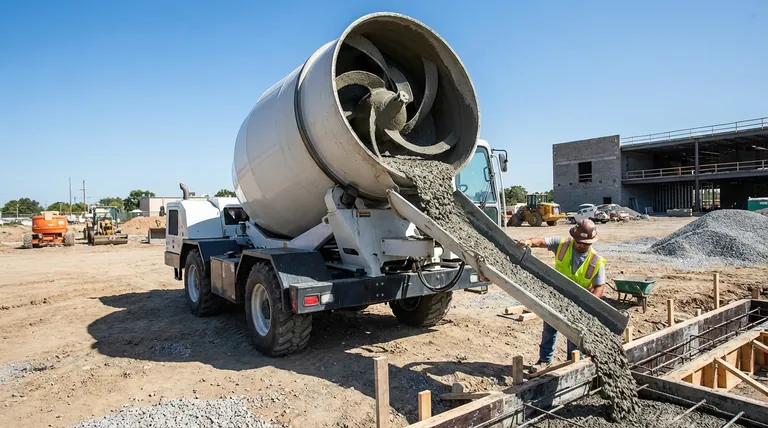
In a self-loading mixer, discharging is achieved through a controlled combination of drum rotation and tilting. The operator tilts the mixing drum, often up to 120 degrees, to position the outlet. They then reverse the direction of the drum's rotation, causing the internal spiral blades to act like a screw and actively push the mixed concrete out for precise placement.
Unlike traditional mixers that often rely on gravity alone, a self-loading mixer uses the powered reversal of its spiral blades to actively control the discharge. This gives the operator superior command over the flow rate and precise placement of the concrete.
The Core Mechanics of Discharging
A self-loading mixer's primary advantage lies in its multi-function drum. The same system that creates the concrete is also expertly designed to deliver it.
The Role of the Spiral Blades
Inside the drum are large, helical blades. During the mixing phase, the drum rotates in one direction, causing these blades to lift and tumble the aggregate, cement, and water, pulling the materials towards the center for a thorough mix.
Reversing the Rotation for Discharge
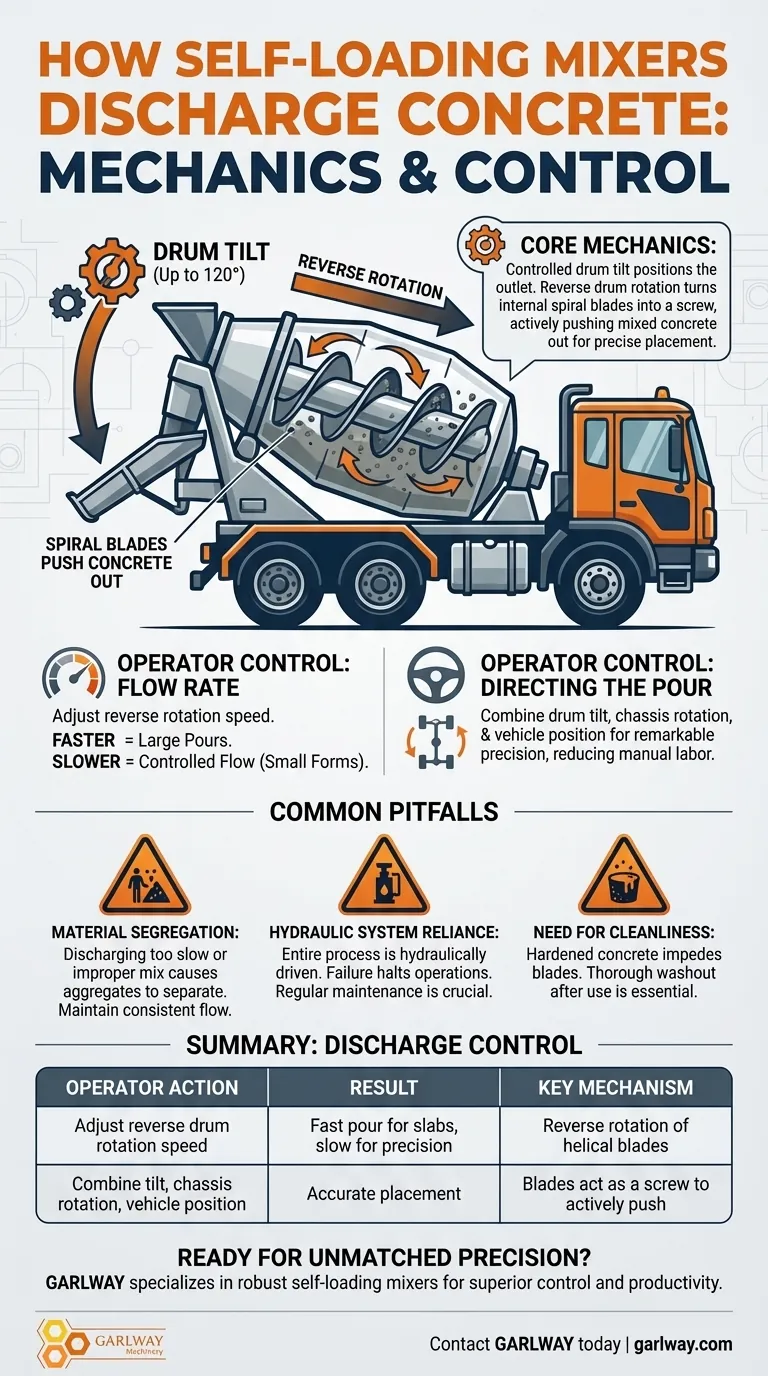
To discharge, the operator simply reverses the drum's rotation. This change in direction transforms the function of the blades. They now work like an Archimedes' screw, catching the mixed concrete and systematically pushing it forward and out of the drum's opening.
The Importance of Drum Tilt
Tilting the drum serves two purposes. First, it lowers the discharge outlet to the required height. Second, it uses gravity to ensure the concrete is always at the mouth of the drum, ready to be expelled by the rotating blades.
Operator Control and Precision
The discharge mechanism isn't just a simple on/off function; it's a system designed for accuracy and control, managed entirely by the operator from the cab.
Adjusting the Flow Rate
The operator can vary the speed of the drum's reverse rotation. A faster rotation expels concrete quickly for large pours, while a slower, intermittent rotation allows for a carefully controlled flow into smaller forms or wheelbarrows.
Directing the Pour
By combining the tilt angle of the drum, the rotation of the upper chassis, and the position of the vehicle itself, a skilled operator can place concrete with remarkable precision. This significantly reduces manual labor and material spillage on the job site.
Common Pitfalls to Avoid
While highly efficient, the discharge process relies on proper operation and machine maintenance to deliver optimal results.
Risk of Material Segregation
Discharging too slowly or with an improperly designed concrete mix can cause the heavier aggregates to separate from the cement paste. It is crucial to maintain a consistent, confident discharge rate once the pour begins.
Reliance on the Hydraulic System
The entire process of tilting and rotating the drum is driven by the vehicle's hydraulic system. Any failure or weakness in this system can halt operations completely. Regular maintenance is non-negotiable.
The Need for Cleanliness
Hardened concrete on the internal blades will severely impede their ability to discharge material smoothly and consistently. The drum and blades must be washed out thoroughly after each use to ensure proper functionality for the next job.
Making the Right Choice for Your Goal
To leverage the full capability of the self-loading mixer, align your discharge technique with the specific demands of the task at hand.
- If your primary focus is speed and volume: Use a steeper drum tilt and a steady reverse rotation to quickly unload material into large slabs or foundations.
- If your primary focus is precision: Utilize a shallower tilt angle and slower, more controlled drum rotation to carefully fill columns, narrow forms, or direct small amounts.
- If your primary focus is mix consistency: Ensure the concrete is fully mixed before discharge begins, and maintain a steady flow rate to prevent material segregation during the pour.
Mastering the interplay between drum rotation and tilt is the key to maximizing the efficiency and precision of a self-loading mixer.
Summary Table:
| Discharge Control | Operator Action | Result |
|---|---|---|
| Flow Rate | Adjust reverse drum rotation speed | Fast pour for large slabs or slow pour for precision work |
| Pour Direction | Combine drum tilt, chassis rotation, and vehicle position | Accurate placement into forms, columns, or wheelbarrows |
| Key Mechanism | Reverse rotation of helical blades | Blades act as a screw to actively push concrete out |
Ready to place concrete with unmatched precision and efficiency?
GARLWAY specializes in construction machinery, offering robust self-loading mixers for construction companies and contractors globally. Our machines are engineered for superior control, durability, and on-site productivity.
Contact GARLWAY today to find the perfect self-loading mixer for your projects and experience the difference professional equipment makes.
Visual Guide
Related Products
- Belle Mixer Drum Self Loading Mortar Mixers JS3000
- Skid Steer Self Loading Concrete Mixers for Construction
- Portable Cement Mixer with Lift Concrete Machine
- Portable Concrete Mixer Machine Equipment for Mixing Concrete
- Portable Ready Mix Concrete Mixer Equipment
People Also Ask
- What are the features of mobile transporting in a self loading mixer? Boost On-Site Efficiency
- Why is timely cleaning important for a self loading mixer? Prevent Costly Downtime and Mix Failure
- What is the purpose of keeping the drum rotating during transportation in a self loading concrete mixer? Ensure Quality & Consistency
- What components are involved in the loading process of a self loading concrete mixer? A Guide to the Key Systems
- How does the weighing process work in a self loading concrete mixer? Achieve Precise, On-Site Concrete Batching