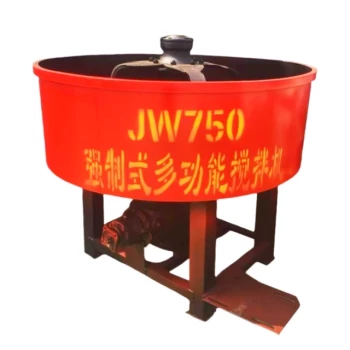
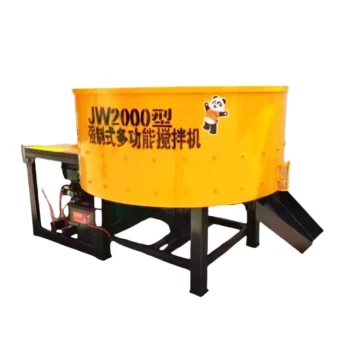
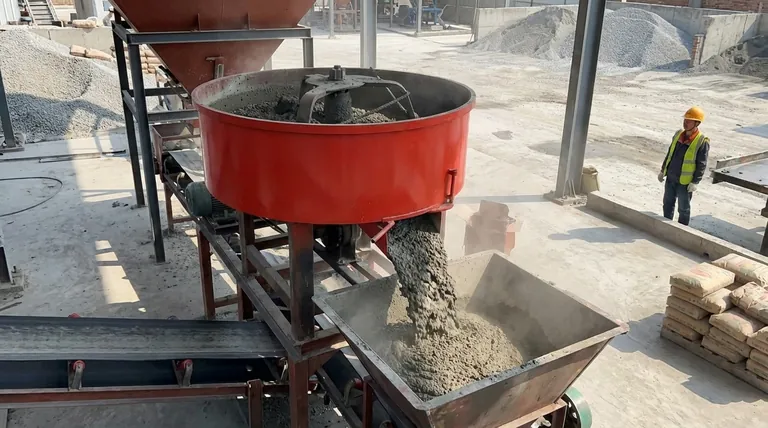
In a pan type mixer, concrete is discharged through a specially designed door or port located at the bottom of the stationary pan. The process is actively assisted by scraper blades that guide the material to the opening, ensuring a clean and complete evacuation of the mixed batch.
The bottom-discharge mechanism is more than just an exit; it's an engineered system designed for the controlled and complete removal of dense, stiff concrete, which is critical for minimizing waste and maintaining the quality of specialized mixes.
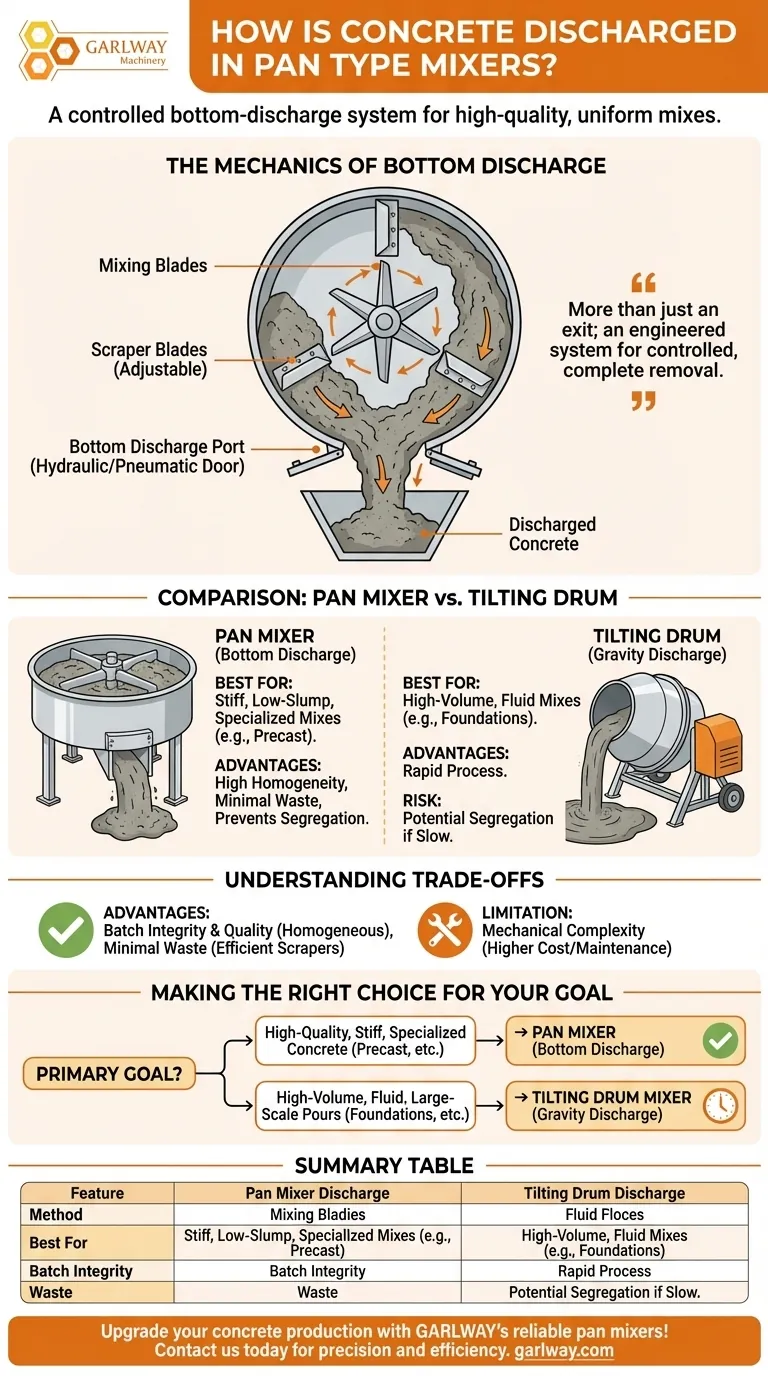
The Mechanics of Bottom Discharge
The discharge process in a pan mixer is a key part of its design, enabling it to handle materials that other mixers cannot. This method ensures the entire, uniformly mixed batch is discharged together.
The Central Discharge Port
At the bottom of the cylindrical pan, there is a hydraulically or pneumatically operated door. When the mixing cycle is complete, this door opens to allow the concrete to fall directly downward, typically into a hopper, bucket, or conveyor system.
The Critical Role of Scraper Blades
The same star-shaped blades that perform the mixing action also play a crucial role in discharge. As they rotate, they push the concrete toward the central opening.
Dedicated scraper blades are often included, and their height can be precisely adjusted. This adjustment ensures they make close contact with the pan floor, preventing material from sticking and guaranteeing that virtually no concrete remains after discharge.
Why This Method Excels for Stiff Mixes
Pan mixers are renowned for producing very homogeneous concrete, especially with stiff, low-slump mixtures. The forceful, mechanical action of the blades is necessary to move this dense material that would not flow easily by gravity alone, ensuring the entire batch is discharged uniformly.
How Pan Mixer Discharge Compares to Other Types
Understanding the alternatives clarifies why the pan mixer's design is so effective for its specific purpose. Each discharge method is suited to different types of concrete and project scales.
Contrast with Tilting Drum Mixers
A tilting drum mixer discharges its contents by tilting the entire drum downward. This is a very rapid, gravity-assisted process well-suited for more fluid concrete mixes and high-volume output on larger projects. It effectively prevents segregation by dumping the entire batch quickly.
Contrast with Rotary/Reversing Drum Mixers
These common mixers discharge by reversing the direction of the drum's rotation. The internal spiral blades, which pull material in during mixing, act as a screw to push the concrete out. This can be a slower process, which sometimes raises the risk of segregation, where heavier aggregates separate from the cement paste.
Understanding the Trade-offs
The bottom-discharge system offers significant advantages but also comes with specific considerations.
Advantage: Batch Integrity and Quality
By discharging the entire mixed batch at once from the bottom, the pan mixer ensures the final product is as homogeneous as it was in the mixer. This prevents the segregation that can occur during a slower pour.
Advantage: Minimal Waste
The efficiency of the scraper blades means very little material is left behind. This is critical for applications like precast concrete, where precise mix volumes and consistent quality from one batch to the next are essential.
Limitation: Mechanical Complexity
The system of a bottom door, seals, and actuators is more mechanically complex than a simple tilting mechanism. This can translate to higher initial costs and more demanding maintenance requirements over the life of the machine.
Making the Right Choice for Your Goal
Selecting the right mixer depends entirely on the type of concrete you are producing and your operational needs.
- If your primary focus is high-quality, stiff, or specialized concrete (like precast or fiber-reinforced): The pan mixer's controlled bottom discharge is superior for ensuring a homogeneous, completely evacuated batch every time.
- If your primary focus is high-volume output for large-scale pours (like foundations or paving): A tilting drum mixer's rapid gravity discharge is often the more time-efficient choice for fluid mixes.
- If your primary focus is portability and smaller, general-purpose batches: A reversing drum mixer offers operational simplicity, though care must be taken to manage the discharge rate.
Ultimately, the discharge method is a direct reflection of the mixer's intended purpose and is key to preserving the integrity of your specific concrete design.
Summary Table:
| Feature | Pan Mixer Discharge | Tilting Drum Discharge |
|---|---|---|
| Method | Bottom port with scraper blades | Tilting drum (gravity-assisted) |
| Best For | Stiff, low-slump, or specialized mixes (e.g., precast) | High-volume, fluid mixes (e.g., foundations) |
| Batch Integrity | High (prevents segregation) | Moderate (rapid discharge minimizes risk) |
| Waste | Minimal (efficient scraper system) | Low (gravity-driven) |
Upgrade your concrete production with GARLWAY's reliable pan mixers! Designed for construction companies and contractors who demand precision and minimal waste, our mixers ensure complete, homogeneous discharge for stiff or specialized mixes like precast concrete. Contact us today to discuss how our solutions can enhance your batch quality and efficiency!
Visual Guide
Related Products
- HZS25 Best Cement Mixer for Quick Mix Concrete at Bunnings
- Harbor Freight JS1500 On Site Concrete Mixing Volumetric Cement Mixer
- Portable Concrete Mixer Machine Equipment for Mixing Concrete
- Concrete Cement Mixer Machine Drum Mixer for Construction
- JDC350 Small Cement Concrete Mortar Mixer
People Also Ask
- How do cement mixers enhance safety on construction sites? Reduce Strain, Hazards, and Accidents
- What are the main components of a cement mixer? A Guide to Core Parts & Functions
- What are some tips for using a cement mixer effectively? Maximize Your Mixer's Performance & Concrete Quality
- How does cleaning a cement mixer after use benefit its performance? Maximize Lifespan and Mix Quality
- Why is it important to clean the cement mixer after use? Prevent Costly Damage and Ensure Quality Concrete