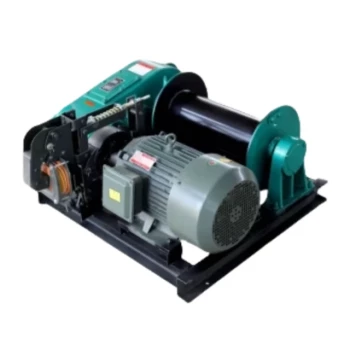
At its core, an electric boat trailer winch uses a 12-volt battery and motor to do the work, while a manual winch relies entirely on your physical effort to crank a handle. This fundamental difference in power source dictates everything from speed and pulling capacity to convenience and cost.
The decision between an electric and manual winch is not just about convenience. It is a critical choice that hinges on your boat's weight, how often you launch, and the level of physical effort you are willing to exert at the ramp.
The Fundamental Difference: Power Source & Operation
The way a winch gets its power is the primary distinction that creates two very different user experiences. One automates the process, while the other gives you direct, physical control.
The Electric Winch: Motor-Driven Power
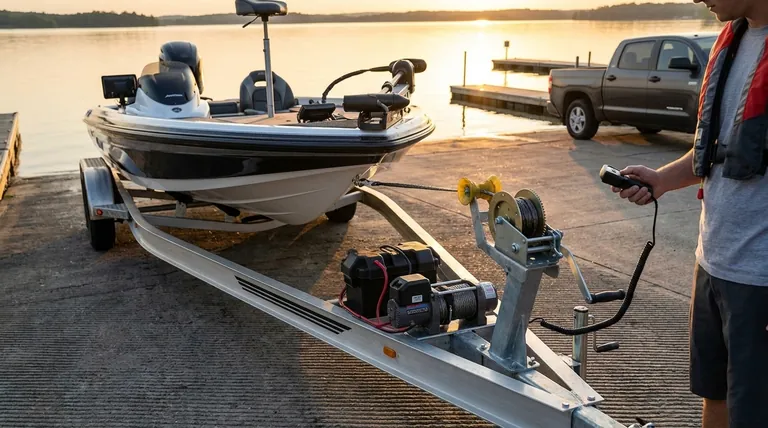
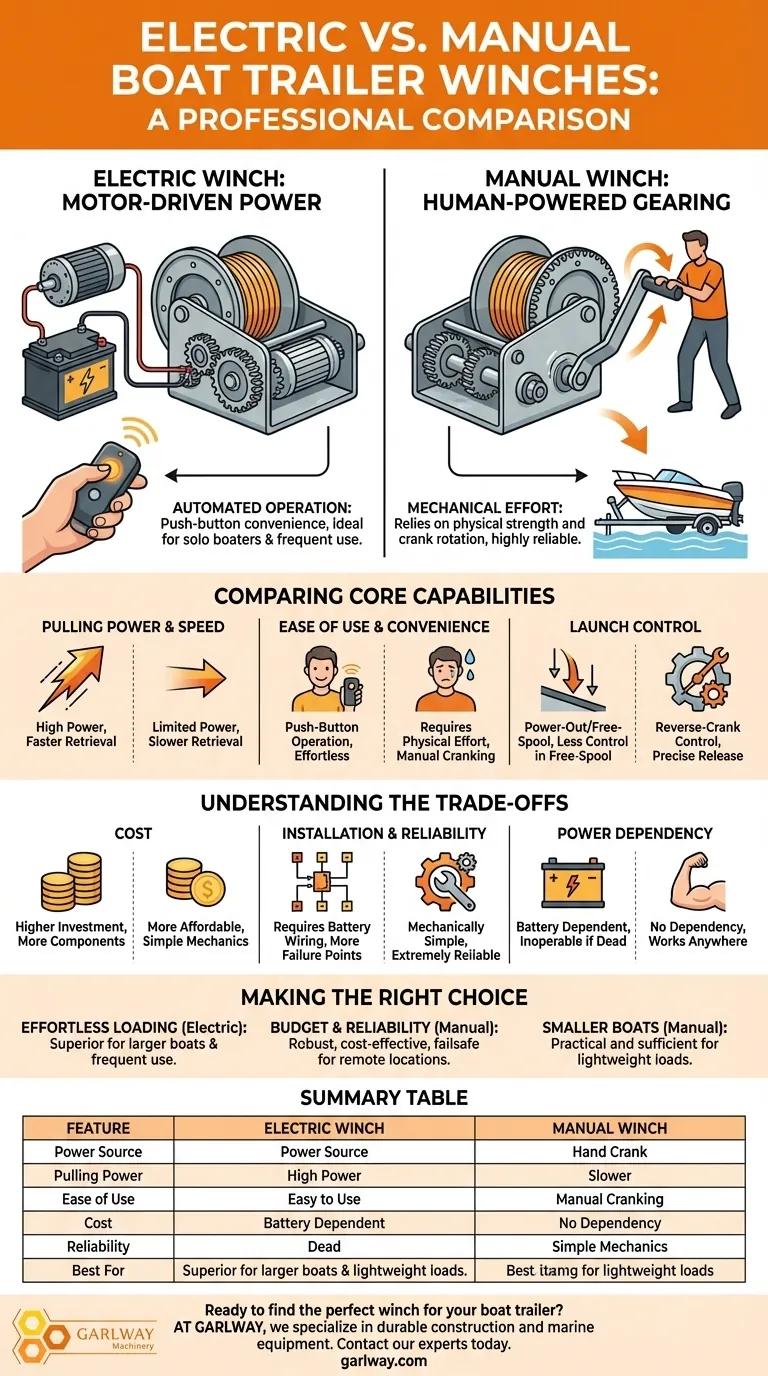
An electric winch connects directly to a 12-volt power source, typically your vehicle's battery. It uses an electric motor, a series of gears, and a control switch or remote to pull your boat onto the trailer.
This system automates the most strenuous part of boat retrieval.
The Manual Winch: Human-Powered Gearing
A manual winch is a purely mechanical device. It uses a hand crank and an efficient gear transmission to multiply your physical force, making it possible to pull a heavy boat.
Your strength, augmented by mechanical advantage, is the engine.
Comparing Core Capabilities
Beyond the power source, the practical differences in performance, control, and ease of use are what truly matter when you're at the boat ramp.
Pulling Power & Speed
Electric winches offer significantly more pulling power with less drama. They are engineered for heavier loads and can retrieve a boat much faster than a manual winch.
Manual winches are limited by the gearing and your own physical ability to turn the crank, making them slower and better suited for lighter boats.
Ease of Use & Convenience
This is the most obvious advantage of an electric model. With the push of a button on a wired or wireless remote, the winch does all the work.
This is a game-changer for solo boaters, individuals with physical limitations, or anyone who launches and retrieves their boat frequently.
Launch Control (Power-Out vs. Free-Spool)
Most electric winches power-in but use a free-spool or clutch mechanism to let the cable out. This allows the boat to roll off the trailer quickly, but it offers less control.
Some advanced electric models feature a power-out function, which uses the motor to release the boat in a slow, controlled manner. Manual winches inherently provide this level of control as you reverse-crank the handle.
Understanding the Trade-offs
Choosing the right winch means acknowledging the downsides and limitations of each system. There is no single perfect solution for every boater.
Cost
The most significant trade-off is cost. Electric winches are substantially more expensive than their manual counterparts due to the added complexity of the motor, electronics, and control systems.
Installation & Reliability
An electric winch requires wiring to a battery, which adds a step to installation. With more components—like a motor, solenoid, and switches—there are more potential points of failure.
A manual winch is mechanically simple, making it extremely reliable and easy to maintain. It will work as long as you can turn the handle.
Power Dependency
An electric winch is completely dependent on a charged battery. If your vehicle's battery is dead, your winch is inoperable.
A manual winch has no such dependency and offers a level of certainty that is valuable in remote locations.
Making the Right Choice for Your Boat
To select the correct winch, you must evaluate your specific needs, your boat's characteristics, and your budget.
- If your primary focus is effortless loading and speed: An electric winch is the superior choice, especially for larger boats or if you boat often.
- If your primary focus is budget, simplicity, and absolute reliability: A manual winch is a robust, cost-effective solution that will never fail due to a dead battery.
- If you have a smaller, lightweight boat: The immense power of an electric winch is often unnecessary, making a simple manual winch the most practical and logical choice.
Ultimately, an honest assessment of your boat, budget, and personal needs will guide you to the perfect winch for a stress-free day on the water.
Summary Table:
| Feature | Electric Winch | Manual Winch |
|---|---|---|
| Power Source | 12V Battery & Motor | Human Power (Hand Crank) |
| Pulling Power | High (Ideal for heavier boats) | Limited by user strength |
| Ease of Use | Push-button operation (Great for solo boaters) | Requires physical effort |
| Cost | Higher initial investment | More affordable |
| Reliability | Dependent on battery charge | Mechanically simple & highly reliable |
| Best For | Frequent use, larger/heavier boats, convenience | Lighter boats, budget-conscious buyers, simplicity |
Ready to find the perfect winch for your boat trailer?
At GARLWAY, we specialize in durable and reliable construction and marine equipment, including high-performance winches. Whether you need the effortless power of an electric model or the dependable simplicity of a manual winch, we have a solution built for contractors and boat owners who demand quality.
Contact our experts today to discuss your needs and get a personalized recommendation. Let us help you make every trip to the boat ramp a success.
Visual Guide
Related Products
- 12000 lb Electric Boat Trailer Winch with Windlass Anchor Warn
- Electric 120V Boat Winch by Badlands
- 12000 lb Heavy Duty Electric Boat Winch
- Heavy Duty Electric Boat Winch Windlass Anchor
- Electric Hoist Winch Boat Anchor Windlass for Marine Applications
People Also Ask
- What size winch do I need for my boat? Get the Right Capacity for Safe Hauling
- How should a boat trailer winch be properly used? A Step-by-Step Guide for Safe Loading
- What maintenance steps are specific to boat trailer winches? Ensure Safety & Reliability at the Ramp
- How strong of a winch do I need for my boat? Get the Right Pulling Power for Trailering & Anchoring
- Is installation of boat trailer winches difficult? A Guide to DIY vs. Pro Installation