
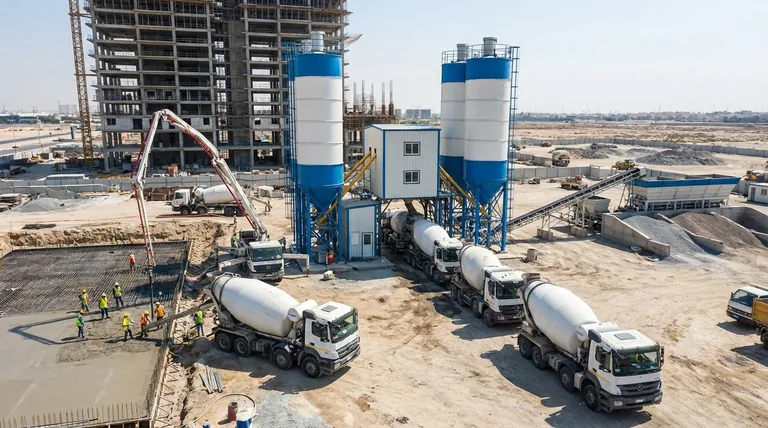
At its core, a concrete batching plant improves construction efficiency by automating the production of high-quality, ready-mix concrete. This centralization allows for the rapid, on-demand delivery of vast quantities of consistent material, which minimizes manual labor, reduces project timelines, and lowers overall costs.
The true advantage of a concrete batching plant is not just making concrete, but gaining precise control over its production. This control over quality, volume, and timing transforms concrete from a simple material into a streamlined component of the entire construction schedule.
From Manual Labor to Automated Precision
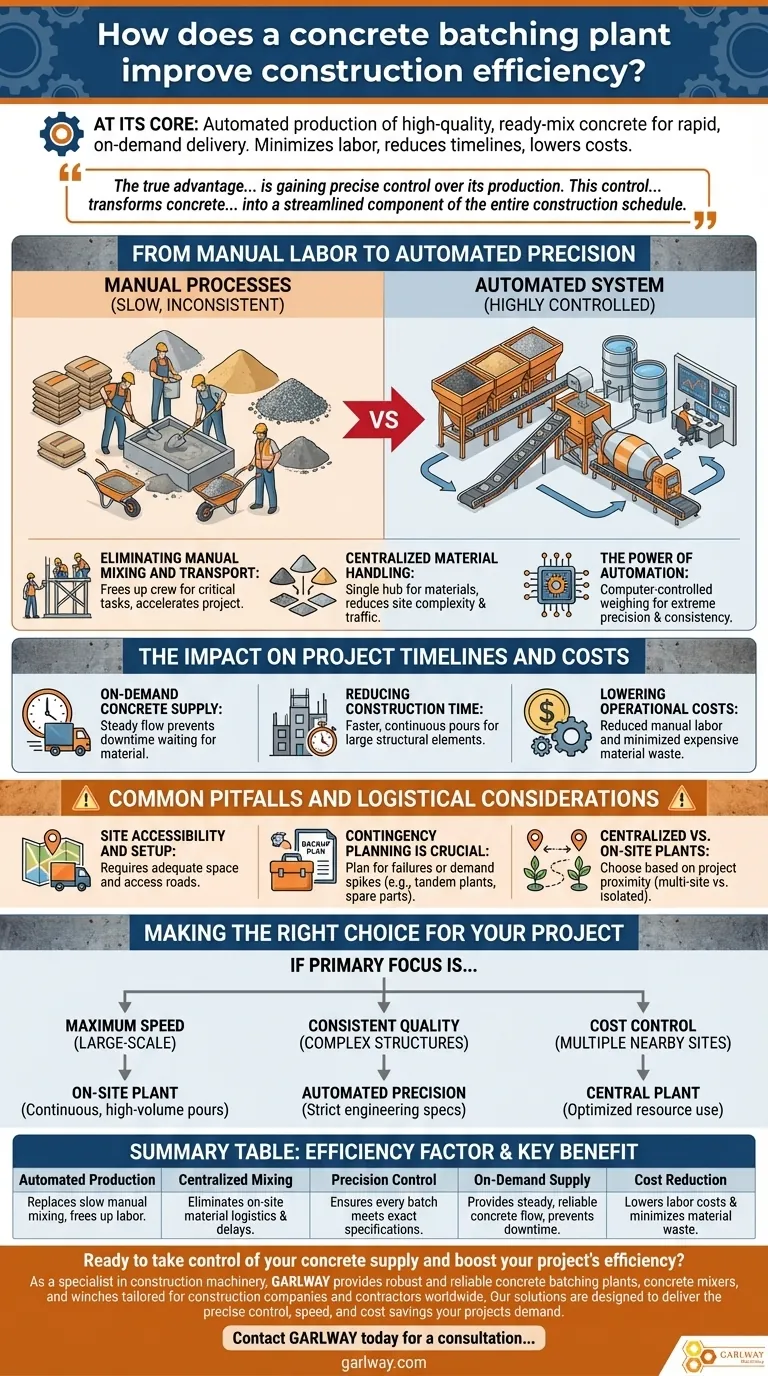
The most significant efficiency gain comes from replacing slow, inconsistent manual processes with a highly controlled, automated system. This shift fundamentally changes how a construction site operates.
Eliminating Manual Mixing and Transport
Traditionally, concrete was mixed on-site in small batches, a labor-intensive and time-consuming process. A batching plant automates this entirely.
This automation frees up the construction crew from mixing duties, allowing them to focus on placement, finishing, and other critical tasks, which directly accelerates the project.
Centralized Material Handling
A batching plant serves as a single, organized hub for all constituent materials: cement, water, sand, and various aggregates.
By centralizing storage and mixing, it eliminates the logistical complexity of moving separate materials around a large and busy construction site, reducing both traffic and potential delays.
The Power of Automation
Modern plants use computer-controlled systems to weigh and measure each ingredient with extreme precision.
This level of accuracy ensures that every batch of concrete meets the exact specifications required for the project, a level of consistency that is nearly impossible to achieve with manual methods.
The Impact on Project Timelines and Costs
Controlling the concrete supply directly translates to control over the project's schedule and budget. A batching plant provides a predictable and reliable source of this critical material.
On-Demand Concrete Supply
The plant produces a steady, uninterrupted supply of concrete exactly when and where it is needed.
This eliminates one of the most common sources of downtime on a construction site: crews waiting for the next truck of ready-mix to arrive or for a new batch to be manually prepared.
Reducing Construction Time
With the ability to produce large volumes of concrete quickly, major structural elements like foundations and columns can be poured in a single, continuous operation.
Completing these large-scale pours faster allows subsequent phases of construction to begin sooner, shortening the entire project timeline.
Lowering Operational Costs
Automation significantly reduces the need for manual labor associated with mixing and material handling.
Furthermore, the precise measurement of ingredients minimizes the waste of expensive materials like cement, leading to direct cost savings.
Common Pitfalls and Logistical Considerations
While highly efficient, the benefits of a batching plant depend on careful planning. A failure to consider the operational context can undermine its effectiveness.
Site Accessibility and Setup
A batching plant, even a smaller one, requires adequate space and stable ground. Planners must account for its footprint and ensure clear access roads for delivery trucks.
Poor site planning can create bottlenecks that negate the very efficiency the plant is meant to provide.
Contingency Planning is Crucial
Mechanical failures or sudden demand spikes can halt progress. It is critical to have a contingency plan.
For massive, single-pour projects, using two smaller plants in tandem can provide redundancy. For remote sites, having sufficient spare parts on hand is essential to prevent long delays.
Centralized vs. On-Site Plants
The decision to use a large, centralized plant serving multiple projects versus a smaller, dedicated on-site plant depends on logistics.
If multiple construction sites are within a short distance, a central plant can be more economical. For large, isolated projects, an on-site plant is often the only viable option.
Making the Right Choice for Your Project
The decision to leverage a concrete batching plant should be aligned with your primary project goals.
- If your primary focus is maximum speed on a large-scale project: An on-site batching plant is essential for providing the continuous, high-volume pours needed to meet aggressive timelines.
- If your primary focus is consistent quality for complex structures: The automated precision of a batching plant is non-negotiable to ensure every batch meets stringent engineering specifications.
- If your primary focus is cost control across multiple nearby sites: A strategically placed central batching plant optimizes resource use and reduces redundant setup costs, enhancing overall economic efficiency.
Ultimately, integrating a concrete batching plant into your project is about taking control of your most critical material supply chain.
Summary Table:
| Efficiency Factor | Key Benefit |
|---|---|
| Automated Production | Replaces slow manual mixing, freeing up labor for critical tasks. |
| Centralized Mixing | Eliminates on-site material logistics and reduces delays. |
| Precision Control | Ensures every batch meets exact project specifications. |
| On-Demand Supply | Provides a steady, reliable concrete flow to prevent downtime. |
| Cost Reduction | Lowers labor costs and minimizes material waste. |
Ready to take control of your concrete supply and boost your project's efficiency?
As a specialist in construction machinery, GARLWAY provides robust and reliable concrete batching plants, concrete mixers, and winches tailored for construction companies and contractors worldwide. Our solutions are designed to deliver the precise control, speed, and cost savings your projects demand.
Contact GARLWAY today for a consultation and let us help you build smarter, faster, and more efficiently.
Visual Guide
Related Products
- HZS120 Ready Mix Concrete Batching Plant Commercial Mud Cement Mixer
- HZS35 Small Cement Concrete Mixing Batch Plant
- HZS75 Concrete Batching Plant Cement Mixer Price Concrete Mixer Bunnings Mixing Plant
- HZS180 Ready Mix Concrete Plant for Foundations with Sand and Cement
- Commercial Electric Concrete Mixer Machine HZS 50 Small Batch Plant for Sale
People Also Ask
- What is a ready mix concrete batching plant? The Engine of Modern Construction
- What is the name of the machine used in ready mix? Unpacking the Complete Concrete System
- What is the core component of a concrete batching plant? The Mixer Unit Defines Your Concrete Quality
- What are the types of concrete mixers used in batching plants? Choose the Right Mixer for Your Project
- What are the advantages and disadvantages of concrete batching plants? Maximize Quality & Efficiency





