
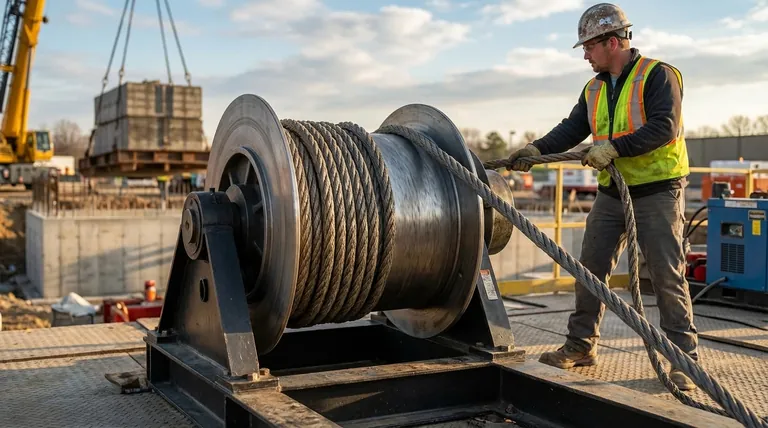
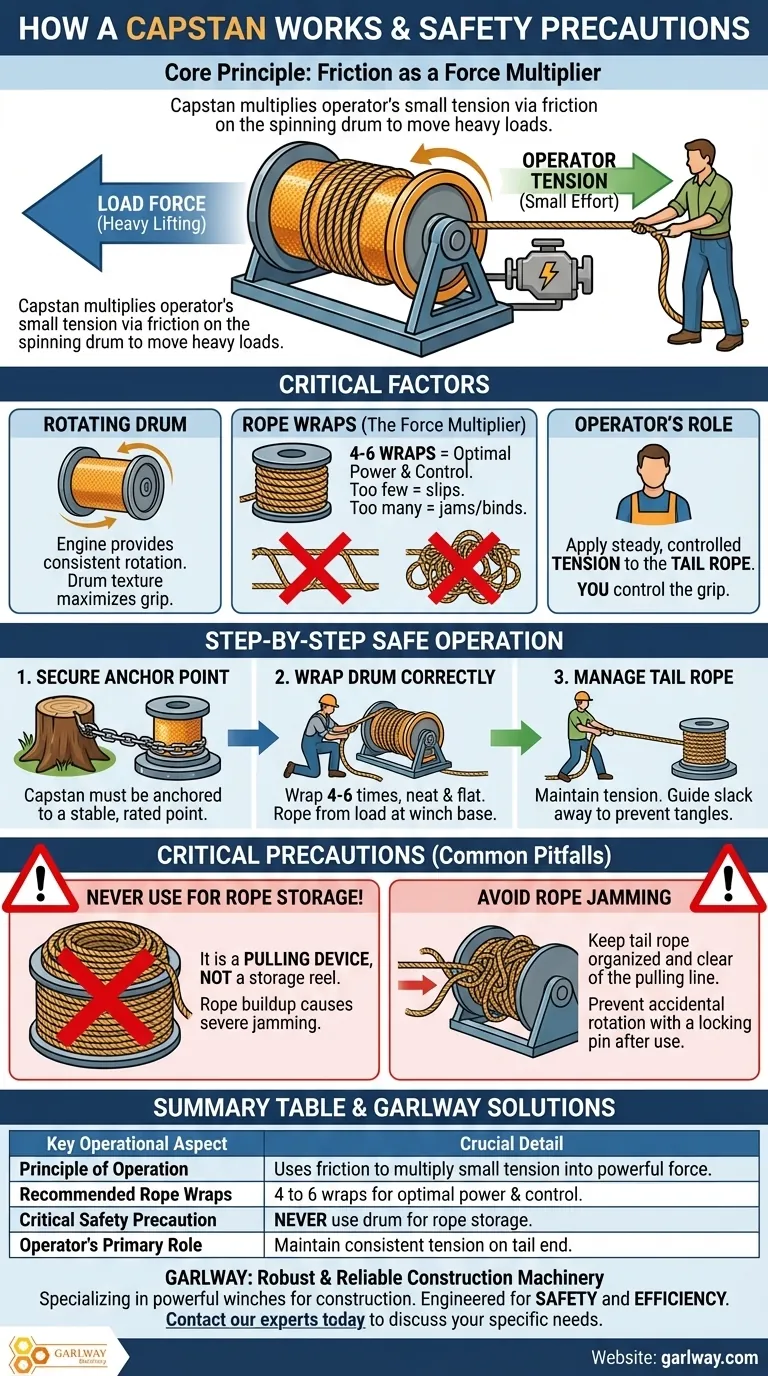
A capstan works by using friction to amplify force. It's not a storage reel, but a simple machine that converts a small amount of tension applied by an operator into a powerful pulling force. By wrapping a rope around a rotating drum (or "barrel"), the operator only needs to hold the tail end of the rope taut; the friction between the rope and the spinning drum multiplies this small effort, enabling the movement of extremely heavy loads.
The critical insight is that a capstan does not store the rope—it is a force multiplier that relies on controlled friction. Safe and effective operation hinges on the operator's ability to manage the tension on the tail end of the rope and the number of wraps around the drum.
The Core Principle: Friction as a Force Multiplier
A capstan is an elegant application of physics. Its power doesn't come from a complex gear system alone but from the exponential increase in friction generated by wrapping a line around a cylinder.
The Role of the Rotating Drum
The engine or motor's primary job is to turn the capstan drum at a consistent speed. This rotation provides the energy for the system. The drum itself is often designed with a specific texture or shape to maximize grip on the rope.
The Importance of Rope Wraps
The number of times you wrap the rope around the drum is the most critical factor in determining pulling power. The references correctly state that 4 to 6 wraps is the standard recommendation.
With each wrap, the holding force is multiplied. Too few wraps, and the rope will slip under load. Too many wraps, and the rope can bind, jam, and become dangerously unpredictable.
Your Role: Applying Tail Tension
The person operating the capstan is not pulling the load directly. Their job is to apply a relatively small amount of tension to the "tail" or slack end of the rope. This tension creates the initial friction needed for the capstan to grip the rope and do the heavy lifting.
A Step-by-Step Guide to Safe Operation
Following a precise operational sequence is essential for both safety and effectiveness.
Step 1: Secure the Anchor Point
Before any operation, the capstan winch itself must be secured to a completely stable anchor point, such as a well-rooted tree or a properly rated vehicle frame. The anchor must be able to withstand the full force of the load you intend to pull.
Step 2: Wrap the Drum Correctly
Wrap the rope around the drum, typically 4 to 6 times, ensuring the wraps lay flat and do not cross over each other. The rope coming from the load should be closest to the base of the winch, with subsequent wraps moving away from it.
Step 3: Manage the Tail Rope
Start the engine to begin rotating the drum. Pull gently on the tail end of the rope to create tension. You will immediately feel the capstan engage and begin pulling the load. Your job is to maintain this tension and guide the slack rope away from the winch to prevent it from tangling.
Critical Precautions and Common Pitfalls
Understanding what can go wrong is as important as knowing the correct procedure. The capstan's simplicity can create a false sense of security.
Never Use the Drum for Rope Storage
A common and dangerous mistake is allowing the pulled rope to accumulate on the drum. A capstan is a pulling device, not a storage reel like a traditional winch. A buildup of rope can cause severe jamming and sudden failure.
Avoid Rope Jamming at All Costs
Keep the tail rope organized and away from the pulling line. If the tail rope gets tangled and pulled into the drum, the operator can be pulled in with it. The wraps on the drum must always remain neat and parallel.
Prevent Accidental Rotation
Once the operation is complete and the engine is off, the drum can sometimes still rotate if the load shifts. As a precaution, a metal rod or locking pin should be used to secure the mechanism and prevent any unexpected movement that could cause injury.
Making the Right Choice for Your Goal
Your approach to using a capstan should be dictated by your primary objective, whether it's raw power, precise control, or team safety.
- If your primary focus is safety: Always maintain control of the tail rope, stand clear of the direct line of pull, and ensure your anchor point is unquestionably stable.
- If your primary focus is efficiency: Use the correct number of wraps (4-6) to maximize pulling power without creating excessive friction that could risk a jam.
- If you are working in a team: Establish clear hand signals and verbal commands before the pull begins to ensure every action is synchronized and understood.
Properly used, a capstan is an invaluable tool; your understanding of its principles is your greatest safety asset.
Summary Table:
| Key Operational Aspect | Crucial Detail |
|---|---|
| Principle of Operation | Uses friction from rope wraps on a rotating drum to multiply a small tail-end tension into a powerful pulling force. |
| Recommended Rope Wraps | 4 to 6 wraps for optimal power and control. |
| Critical Safety Precaution | NEVER use the drum for rope storage; it is a pulling device, not a storage reel. |
| Operator's Primary Role | Maintain consistent tension on the tail end of the rope to control the pull. |
Ready to harness the power of a capstan for your heavy-duty projects?
GARLWAY specializes in providing robust and reliable construction machinery, including powerful winches for construction companies and contractors worldwide. Our equipment is engineered for safety and efficiency, helping you move heavy loads with confidence.
Contact our experts today to discuss your specific needs and discover how GARLWAY's solutions can enhance your operational safety and productivity.
Visual Guide
Related Products
- Portable Electric Small Cement Mixer Concrete Machine
- JDC350 Small Cement Concrete Mortar Mixer
- Belle Mixer Drum Self Loading Mortar Mixers JS3000
- Portable Electric Concrete Mixer Machine for Cement Mixing
People Also Ask
- What is a portable cement mixer? Achieve Consistent, On-Demand Concrete Mixing
- What are the power sources for portable cement mixers? Choose the Right Power for Your Job Site
- What are the size and portability options for portable cement mixers? Find Your Perfect Match for Any Job
- What was the first recorded version of the portable concrete mixer and who invented it? Discover the 1904 Horse-Drawn Innovation
- How does a portable concrete mixer benefit construction projects? Boost Efficiency & Cut Costs On-Site


