
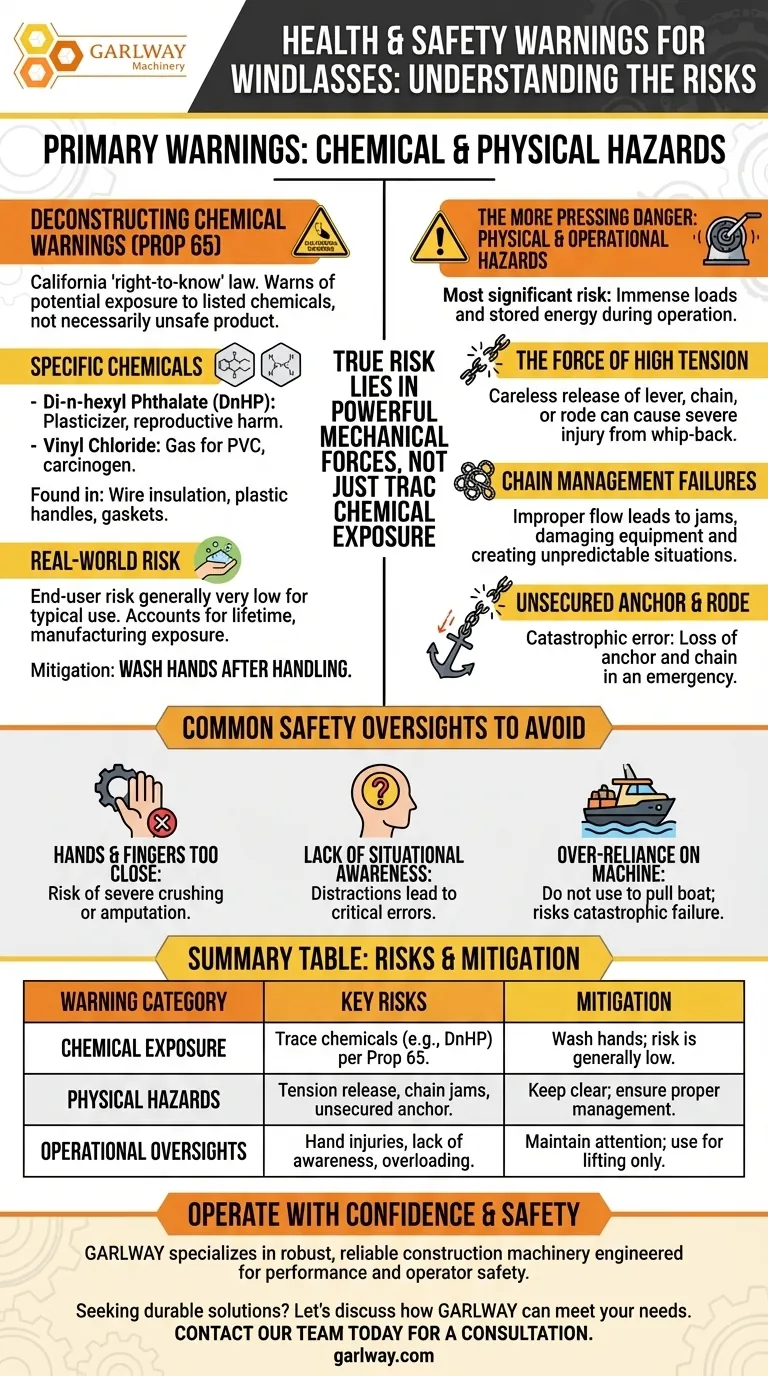
The primary health warnings for windlasses fall into two distinct categories: chemical exposure notices required by law in certain regions, and immediate physical safety hazards related to operation. These include warnings for potential exposure to chemicals like Di-n-hexyl Phthalate and Vinyl Chloride, and critical operational risks such as the careless release of items under tension.
Understanding windlass safety requires looking beyond legal chemical warnings to focus on the more immediate and severe physical dangers of operation. The true risk lies not in trace chemical exposure, but in the powerful mechanical forces the machine generates.
Deconstructing the Chemical Warnings (Proposition 65)
Many users notice a warning label on their windlass and are understandably concerned. This warning typically originates from California's Proposition 65 law and requires context.
What is Proposition 65?
Proposition 65 is a California "right-to-know" law. It requires businesses to provide warnings about significant exposures to chemicals that cause cancer, birth defects, or other reproductive harm.
The presence of this warning does not mean the product is unsafe. It simply means the product contains one or more of the 900+ chemicals on the state's list, and the manufacturer is informing California residents of potential exposure.
The Specific Chemicals Mentioned
The warnings often cite two specific chemicals:
- Di-n-hexyl Phthalate (DnHP): A plasticizer used to make plastics like PVC soft and flexible. It is listed as a cause of reproductive harm.
- Vinyl Chloride: A gas used to make PVC plastic. It is listed as a known carcinogen.
These materials might be present in components like electrical wire insulation, plastic handles, or certain gaskets.
What is the Real-World Risk?
For an end-user, the risk of significant exposure from simply operating a windlass is generally considered very low. The warning is broad and accounts for potential exposure over a lifetime, often from scenarios like manufacturing or disposal, not typical daily use.
The More Pressing Danger: Physical and Operational Hazards
While chemical warnings demand attention, the most significant risk to your health and safety comes from the physical operation of the windlass itself. These machines handle immense loads and stored energy.
The Force of High Tension
A windlass lever, chain, and rode are under tremendous strain when weighing anchor. A careless or accidental release of this tension can cause the equipment to whip back with incredible force, leading to severe injury.
Chain Management Failures
Proper chain flow is critical. If the chain piles up in the anchor locker instead of falling cleanly, it can jam the windlass. This can cause the chain to jump off the gypsy or damage the motor, creating an unpredictable and dangerous situation.
Unsecured Anchor and Rode
Failing to secure the bitter end of the anchor chain to the boat is a catastrophic error. It can result in the complete loss of your anchor and the entire length of chain, leaving you without your most critical piece of safety equipment in an emergency.
Common Safety Oversights to Avoid
Beyond the primary warnings, several common mistakes lead to injury or equipment failure. Awareness is the first step in prevention.
Hands and Fingers Too Close
The single most common cause of injury is placing hands or fingers near the chain or gypsy while the windlass is operating. The powerful mechanism can cause severe crushing or amputation injuries in an instant.
Lack of Situational Awareness
Operating a windlass requires your full attention. Distractions can lead you to miss a chain jam, ignore a signal from the helm, or make a critical operational error.
Over-reliance on the Machine
A windlass is designed for lifting the anchor, not for pulling the boat forward against wind or current. Using the windlass to kedge the boat puts an enormous strain on the motor and mounting bolts, risking catastrophic failure.
How to Apply This to Your Operations
Your approach to safety should be tailored to mitigating the most probable and severe risks.
- If your primary focus is minimizing chemical exposure: While the risk is low, wash your hands after handling the equipment, especially before eating.
- If your primary focus is preventing physical injury: Always keep hands and feet clear of the chain and gypsy during operation, ensure clear communication with the helm, and practice proper chain management.
Ultimately, your safety depends on disciplined and attentive operation, treating the immense forces involved with the respect they demand.
Summary Table:
| Warning Category | Key Risks | Mitigation |
|---|---|---|
| Chemical Exposure | Trace chemicals (e.g., Di-n-hexyl Phthalate) per Prop 65. | Wash hands after handling; risk is generally low. |
| Physical Hazards | Tension release, chain jams, unsecured anchor. | Keep clear of moving parts; ensure proper chain management. |
| Operational Oversights | Hand injuries, lack of awareness, overloading. | Maintain full attention; use windlass for lifting only. |
Operate with Confidence and Safety
While understanding warnings is crucial, using the right, reliable equipment is the foundation of safety. GARLWAY specializes in robust construction machinery, including winches designed for heavy-duty applications. Our equipment is engineered for performance and operator safety.
If you are a construction company or contractor seeking durable and safe mechanical solutions, let's discuss how GARLWAY's products can meet your needs. Contact our team today for a consultation.
Visual Guide
Related Products
- Quick Windlass Portable Winch for Truck and Boat Best Boat Winch
- Warn Winch Windlass Boat Trailer Winch
- Electric Hoist Winch Boat Anchor Windlass for Marine Applications
- Heavy Duty Electric Boat Winch Windlass Anchor
- 12000 lb Electric Boat Trailer Winch with Windlass Anchor Warn
People Also Ask
- What features were incorporated into the upgraded portable winch system? Boost Your Recovery Power & Safety
- What are some uses mentioned for portable winches beyond vehicle recovery? Essential Versatility for Property & Work
- How could the twisting issue with a portable winch be mitigated? Achieve Safe, Centered Pulls with Proper Rigging
- What are the primary uses of a portable winch for a truck? Boost Your Truck's Capability and Self-Reliance
- What is the single rope traction force of the quick winch without a pulley block? 0.5 to 40 Tons Explained


