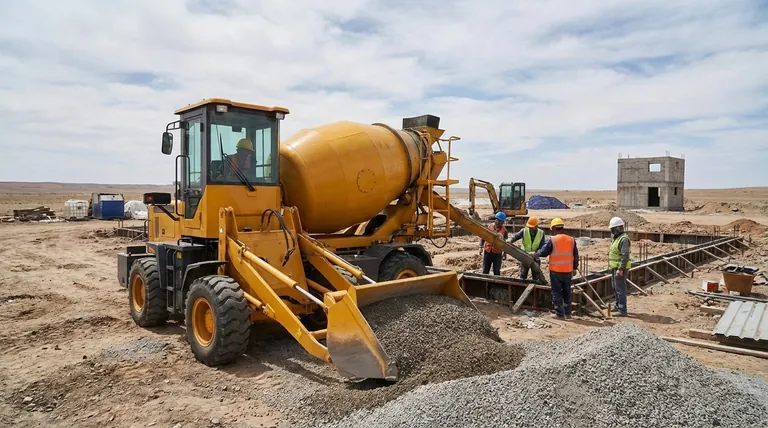
The fundamental efficiency of a self-loading mobile concrete mixer stems from its ability to function as a complete, independent batching plant on wheels. Unlike a regular mixer, which only transports ready-mixed concrete from a central plant, a self-loading mixer loads its own raw materials, mixes them to precise specifications on-site, and then delivers the fresh concrete exactly where it's needed. This integration eliminates the entire logistical chain of depending on a separate plant.
The core shift is from a system of centralized production and delivery to one of decentralized, on-demand manufacturing. This gives project managers direct control over the timing, quality, and placement of concrete, fundamentally changing project workflow.
From Transportation to On-Site Production
To grasp the efficiency gains, it's essential to understand the distinct operational models of each machine. They solve two very different problems.
The Regular Mixer: A Delivery Vehicle
A traditional concrete truck, or transit mixer, is essentially a delivery vehicle. Its sole purpose is to transport pre-mixed, perishable concrete from a stationary batching plant to the job site.
This model makes the project entirely dependent on the plant's schedule, traffic conditions, and batch availability.
The Self-Loader: A Mobile Factory
A self-loading mixer is a self-contained production unit. It uses its own front-mounted bucket to load raw materials like sand, aggregate, and cement into its mixing drum.
An integrated water system and onboard weighing technology allow a single operator to produce concrete to exact specifications anytime, anywhere.
Key Drivers of Operational Efficiency
The self-loader's all-in-one design creates several compounding advantages that directly impact project timelines and budgets.
Eliminating Dependence on a Central Plant
By producing concrete on-site, you remove the biggest bottleneck in traditional concreting: the batching plant. This means no more travel time, no waiting for trucks to arrive, and no risk of a batch being rejected for setting too long in transit.
Reducing Labor and Machinery Requirements
A single skilled operator can manage the entire process: loading aggregates, mixing the concrete, and driving the machine to the pour site. This consolidates the roles of a front-end loader operator, a batch plant operator, and a truck driver into one.
Achieving Precision and Minimizing Waste
Modern self-loaders feature onboard computer systems and weigh-batching capabilities. This ensures every batch is consistent and meets project specifications.
Furthermore, you mix only what you need, when you need it. This virtually eliminates the costly problem of over-ordering and disposing of unused ready-mix concrete.
Unlocking Unprecedented Site Accessibility
These machines are often built with all-terrain capabilities and superior maneuverability compared to large, road-based transit mixers.
They can navigate rough, remote, or confined job sites that would be completely inaccessible to a regular concrete truck, providing immense flexibility for infrastructure, rural, or challenging urban projects.
Understanding the Trade-offs
While highly efficient for many scenarios, the self-loading model is not a universal replacement for traditional methods. Objectivity requires acknowledging its limitations.
Lower Batch Volume
A self-loading mixer has a finite drum capacity, typically smaller than the largest transit mixers. For massive, continuous pours like a skyscraper foundation, the high-volume output of a dedicated batching plant and a fleet of regular trucks is still superior.
On-site Material Logistics
The convenience of on-site production introduces a new responsibility: managing raw material stockpiles. You must have adequate space and a plan for storing sand, aggregate, cement, and water on your job site.
Higher Initial Capital Investment
A self-loading mixer is a more complex piece of machinery than a simple transit mixer. The upfront purchase price is higher due to its integrated loading, weighing, and mixing systems.
Making the Right Choice for Your Project
The decision between a self-loader and a traditional mixer depends entirely on the specific demands of your projects.
- If your primary focus is remote or varied job sites: A self-loading mixer provides unmatched logistical freedom and operational independence.
- If your primary focus is cost control on small-to-medium projects: The reduction in waste, labor, and transport time can deliver significant savings.
- If your primary focus is large-scale, high-volume, continuous pours: A reliable supply from a dedicated ready-mix plant remains the most efficient solution.
Ultimately, choosing the right mixer requires you to decide whether your goal is simply to transport concrete or to take full control of its entire production lifecycle.
Summary Table:
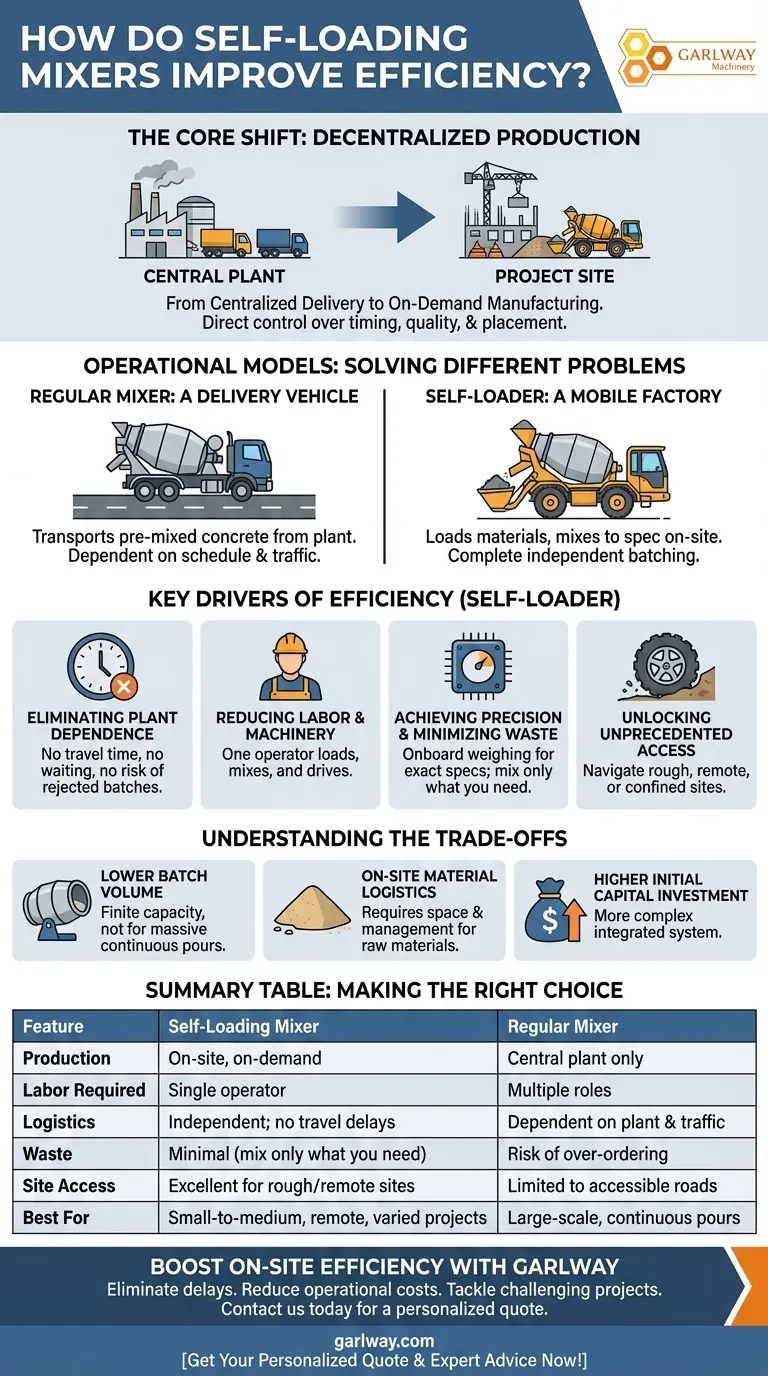
| Feature | Self-Loading Mixer | Regular Mixer |
|---|---|---|
| Production | On-site, on-demand | Central plant only |
| Labor Required | Single operator | Multiple roles (loader, driver, plant operator) |
| Logistics | Independent; no travel time or scheduling delays | Dependent on plant schedule and traffic |
| Waste | Minimal (mix only what you need) | Risk of over-ordering and disposal |
| Site Access | Excellent for rough, remote, or confined sites | Limited to accessible roads |
| Best For | Small-to-medium, remote, or varied projects | Large-scale, continuous pours |
Ready to take control of your concrete production and boost on-site efficiency?
GARLWAY specializes in construction machinery, offering robust and reliable self-loading concrete mixers designed for construction companies and contractors globally. Our mixers empower you to:
- Eliminate delays by producing concrete on-demand, right where you need it.
- Reduce operational costs by consolidating labor and minimizing material waste.
- Tackle challenging projects with enhanced maneuverability and all-terrain capabilities.
Contact us today to find the perfect self-loading solution for your specific project needs and discover how we can enhance your productivity and profitability.
Get Your Personalized Quote & Expert Advice Now!
Visual Guide
Related Products
- Skid Steer Self Loading Concrete Mixers for Construction
- Belle Mixer Drum Self Loading Mortar Mixers JS3000
- Portable Cement Mixer with Lift Concrete Machine
- Portable Concrete Mixer Machine Equipment for Mixing Concrete
- Portable Ready Mix Concrete Mixer Equipment
People Also Ask
- How does the control system improve production efficiency in a self loading concrete mixer? Automate Mixing for Speed & Quality
- What is the purpose of keeping the drum rotating during transportation in a self loading concrete mixer? Ensure Quality & Consistency
- How does the weighing process work in a self loading concrete mixer? Achieve Precise, On-Site Concrete Batching
- What components are involved in the loading process of a self loading concrete mixer? A Guide to the Key Systems
- How should materials be loaded into a self-loading concrete mixer? Master the Step-by-Step Process