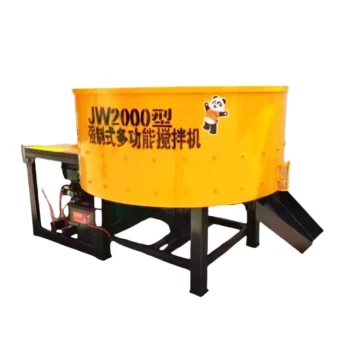
Small cement mixers are designed for versatility and can be positioned in three primary ways: as stationary units for a fixed location, as portable wheeled units for on-site movement, or mounted directly onto vehicles like trucks and trailers for transport between job sites.
The core decision isn't just about moving the mixer, but matching its mobility type to your project's scale and site logistics. The right choice ensures your workflow is efficient, whether you're working in one spot or across multiple locations.
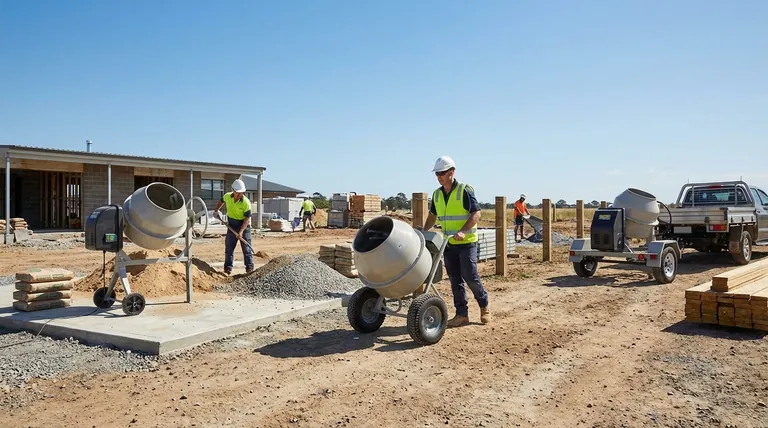
The Three Core Mobility Configurations
Understanding the fundamental designs for small cement mixers is the first step in planning your project's logistics. Each configuration serves a distinct purpose.
Stationary Mixers
A stationary mixer is designed to be set up in a single, central location for the duration of a job.
These are ideal for projects where all the concrete work is concentrated in one area, such as pouring a single large slab or foundation. You bring the raw materials to the mixer, not the other way around.
Portable (Wheeled) Mixers
This is the most common type for small- to medium-sized projects. These mixers are equipped with wheels, allowing them to be easily moved around a job site by one or two people.
Their purpose is on-site mobility. This allows you to mix concrete directly where you need to pour it, such as filling post holes for a fence along a property line.
Vehicle-Mounted Mixers
For maximum mobility between different locations, mixers can be mounted on a truck bed or integrated into a trailer chassis.
These often feature a tow bar, making them suitable for professionals or those who need to transport the equipment on public roads. This configuration is built for moving between entirely separate job sites, not just around a single property.
Understanding the Trade-offs
Choosing a mixer type involves balancing convenience, stability, and scale. No single option is perfect for every scenario.
Stability vs. Flexibility
Stationary mixers, once placed and leveled, offer the greatest stability during operation. However, they provide zero repositioning flexibility.
Wheeled mixers offer excellent flexibility but must be positioned on level, stable ground each time they are moved to ensure safe operation.
On-Site vs. Inter-Site Mobility
The critical distinction is what "mobile" means for your project. Wheels are for on-site movement, like wheeling the mixer from the driveway to the backyard.
A tow bar or truck mount is for inter-site mobility—transporting the mixer from one property to another. Using a simple wheeled mixer for road transport is unsafe and often illegal.
Footprint and Access
A simple portable mixer has a small footprint, making it ideal for tight spaces like a residential backyard.
Vehicle-mounted mixers require more space to operate and need clear vehicle access to the worksite, which may not always be possible.
Making the Right Choice for Your Goal
Select your mixer based on the logistical demands of your specific project.
- If your primary focus is a single, contained project (like a patio): A stationary or basic wheeled mixer set up in one spot will be most efficient.
- If your primary focus is a project spread across a large property (like setting fence posts): A portable mixer with durable wheels is essential for on-site repositioning.
- If your primary focus is professional work across multiple job sites: A towable, trailer-mounted, or truck-mounted mixer is the only practical choice for transport.
By matching the mixer's mobility to your workflow, you ensure maximum efficiency and safety on the job.
Summary Table:
| Mobility Type | Best For | Key Feature |
|---|---|---|
| Stationary Mixers | Single, contained projects (e.g., a patio) | Fixed setup for maximum stability |
| Portable (Wheeled) Mixers | Projects spread across a large site (e.g., fence posts) | On-site mobility with wheels |
| Vehicle-Mounted Mixers | Professional work across multiple job sites | Tow bar or truck mount for transport |
Ready to optimize your concrete workflow? GARLWAY specializes in durable construction machinery, including a range of small cement mixers designed for contractors and construction companies. Whether you need a stationary, portable, or vehicle-mounted solution, we have the right equipment to enhance your job site efficiency and safety. Contact GARLWAY today to discuss your project needs and find the perfect mixer!
Visual Guide

Related Products
- JDC350 Small Cement Concrete Mortar Mixer
- JZC400 Mobile Small Concrete Mixer Cement Mixer Machine
- Portable Electric Small Cement Mixer Concrete Machine
- HZS35 Small Cement Concrete Mixing Batch Plant
- Mini Cement Mortar Mixer Truck for Construction
People Also Ask
- What are the primary uses of a small cement mixer? Boost Efficiency for Small to Medium Construction Jobs
- What are the physical benefits of using a small cement mixer? Reduce Strain and Prevent Injury
- What are the cost benefits of using a small cement mixer? Save on Labor, Materials & Time
- What makes small cement mixers easy and convenient to use? Boost Productivity on Any Job Site
- What factors should be considered before purchasing a small cement mixer? Find the Perfect Match for Your Project