
Beyond its primary role with concrete, a cement mixer's powerful tumbling action makes it a surprisingly versatile tool for a range of unconventional tasks. Its ability to uniformly combine large volumes of material can be adapted for everything from artistic projects and landscaping to even large-scale food preparation at festivals.
The true value of a cement mixer lies in its function as a bulk material tumbler. While this principle can be applied to many materials beyond concrete, you must always consider the machine's design for heavy aggregates and the critical risk of cross-contamination between different uses.

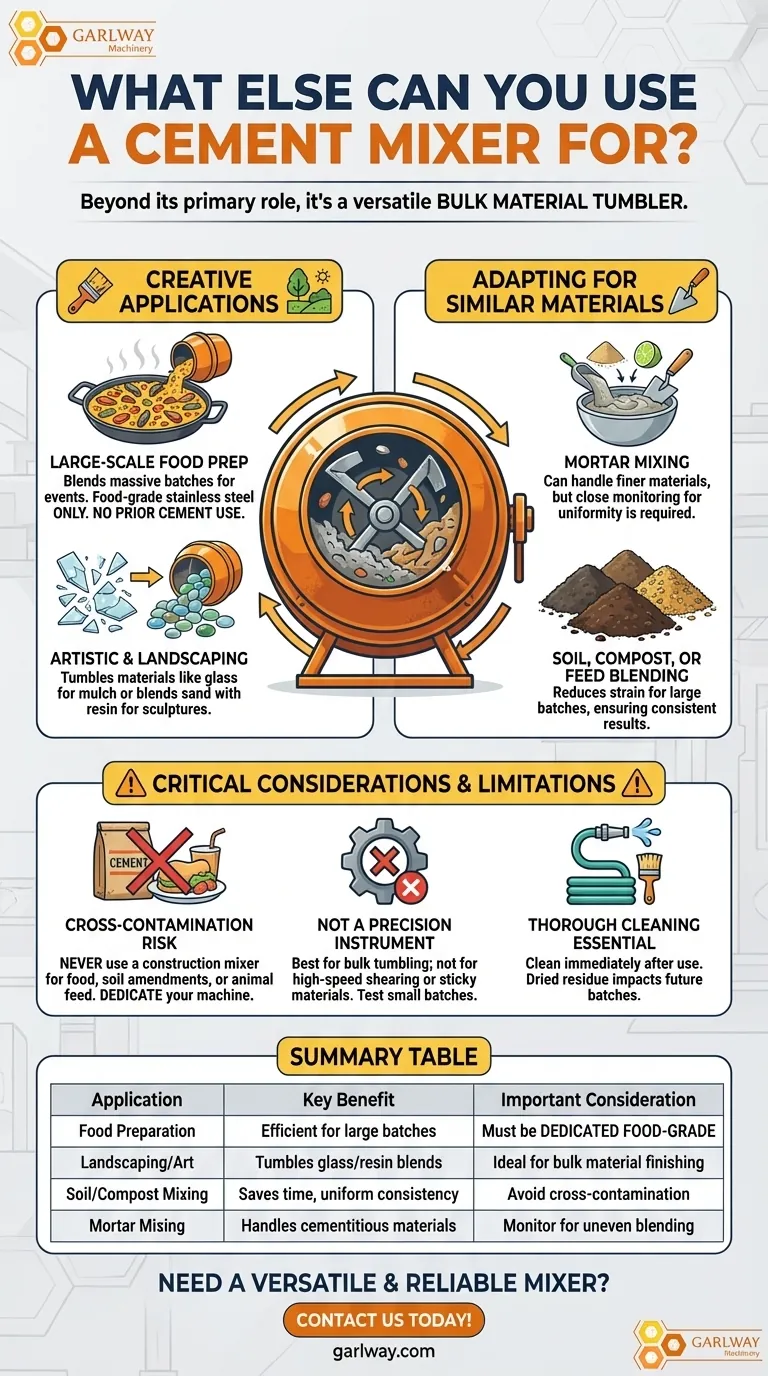
Beyond Construction: Creative Applications
A cement mixer's simple, robust design opens the door to several creative and practical uses that have nothing to do with laying a foundation.
Large-Scale Food Preparation
At food festivals or large events, a clean, dedicated cement mixer can be transformed into a unique outdoor kitchen appliance.
Its rotating drum is surprisingly effective for blending massive batches of paella or stir-fry, ensuring all ingredients are evenly mixed and cooked. Some have even adapted them for making huge quantities of ice cream.
Crucially, any mixer used for food must be food-grade (such as stainless steel) and must never have been used for cement or other toxic materials.
Artistic and Landscaping Projects
The mixer's tumbling ability is perfect for finishing or combining materials for artistic and garden applications.
You can tumble sharp, broken glass with sand and water to create smooth, rounded edges for use as a decorative garden mulch.
It's also highly effective for thoroughly blending sand with epoxy resin, which is a necessary step for creating durable sand sculptures.
Adapting the Mixer for Similar Materials
While not its intended purpose, a mixer can often handle other construction or agricultural materials, provided you understand its limitations.
Mixing Mortar and Other Cementitious Products
Many people use a cement mixer for mortar. However, its design is optimized for tumbling coarse aggregates like gravel.
Finer materials, like the lime and sand in mortar, can sometimes mix unevenly. Close monitoring is required to ensure a uniform consistency.
Blending Soil, Compost, or Feed
The mixer is an excellent tool for reducing the physical strain of blending large batches of custom potting soil, compost, or animal feed.
It saves significant time and energy compared to mixing these materials manually with a shovel, and it ensures a much more consistent final product.
Understanding the Trade-offs and Limitations
Using a cement mixer for non-standard tasks requires an awareness of its design limitations and potential risks.
The Critical Issue of Contamination
The most significant risk is cross-contamination. A mixer used even once for concrete or mortar should never be used for food, soil amendments, or animal feed.
Cement residue contains chemicals that can be harmful if ingested by people, animals, or plants. Always use a separate, dedicated mixer for non-construction applications.
Not a Precision Instrument
A cement mixer is a bulk tool, not a precision one. It works by lifting and dropping material.
This action is less effective for materials that require high-speed shearing or that can get stuck to the sides. Always test a small batch first.
The Necessity of Thorough Cleaning
No matter the use, cleaning the mixer immediately is essential.
Material left to dry in the drum is extremely difficult to remove and can impact the quality of future batches. Proper cleaning protects your investment and ensures consistent results.
Making the Right Choice for Your Goal
To use your mixer effectively, match the task to the machine's core strengths and weaknesses.
- If your primary focus is construction: Use the mixer for concrete, and cautiously for mortar, always monitoring for consistent blending.
- If your primary focus is creative projects or landscaping: The mixer is an excellent tool for tumbling materials like glass or blending large batches of soil or resin composites.
- If your primary focus is food preparation: You must invest in a separate, dedicated food-grade mixer to eliminate any risk of toxic contamination.
Ultimately, recognizing the cement mixer as a powerful bulk tumbler is the key to unlocking its full, versatile potential.
Summary Table:
| Application | Key Benefit | Important Consideration |
|---|---|---|
| Food Preparation | Efficiently blends large batches for events | Must use a dedicated, food-grade mixer |
| Landscaping/Art | Tumbles materials like glass or resin blends | Ideal for bulk material finishing |
| Soil/Compost Mixing | Saves time and ensures uniform consistency | Avoid cross-contamination with construction uses |
| Mortar Mixing | Can handle similar cementitious materials | Monitor for uneven blending of finer materials |
Need a versatile and reliable cement mixer for your unique projects?
At GARLWAY, we specialize in durable construction machinery designed for professionals. Whether you're a contractor needing a robust mixer for concrete or a creative professional looking for a machine to handle unconventional tasks like blending soil or tumbling materials, we have the right solution.
Our cement mixers are built for performance and longevity, ensuring you get consistent results batch after batch.
Contact us today to find the perfect mixer for your specific needs and unlock its full potential!
Visual Guide
Related Products
- HZS25 Best Cement Mixer for Quick Mix Concrete at Bunnings
- JDC350 Small Cement Concrete Mortar Mixer
- JW1000 Mobile Cement Mixer Concrete Mixer Truck and Batching Plant
- JZC400 Mobile Small Concrete Mixer Cement Mixer Machine
- Concrete Cement Mixer Machine Drum Mixer for Construction
People Also Ask
- How do cement mixers enhance safety on construction sites? Reduce Strain, Hazards, and Accidents
- What are the main components of a cement mixer? A Guide to Core Parts & Functions
- What are some tips for using a cement mixer effectively? Maximize Your Mixer's Performance & Concrete Quality
- How does cleaning a cement mixer after use benefit its performance? Maximize Lifespan and Mix Quality
- Why is it important to clean the cement mixer after use? Prevent Costly Damage and Ensure Quality Concrete





