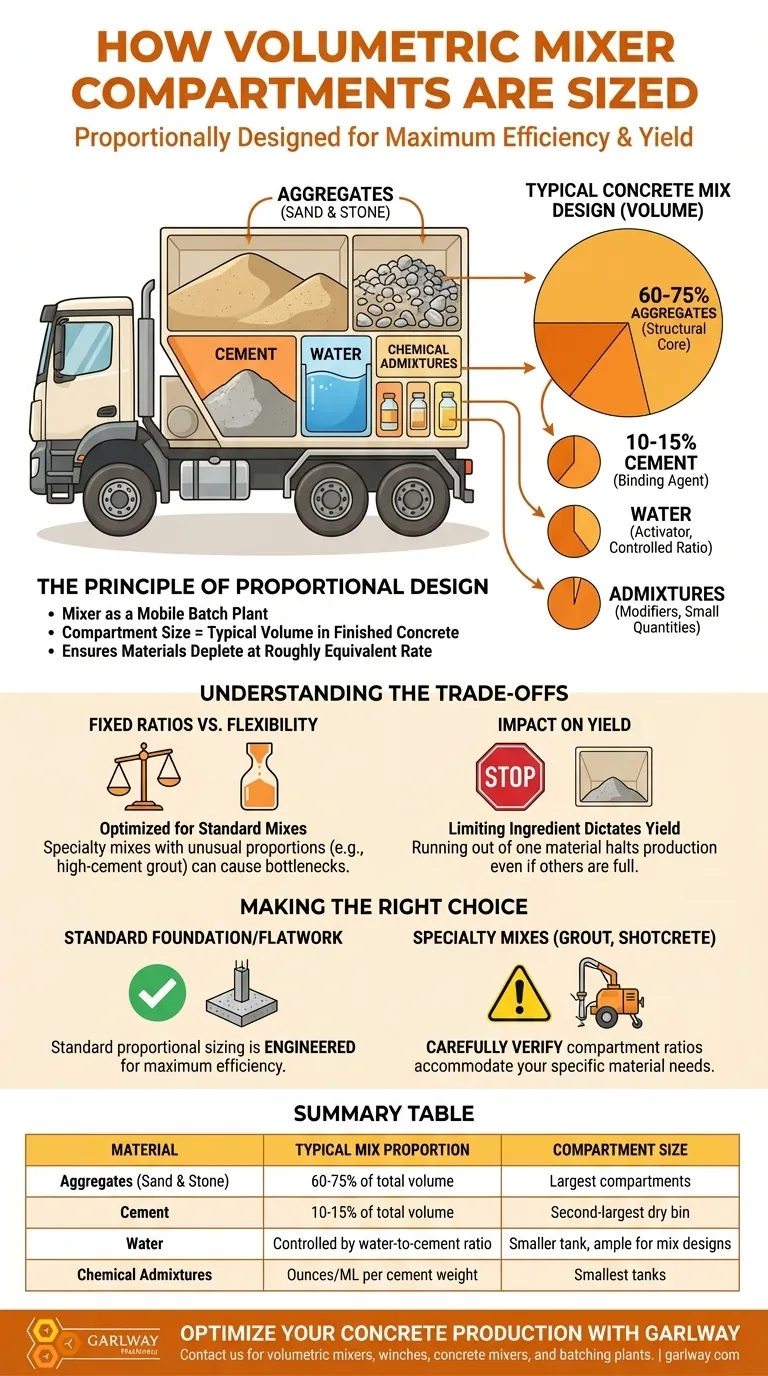
The compartments in a volumetric mixer are sized proportionally, directly mirroring the typical recipe for concrete. The largest bins are reserved for sand and stone (aggregates), followed by the cement compartment, then the water tank, and finally the much smaller tanks for chemical admixtures.
The sizing of each compartment is not arbitrary; it is a direct reflection of a standard concrete mix design. This ensures that as materials are consumed, they deplete at a roughly equivalent rate, maximizing the mixer's yield and operational efficiency for common jobs.
The Principle of Proportional Design
A volumetric mixer functions as a mobile batch plant, and its design is fundamentally based on the science of concrete. The size of each material compartment is dictated by the typical volume that ingredient occupies in a finished cubic yard or meter of concrete.
Aggregates: The Structural Core
Sand and stone are the primary structural fillers in concrete. They typically constitute 60% to 75% of the total volume of the mix.
Because they are the most voluminous ingredient, the aggregate compartments are, by a significant margin, the largest on the mixer.
Cement: The Binding Agent
Cement is the reactive powder that, when mixed with water, binds the aggregates together. By volume, cement usually makes up 10% to 15% of the mix.
Consequently, the cement bin is the second-largest dry material compartment, sized to hold enough binder for the corresponding volume of aggregates.
Water: The Activator
Water is essential for the chemical reaction (hydration) that gives concrete its strength. Its volume is carefully controlled relative to the amount of cement (the water-to-cement ratio).
The water tank's size is smaller than the cement bin but is ample enough to accommodate various mix designs, from dry to wet.
Admixtures: The Modifiers
Chemical admixtures are used in very small quantities to modify the properties of the concrete, such as accelerating set time or increasing flowability.
Because they are added in ounces or milliliters per hundredweight of cement, their tanks are the smallest components on the unit.
Understanding the Trade-offs
While proportional design is highly efficient for most applications, it's critical to understand its inherent constraints.
Fixed Ratios vs. Flexibility
The mixer's design is optimized for standard concrete mix designs. If you need to produce a specialty mix with unusual proportions—such as a high-cement grout or a low-aggregate flowable fill—you may encounter a bottleneck.
For example, a high-cement mix could deplete the cement bin long before the aggregate bins are empty, forcing a premature stop to reload.
The Impact on Yield
The maximum yield of a mixer on a single run is dictated by its limiting ingredient. Running out of cement or water will halt production, even if the large aggregate compartments are still full.
This makes it crucial to ensure the mixer's specific compartment capacities are a good match for the primary mix designs you intend to produce.
Making the Right Choice for Your Goal
Understanding this design principle allows you to select and operate equipment more effectively.
- If your primary focus is standard foundation or flatwork concrete: The standard proportional sizing is engineered for maximum efficiency and will serve you perfectly.
- If your primary focus is specialty mixes like grout or shotcrete: You must carefully verify that the mixer's compartment ratios can accommodate your specific material needs without creating operational bottlenecks.
Ultimately, recognizing that a volumetric mixer is a physical representation of a concrete recipe empowers you to optimize your material logistics and production workflow.
Summary Table:
| Material | Typical Mix Proportion | Compartment Size |
|---|---|---|
| Aggregates (Sand & Stone) | 60-75% of total volume | Largest compartments |
| Cement | 10-15% of total volume | Second-largest dry bin |
| Water | Controlled by water-to-cement ratio | Smaller tank, ample for mix designs |
| Chemical Admixtures | Ounces/ML per cement weight | Smallest tanks |
Ready to optimize your concrete production with a perfectly proportioned mixer?
At GARLWAY, we specialize in engineering construction machinery, including volumetric mixers, winches, concrete mixers, and batching plants, tailored for construction companies and contractors worldwide.
Our mixers are designed for maximum yield and operational efficiency, ensuring your materials deplete at an equivalent rate for common jobs. Let us help you select the right equipment for your specific mix designs and project goals.
Contact GARLWAY today for a consultation and discover how our machinery can enhance your workflow and profitability!
Visual Guide
Related Products
- Belle Cement Mixer JS2000 Volumetric Concrete Mixer for Harbor Freight
- JS1000 Volumetric Concrete Mortar Mixer for Sale Skid Steer Cement Mixer
- Harbor Freight JS1500 On Site Concrete Mixing Volumetric Cement Mixer
- Portable Concrete Mixer Machine Equipment for Mixing Concrete
- HZS90 Large Multiquip Concrete Mixers for Construction
People Also Ask
- What is a volumetric concrete mixer? A Mobile Concrete Batch Plant for On-Demand Mixing
- What is the predicted future for volumetric concrete mixers? Growth Driven by On-Demand Efficiency
- How does a volumetric concrete mixer contribute to sustainability? Reduce Waste, Water, and Emissions On-Site
- How does volumetric concrete compare to ready-mix concrete? Choose the Right Method for Your Project
- What types of concrete can be produced with volumetric mixers? Achieve On-Demand Mixing for Any Project