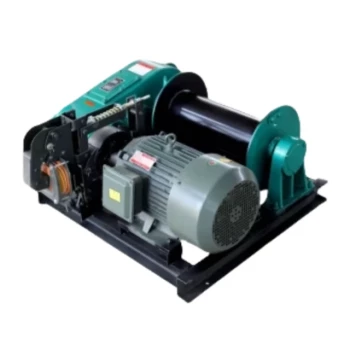
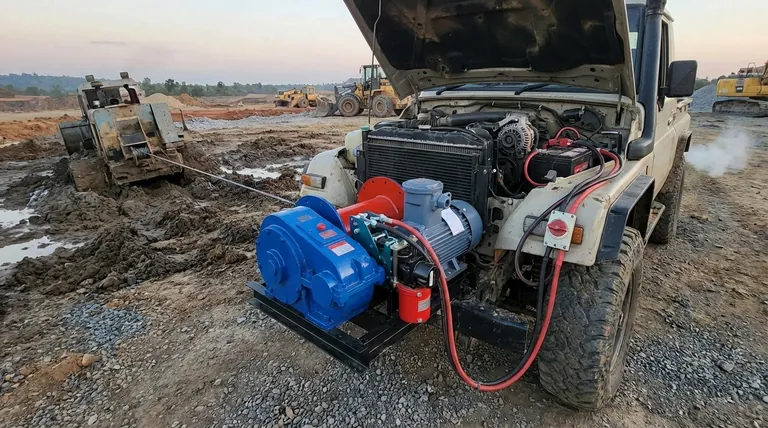
Yes, you can and should run a 12V DC winch directly from your vehicle's 12V battery, as this is precisely what it's designed for. However, it is absolutely critical that the vehicle's engine is running while you operate the winch. Simply connecting to a standalone battery is not a sustainable or safe practice for any significant load.
The core principle is that your vehicle's battery acts as a temporary buffer for the massive power draw, but it is the alternator, driven by the running engine, that provides the sustained power needed to operate the winch safely and prevent catastrophic battery drain.
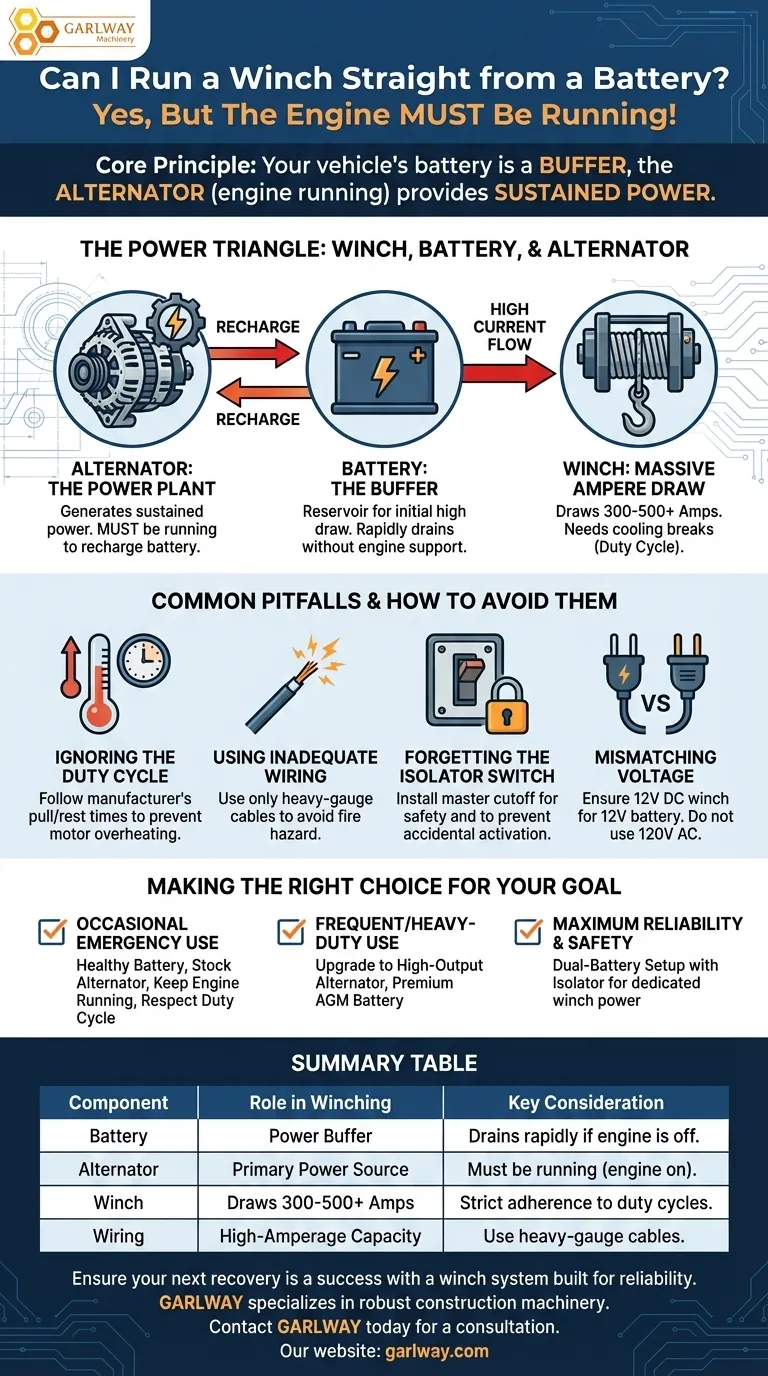
The Power Triangle: Winch, Battery, and Alternator
A winch places one of the heaviest electrical loads possible on a vehicle. Understanding how the components work together is not just technical detail—it's essential for safety and reliability when you need it most.
The Massive Ampere Draw
A winch under heavy load can easily draw 300 to 500+ amps of direct current. For perspective, your headlights might draw 10 amps, and your starter motor pulls a high load for only a few seconds. A winch pulls a massive load for minutes at a time.
The Battery's Role: The Buffer
Your vehicle's battery is a reservoir of power. It can deliver this huge amperage for a very short period. It acts as the initial power source and smooths out the demand, but it cannot sustain that level of output on its own.
The Alternator's Role: The Power Plant
The alternator is your vehicle's onboard generator. A standard truck alternator might produce 90-150 amps. While this is less than the winch's peak draw, it is constantly working to aggressively recharge the battery as the winch depletes it. Without the alternator running, the battery would be completely drained in just a few minutes of heavy winching.
Why You Must Keep the Engine Running
Operating a winch with the engine off is the single most common mistake. Doing so will rapidly drain your battery, leaving you with not only a stuck vehicle but also a dead one. Keeping the engine running (ideally at a slightly elevated idle) ensures the alternator is actively replenishing the battery during the pull.
Common Pitfalls and How to Avoid Them
Failing to respect the electrical demands of a winch can lead to equipment failure, a dead battery, or even a fire.
Ignoring the Duty Cycle
Winches generate immense heat. They are not designed for continuous operation. The duty cycle is the manufacturer's specification for how long you can pull versus how long the motor needs to cool down. A typical cycle might be 1-2 minutes of pulling followed by 10-15 minutes of rest. Ignoring this leads to permanent motor damage.
Using Inadequate Wiring
Always use the heavy-gauge cables supplied with your winch. Attempting to use thinner wires is exceptionally dangerous. The high amperage will cause them to overheat, melt their insulation, and create a significant fire hazard.
Forgetting the Isolator Switch
A proper installation includes a master power cutoff or isolator switch. This crucial safety device prevents the winch from being accidentally activated and ensures the thick, high-amperage cable is not live when not in use, preventing a potential short circuit.
Mismatching Voltage (120V AC vs. 12V DC)
It is critical to distinguish between winch types. The vast majority of vehicle-mounted winches are 12V DC. However, some shop or industrial winches are 120V AC. You absolutely cannot run a 120V AC winch from a 12V DC battery without a massive, impractical, and expensive inverter. Always match the winch voltage to the source.
Making the Right Choice for Your Goal
Your vehicle's electrical system must be prepared for the load.
- If your primary focus is occasional emergency use: A healthy, high-quality battery and your vehicle's stock alternator will suffice, provided you keep the engine running and respect the winch's duty cycle.
- If your primary focus is frequent or heavy-duty use: Consider upgrading to a high-output alternator and a premium AGM (Absorbent Glass Mat) battery to better handle the deep cycling and high demand.
- If your primary focus is maximum reliability and safety: The professional standard is a dual-battery setup with an isolator, which dedicates one battery to the winch and accessories while protecting your main starting battery.
Ultimately, powering your winch correctly is about managing the immense electrical load by using your entire vehicle's charging system as intended.
Summary Table:
| Component | Role in Winching | Key Consideration |
|---|---|---|
| Battery | Acts as a power buffer for initial high draw. | Will drain rapidly if engine is off. |
| Alternator | The primary power source; recharges the battery. | Must be running (engine on) during operation. |
| Winch | Draws 300-500+ amps under heavy load. | Requires strict adherence to duty cycles to prevent motor damage. |
| Wiring | Connects the system with high-amperage capacity. | Use only supplied heavy-gauge cables to prevent fire risk. |
Ensure your next recovery is a success with a winch system built for reliability. GARLWAY specializes in robust construction machinery, offering a range of winches, concrete mixers, and batching plants designed for the demanding needs of construction companies and contractors globally. Our experts can help you select the right equipment and understand the critical setup for safe operation.
Contact GARLWAY today for a consultation and let us power your projects with confidence.
Visual Guide
Related Products
- Electric 120V Boat Winch by Badlands
- Small Electric Winch 120V and 240V for Compact Applications
- 12000 lb Heavy Duty Electric Boat Winch
- Electric and Hydraulic Winch for Heavy Duty Applications
- Electric Hoist Winch Boat Anchor Windlass for Marine Applications
People Also Ask
- How do electric boat winches work? Unlock Effortless Launching & Retrieval
- How much current does an electric boat winch draw? Plan Your Electrical System for Peak Performance
- What are the types of electric winches available? Choose the Right Winch for Your Job
- What are the uses of electric winches in mining and tunneling? Enhance Safety and Efficiency Underground
- What safety considerations should be followed when using an electric winch? A Guide to Risk-Free Operation