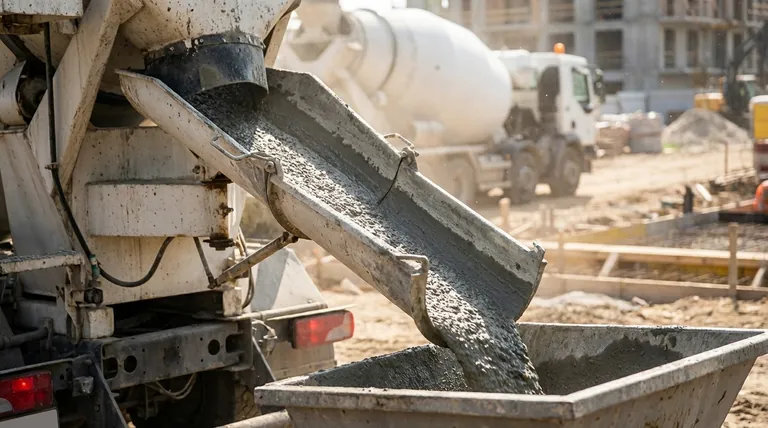
The Anatomy of a Bottleneck
Imagine a construction site. A massive concrete batching plant hums with activity, the heart of the operation. Suddenly, the flow of cement powder from the silo stutters and stops. The mixer starves. Trucks wait. The entire project timeline is now held hostage by a stubborn clog of material.
This isn't a random failure. It's a failure of physics, a consequence of overlooking a detail that seems trivial: the angle of an outlet.
The frustration of operational downtime rarely stems from a catastrophic breakdown. More often, it's the result of a thousand tiny frictions—a small, persistent design flaw that creates a systemic bottleneck.
The Flawed Logic of "Straight Down"
When moving material from Point A to Point B, our intuition tells us the most efficient path is a straight line. We imagine a 90-degree corner or a 180-degree vertical drop. It feels simple, direct, and space-efficient.
But materials—especially granular solids like sand, cement, or aggregate—don't obey our simple logic. They obey the laws of physics.
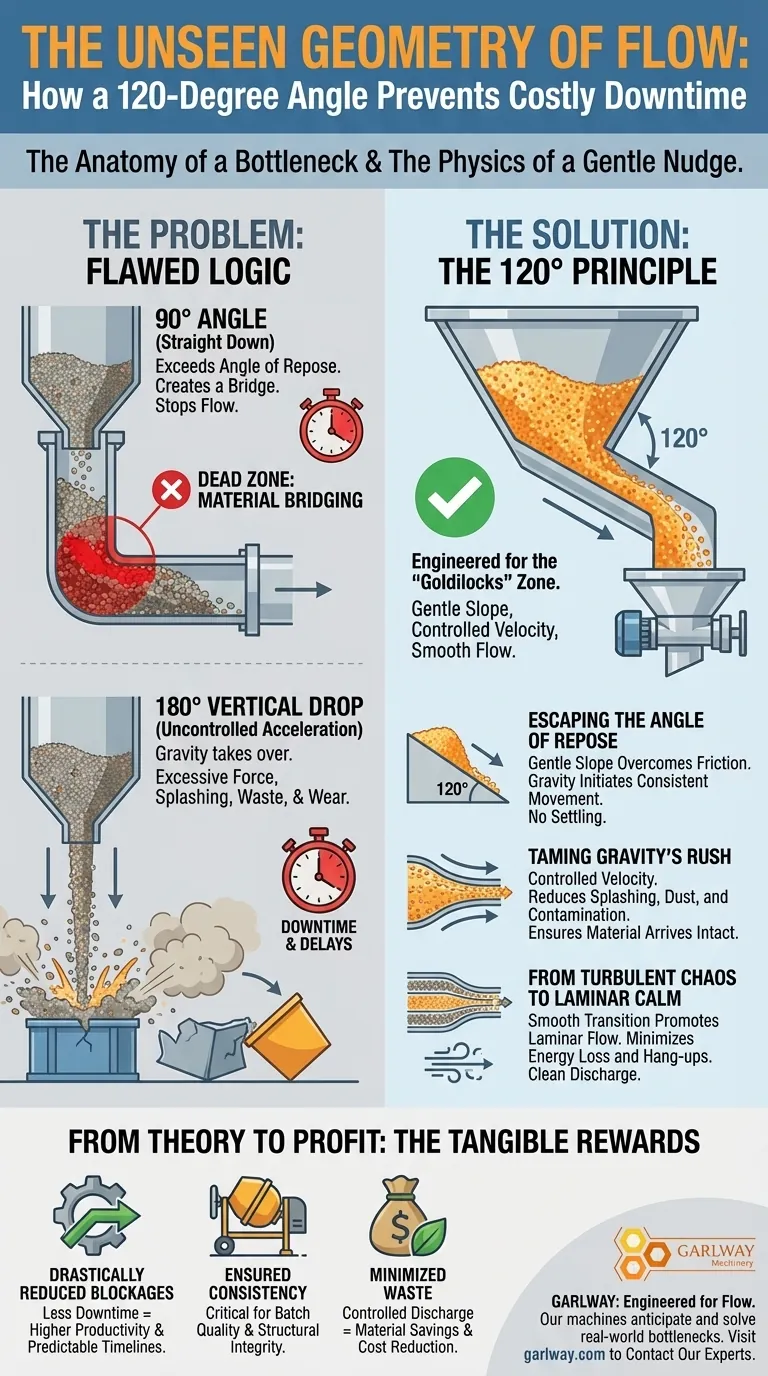
A sharp 90-degree angle creates a "dead zone." Material builds up in the corner, exceeding its natural angle of repose—the steepest it can be piled before slumping. This buildup creates a bridge, a self-reinforcing arch that blocks all further flow.
A 180-degree vertical drop creates the opposite problem: uncontrolled acceleration. Gravity takes over completely, causing materials to splash, create dust clouds, and impact surfaces with excessive force. This leads to waste, contamination, and unnecessary wear.
The Physics of a Gentle Nudge
The 120-degree outlet is not an arbitrary choice. It is a deliberate, engineered solution born from a deep understanding of these forces. It represents a "Goldilocks" zone between stagnation and chaos.
Escaping the Angle of Repose
The obtuse 120-degree angle provides a gentle slope. This slope is steep enough to overcome the material's internal friction and angle of repose, ensuring gravity can consistently initiate and maintain movement. It doesn't give the material a chance to settle, compact, and form a blockage.
Taming Gravity's Rush
While steep enough to guarantee flow, the angle is also gentle enough to control velocity. Instead of a chaotic, plunging drop, the material slides in a controlled, predictable manner. This simple act of taming gravity is the key to minimizing splashing, reducing dust, and ensuring the material arrives where it's supposed to, intact.
From Turbulent Chaos to Laminar Calm
Sharp angles create friction and turbulence. Think of water hitting a sharp bend in a pipe. The flow becomes chaotic and inefficient. The wider, smoother transition of a 120-degree outlet promotes a more laminar flow, where particles move in smooth, parallel layers. This minimizes energy loss and the chance for particles to get hung up, ensuring a clean and complete discharge every time.
From Theory to Profit: The Tangible Rewards
This subtle principle of geometry has direct, tangible impacts on the bottom line.
- Drastically Reduced Blockages: This is the most significant benefit. Less downtime for manual intervention means higher productivity and predictable project timelines.
- Ensured Consistency: In applications like concrete mixing, consistent, predictable material flow is critical for batch quality and structural integrity.
- Minimized Waste: Controlled discharge means less material lost to splashing and dust clouds. Over thousands of cycles, this saved material translates directly to cost savings.
Where Design Philosophy Meets Practical Reality
Of course, no solution is universal. Extremely cohesive materials may need flow aids, and hyper-compact designs might be forced to compromise.
But for the vast majority of applications, the 120-degree principle is a hallmark of thoughtful engineering. It reveals a design philosophy that anticipates problems rather than reacting to them.
This is the thinking embedded in GARLWAY's construction machinery. Our concrete batching plants and mixers are engineered to solve the real-world frustrations of construction sites—the bottlenecks, the delays, the waste. We don't just build machines; we build systems designed around the fundamental principles of flow, efficiency, and reliability.
Choosing equipment isn't just about horsepower or capacity. It's about choosing a partner who understands that preventing a small clog can save an entire day's work. To build a more resilient and efficient operation, you must master the physics of the bottleneck.
For machinery designed to prevent failure before it ever starts, Contact Our Experts.
Visual Guide
Related Products
Related Articles
- How to Maximize Electrical Winch Performance in Challenging Environments
- How Electric Winch Safety Features Prevent Catastrophic Industrial Accidents
- How to Choose Between Manual and Electric Winches for Your Project
- How Electric Winches Solve Industrial Safety and Cost Challenges
- How Electric Winches’ Engineering Enhances Efficiency and Safety in Heavy-Duty Applications

