The Simple Facade of a Complex Giant
Concrete feels elemental. It's the rock, sand, and water that forms the backbone of our modern world. This perceived simplicity is deceptive.
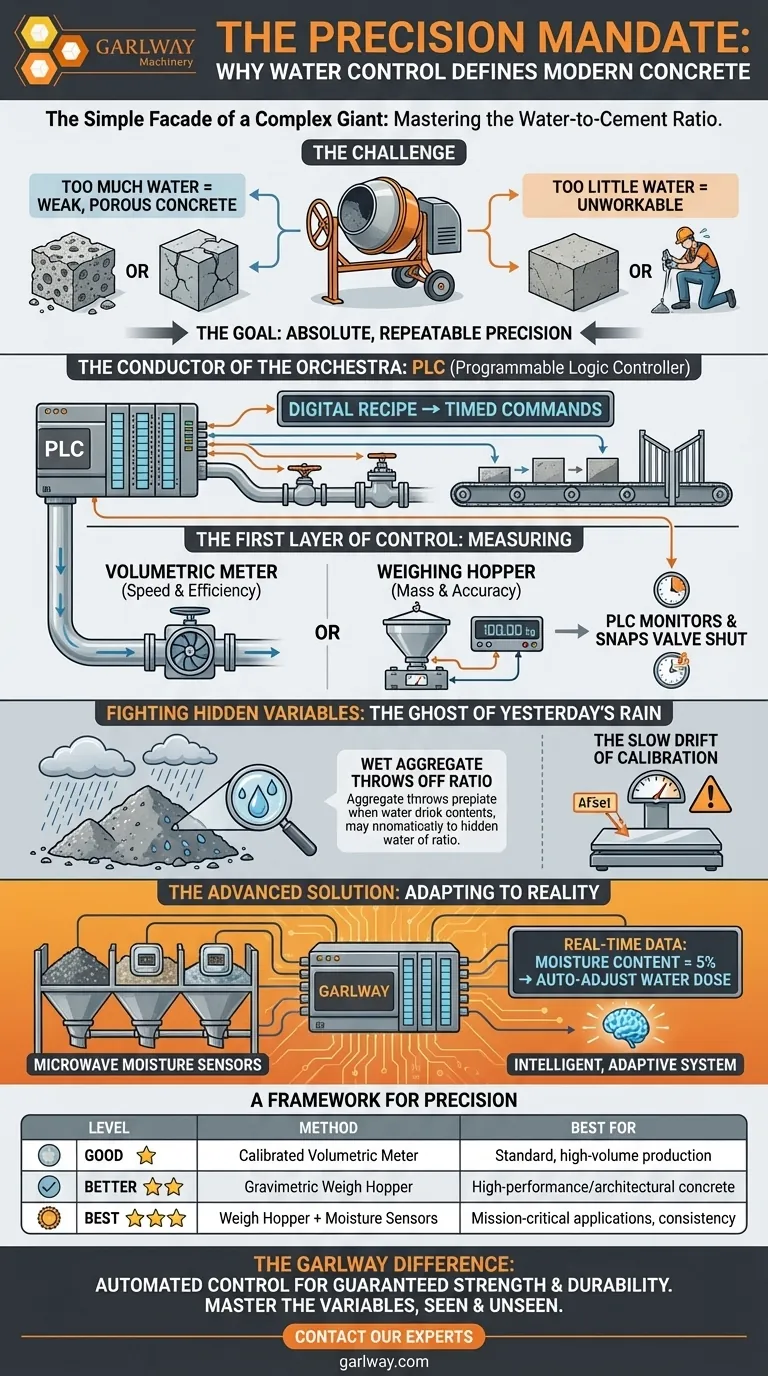
The final strength of a concrete structure is born from a precise chemical reaction, and that reaction is governed by one overwhelmingly critical factor: the water-to-cement ratio. Too much water, and you get weak, porous concrete. Too little, and it's unworkable.
The central challenge, then, isn’t just adding water. It’s about achieving absolute, repeatable precision in the face of a chaotic physical world. It's a battle of control.
The Conductor of the Orchestra
At the heart of a modern concrete batching plant sits its control system, typically a Programmable Logic Controller (PLC). This is not merely a computer; it's the conductor of a powerful mechanical orchestra.
The operator selects a mix design—a digital recipe. The PLC takes this recipe and translates it into a sequence of perfectly timed commands. It tells valves when to open, conveyors when to run, and gates when to close. It imposes digital order on an analog process, transforming raw materials into a highly engineered product.
This system is the brain, responsible for executing the plan flawlessly.
The First Layer of Control: Measuring What You Add
The plan begins with dosing the water. The PLC sends its command, and the system responds, measuring the water in one of two ways:
- Volumetric Meter: A high-precision turbine measures the volume of water as it flows through a pipe. It's fast and efficient.
- Weighing Hopper: Water is fed into a dedicated hopper suspended on load cells. This method measures the water's mass, which is inherently more accurate as it's unaffected by temperature or pressure.
The PLC constantly monitors the feedback from these sensors. As the target amount approaches, it throttles the flow and then snaps the valve shut at the perfect moment, accounting for system lag and the "in-flight" water still traveling down the pipe.
This is precision. But precision is not the same as accuracy.
Fighting the Hidden Variables
Imagine a perfect batch, calculated to the gram. The PLC executes the recipe flawlessly. Yet the resulting concrete fails its strength test. Why?
The system was precise, but it was precisely wrong. It was blind to a variable it wasn't programmed to see. The real challenge in quality control isn't just commanding the machinery; it's accounting for the variables you can't easily command.
The Ghost of Yesterday's Rain
The most common culprit is aggregate moisture. The sand and gravel delivered to a plant are rarely perfectly dry. If it rained the night before, that pile of sand could be holding a significant amount of water.
A standard control system doesn't know this. It adds the full, programmed amount of water to aggregates that are already wet. The water-to-cement ratio is thrown off before the mixing even begins. The result is a silent, invisible flaw that compromises the integrity of the final structure.
This is where true mastery comes in. Advanced plants, like those engineered by GARLWAY, integrate microwave moisture sensors directly into the aggregate bins. These sensors provide the PLC with real-time data on the hidden water content. The system then becomes intelligent; it automatically subtracts the aggregate moisture from the target water dose.
It's no longer just following a recipe. It's adapting to reality.
The Slow Drift of Calibration
Another hidden enemy is drift. Over time, load cells and flow meters can lose their perfect calibration. The system might report it added 100 liters, when it actually added 102. This slow, insidious error can degrade quality across hundreds of batches before it's caught.
Discipline is the only defense. A rigorous schedule of calibration and maintenance ensures that the system's perception of reality matches reality itself.
A Framework for Precision
The right water control strategy depends entirely on the standards you must meet.
| Level of Control | Method | Best For |
|---|---|---|
| Good | Calibrated Volumetric Meter | Standard, high-volume production where efficiency is key. |
| Better | Gravimetric Weigh Hopper | High-performance or architectural concrete where precision is paramount. |
| Best | Weigh Hopper + Moisture Sensors | Mission-critical applications demanding absolute batch-to-batch consistency. |
Ultimately, producing predictable, high-quality concrete is not about having a good recipe. It's about having an intelligent, adaptive system that can execute that recipe perfectly under real-world conditions. It's about eliminating the guesswork and mastering the variables, both seen and unseen.
At GARLWAY, our concrete batching plants are designed with this mandate for precision at their core, providing the automated control necessary to guarantee strength and durability. To elevate your production and ensure every batch meets specification, it's time to invest in a system that sees the whole picture. Contact Our Experts
Visual Guide
Related Products
- HZS120 Ready Mix Concrete Batching Plant Commercial Mud Cement Mixer
- HZS35 Small Cement Concrete Mixing Batch Plant
- HZS75 Concrete Batching Plant Cement Mixer Price Concrete Mixer Bunnings Mixing Plant
- HZS180 Ready Mix Concrete Plant for Foundations with Sand and Cement
- Commercial Electric Concrete Mixer Machine HZS 50 Small Batch Plant for Sale
Related Articles
- How Raw Material Variability Impacts Concrete Batching Accuracy
- How to Optimize Dust Control in Concrete Batching Plants: A Compliance-Focused Guide
- Optimizing Concrete Batching Accuracy: Technology-Driven Solutions for Modern Plants
- How Sensor Technologies Revolutionize Concrete Batching Accuracy
- How Sensor Technologies Reduce Concrete Batching Errors and Boost ROI