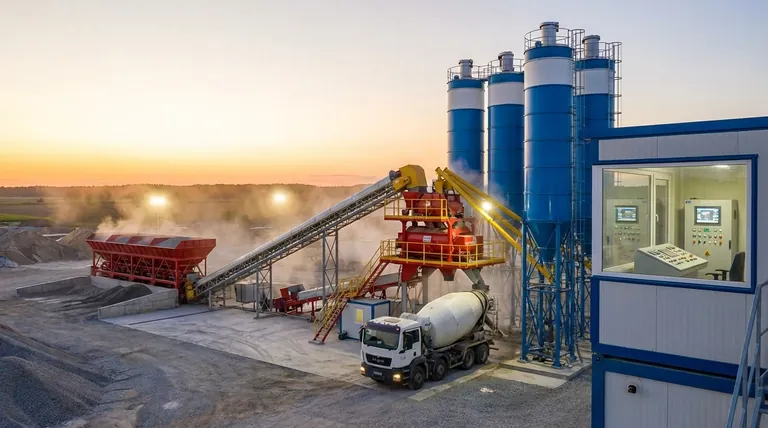
The Hidden Risk in Every Yard of Concrete
Every project manager lives with a quiet fear: the inconsistency of concrete. A single bad batch can compromise the structural integrity of a foundation, lead to failed inspections, and trigger catastrophic budget overruns.
This isn't a failure of materials. It's a failure of process. The challenge isn't just mixing sand, cement, and water; it's doing so with inhuman precision, thousands of times over.
The human mind, for all its brilliance, is not built for this kind of repetitive, high-stakes measurement. Fatigue sets in. A momentary distraction occurs. A small miscalculation is made. In manual or semi-automated systems, these tiny deviations are the seeds of failure.
This is where the modern control panel ceases to be a mere tool and becomes the central nervous system of the entire operation. It is the brain that automates perfection.
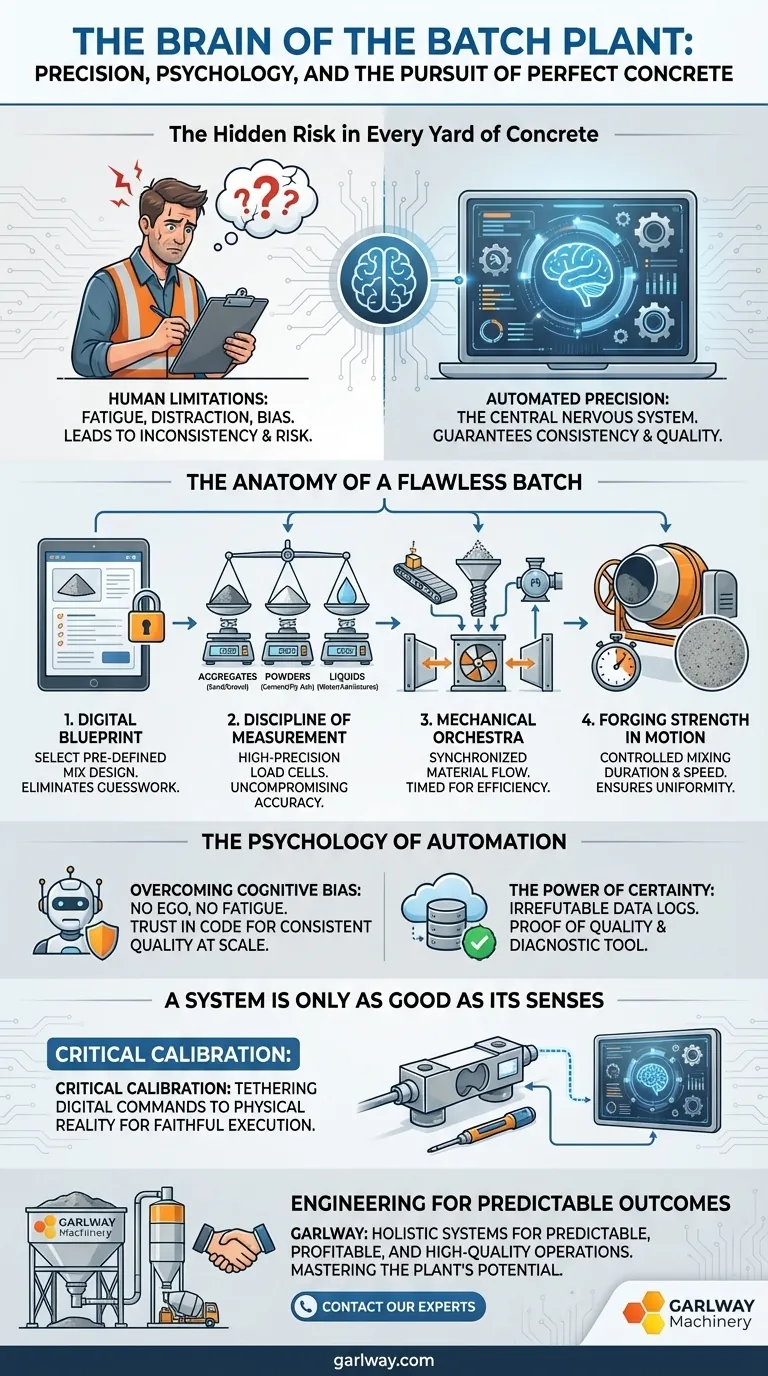
The Anatomy of a Flawless Batch
The control panel’s mission is to translate a digital blueprint—the recipe—into a physical reality. It executes this with a disciplined, unblinking sequence of commands.
Step 1: The Digital Blueprint
It all begins with the recipe. This isn't just a list of ingredients; it's the genetic code for the final product's strength and durability. The operator selects a pre-defined mix design from the panel's memory, locking in the exact proportions required. This single action eliminates the guesswork that plagues manual mixing.
Step 2: The Discipline of Measurement
This is the system's most critical function. The control panel commands a series of high-precision load cells and meters to weigh each component.
- Aggregates: Sand and gravel are weighed to the exact kilogram.
- Powders: Cement and fly ash are measured with uncompromising accuracy.
- Liquids: Water and admixtures are dosed with volumetric precision.
The panel doesn't "estimate." It measures, confirms, and cross-references, ensuring the physical weights perfectly match the digital blueprint.
Step 3: The Mechanical Orchestra
Once each ingredient is perfectly weighed, the panel becomes a conductor. It orchestrates a symphony of conveyor belts, screw feeders, and pumps.
Gates open and close in a precise sequence. Materials flow from their respective bins and silos into the central mixer. The timing is crucial to prevent bottlenecks and ensure a smooth, efficient transfer.
Step 4: Forging Strength in Motion
With all materials in the mixer, the panel dictates the final, critical stage. It controls the mixing duration and speed, ensuring every grain of sand and particle of cement is perfectly blended into a homogenous, high-performance concrete.
The Psychology of Automation
Why is this automated system so superior? It addresses fundamental human limitations.
Overcoming Cognitive Bias
An automated system has no ego. It doesn't round up or down. It doesn't get tired after an eight-hour shift. It removes the variables of human judgment and replaces them with the certainty of code. This shift from reliance on individual skill to trust in system integrity is the key to consistent quality at scale.
The Power of Certainty
Modern control panels do more than just execute commands; they record everything. Every batch is logged, creating an irrefutable record of what was produced. This data provides psychological relief—proof of quality for clients and inspectors, and a diagnostic tool for troubleshooting. It replaces assumption with fact.
A System Is Only as Good as Its Senses
This digital brain is powerful, but it relies on its "senses"—the physical sensors and load cells throughout the plant.
The most sophisticated control logic is useless if the load cell it's reading is out of calibration. A command for 1,000kg of cement becomes an instruction for 980kg in reality. Over time, this small discrepancy erodes quality and inflates costs.
This is why the "calibration ritual" is not just a maintenance task; it's the act of tethering the digital world to the physical one. It ensures the brain's commands are faithfully executed.
| Control Panel Function | Key Action | Primary Benefit |
|---|---|---|
| Recipe Management | Stores and selects precise mix designs | Ensures batch consistency and quality |
| Weighing Systems | Commands accurate measurement of all materials | Minimizes material waste and cost |
| Material Conveyance | Orchestrates the flow of ingredients to the mixer | Increases production speed and efficiency |
| Mixing Process Control | Dictates mixing time and speed for homogeneity | Guarantees a durable, uniform final product |
Engineering for Predictable Outcomes
Understanding this interplay between digital control and physical reality is what separates an average concrete batching plant from a truly great one.
At GARLWAY, our concrete batching plants are designed as holistic systems. We engineer our control panels for intuitive operation and unwavering reliability, but we also ensure the underlying mechanical components and sensors they command are robust and precise. We build systems that minimize the potential for error, turning the complex process of concrete production into a predictable, profitable, and high-quality operation.
For construction companies and contractors who can't afford the risk of inconsistency, mastering the plant's control system is the key to unlocking its full potential. To achieve this, you need a partner who understands the engineering and the psychology behind it. Contact Our Experts
Visual Guide
Related Products
- HZS120 Ready Mix Concrete Batching Plant Commercial Mud Cement Mixer
- HZS180 Ready Mix Concrete Plant for Foundations with Sand and Cement
- HZS35 Small Cement Concrete Mixing Batch Plant
- HZS75 Concrete Batching Plant Cement Mixer Price Concrete Mixer Bunnings Mixing Plant
- Commercial Electric Concrete Mixer Machine HZS 50 Small Batch Plant for Sale
Related Articles
- How Raw Material Variability Impacts Concrete Batching Accuracy
- How to Optimize Dust Control in Concrete Batching Plants: A Compliance-Focused Guide
- Optimizing Concrete Batching Accuracy: Technology-Driven Solutions for Modern Plants
- How Sensor Technologies Revolutionize Concrete Batching Accuracy
- How Sensor Technologies Reduce Concrete Batching Errors and Boost ROI





