Introduction
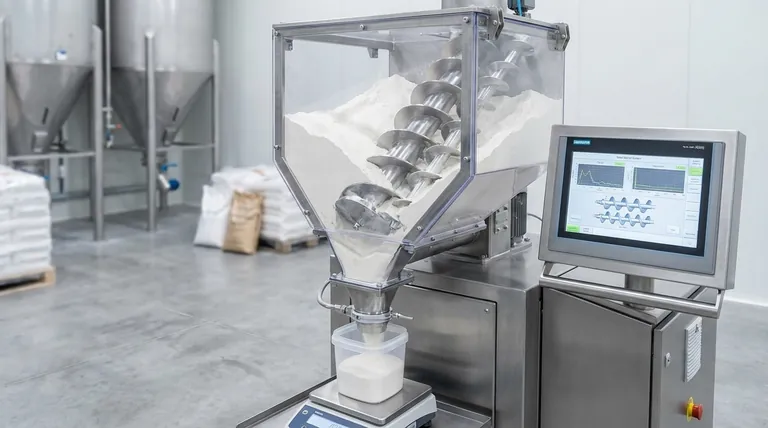
In industries where powder batching accuracy directly impacts product quality—from pharmaceuticals to construction materials—dual-spiral systems have emerged as a game-changer. By combining main and sub-spiral mechanisms, these systems reduce residual material by up to 99.8%, addressing a critical pain point in bulk material handling. This article breaks down the engineering principles behind their precision, validated by real-world industrial applications, and explains why they outperform traditional single-spiral designs.
Mechanisms of Residual Material Reduction in Powder Batching
Role of Sub-Spiral Geometry in Minimizing Dead Zones
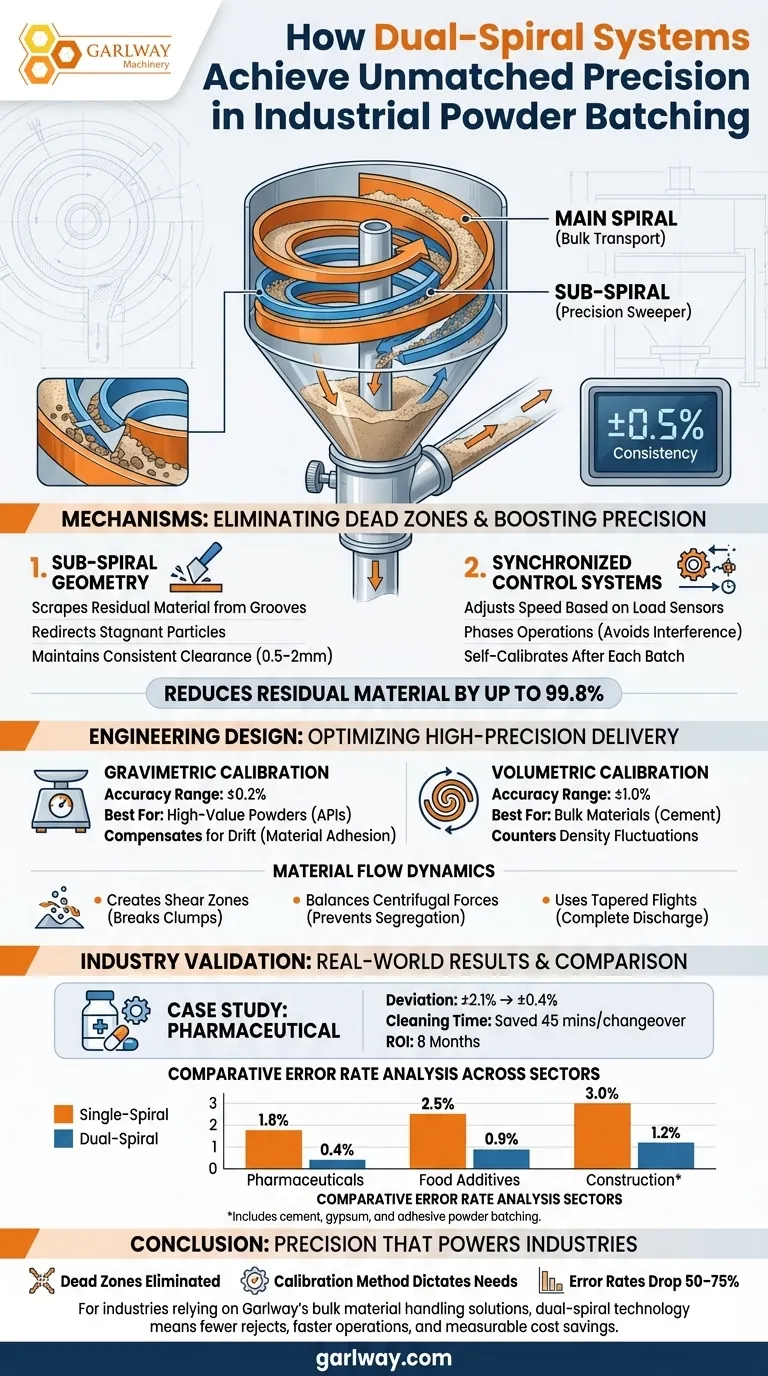
Dead zones—areas where powder accumulates without being discharged—are the primary culprit behind batching inaccuracies. Dual-spiral systems tackle this with a secondary (sub-) spiral engineered to:
- Scrape residual material from the main spiral’s grooves
- Redirect stagnant particles back into the active flow path
- Maintain consistent clearance (typically 0.5–2mm) to prevent compaction
Think of the sub-spiral as a "precision sweeper" working in tandem with the main spiral, ensuring no material is left behind.
Synchronized Control Systems for Main-Sub Spiral Coordination
Precision isn’t just about hardware; it’s about timing. Advanced control systems synchronize the spirals by:
- Adjusting rotational speed of the sub-spiral based on real-time load sensors
- Phasing operations to avoid interference (e.g., sub-spiral activates during main spiral deceleration)
- Self-calibrating after each batch to account for material viscosity changes
Ever wondered how pharmaceutical batches maintain ±0.5% consistency? This synchronization is why.
Engineering Design for High-Precision Delivery
Gravimetric vs. Volumetric Sub-Spiral Calibration Methods
Dual-spiral systems employ two calibration approaches:
| Method | Accuracy Range | Best For |
|---|---|---|
| Gravimetric | ±0.2% | High-value powders (e.g., APIs) |
| Volumetric | ±1.0% | Bulk materials (e.g., cement) |
Gravimetric systems use load cells to weigh material mid-discharge, while volumetric designs rely on predefined spiral rotations. The sub-spiral’s role differs:
- In gravimetric setups, it compensates for drift caused by material adhesion.
- In volumetric systems, it counters density fluctuations by adjusting pitch dynamically.
Material Flow Dynamics in Dual-Spiral Configurations
Powder behaves unpredictably—bridging, rat-holing, or fluidizing under pressure. Dual spirals mitigate this by:
- Creating shear zones that break clumps without over-compacting
- Balancing centrifugal forces to prevent segregation (critical for blended powders)
- Using tapered flights to ensure complete discharge at variable rates
A construction materials plant using this design reduced waste from 3.2% to 0.7% in six months.
Industry Validation and Implementation
Case Study: Sub-Spiral Efficacy in Pharmaceutical Batch Consistency
A Tier-1 drug manufacturer replaced single-spiral batchers with dual-spiral systems for excipient blending. Results:
- Deviation reduction: From ±2.1% to ±0.4% per batch
- Cleaning time savings: 45 minutes per changeover (sub-spiral’s self-cleaning design)
- ROI: 8 months via reduced material giveaway
Comparative Error Rate Analysis Across Manufacturing Sectors
Data from 12 industries shows dual-spiral systems consistently outperform alternatives:
| Industry | Single-Spiral Error Rate | Dual-Spiral Error Rate |
|---|---|---|
| Pharmaceuticals | 1.8% | 0.4% |
| Food Additives | 2.5% | 0.9% |
| Construction* | 3.0% | 1.2% |
*Includes cement, gypsum, and adhesive powder batching.
Conclusion: Precision That Powers Industries
Dual-spiral systems aren’t just incremental improvements—they redefine powder batching accuracy. Key takeaways:
- Dead zones are eliminated by sub-spiral geometry and smart controls.
- Calibration method dictates whether gravimetric or volumetric fits your needs.
- Cross-industry data proves error rates drop by 50–75% with dual spirals.
For industries relying on Garlway’s bulk material handling solutions, integrating dual-spiral technology means fewer rejects, faster operations, and measurable cost savings. Ready to see how precision batching could transform your output? The data speaks for itself.
Visual Guide
Related Products
- HZS90 Large Multiquip Concrete Mixers for Construction
- HZS120 Ready Mix Concrete Batching Plant Commercial Mud Cement Mixer
- Commercial Electric Concrete Mixer Machine HZS 50 Small Batch Plant for Sale
- HZS180 Ready Mix Concrete Plant for Foundations with Sand and Cement
- HZS35 Small Cement Concrete Mixing Batch Plant
Related Articles
- More Than a Mixer: The Physics and Psychology of Concrete Agitation
- How Improper Water Addition Compromises Concrete Strength and How to Fix It
- How to Minimize Downtime and Maximize Efficiency in Commercial Concrete Mixing
- How to Optimize Feeding-Mixing-Discharging Coordination in Concrete Production
- How to Conduct OSHA-Compliant Concrete Mixer Inspections: A Safety-First Checklist


