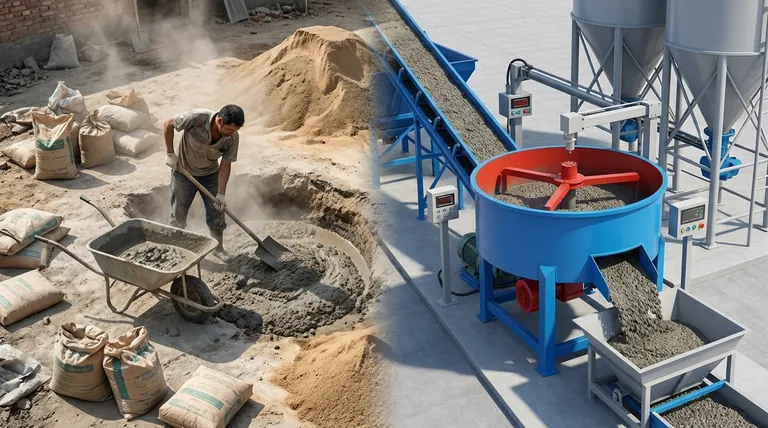
The Architect's Anxiety
On any high-stakes construction site, the air is thick with controlled chaos. Every blueprint, every steel beam, and every calculation is a testament to human ingenuity and precision. Yet, one of the most fundamental components—the concrete that forms the structure's very bones—is often left to a process prone to approximation and human error.
The real anxiety for an engineer isn't a sudden, catastrophic failure. It's the slow, silent compromise. It's the knowledge that a single, poorly mixed batch of concrete, hidden deep within a support column, could become a point of weakness for decades to come.
This is the core tension: the pursuit of engineering perfection versus the reality of manual labor. The choice between manual mixing and a concrete batching plant is not merely about tools; it's a decision between leaving a critical variable to chance or seizing absolute control.
Precision vs. Approximation
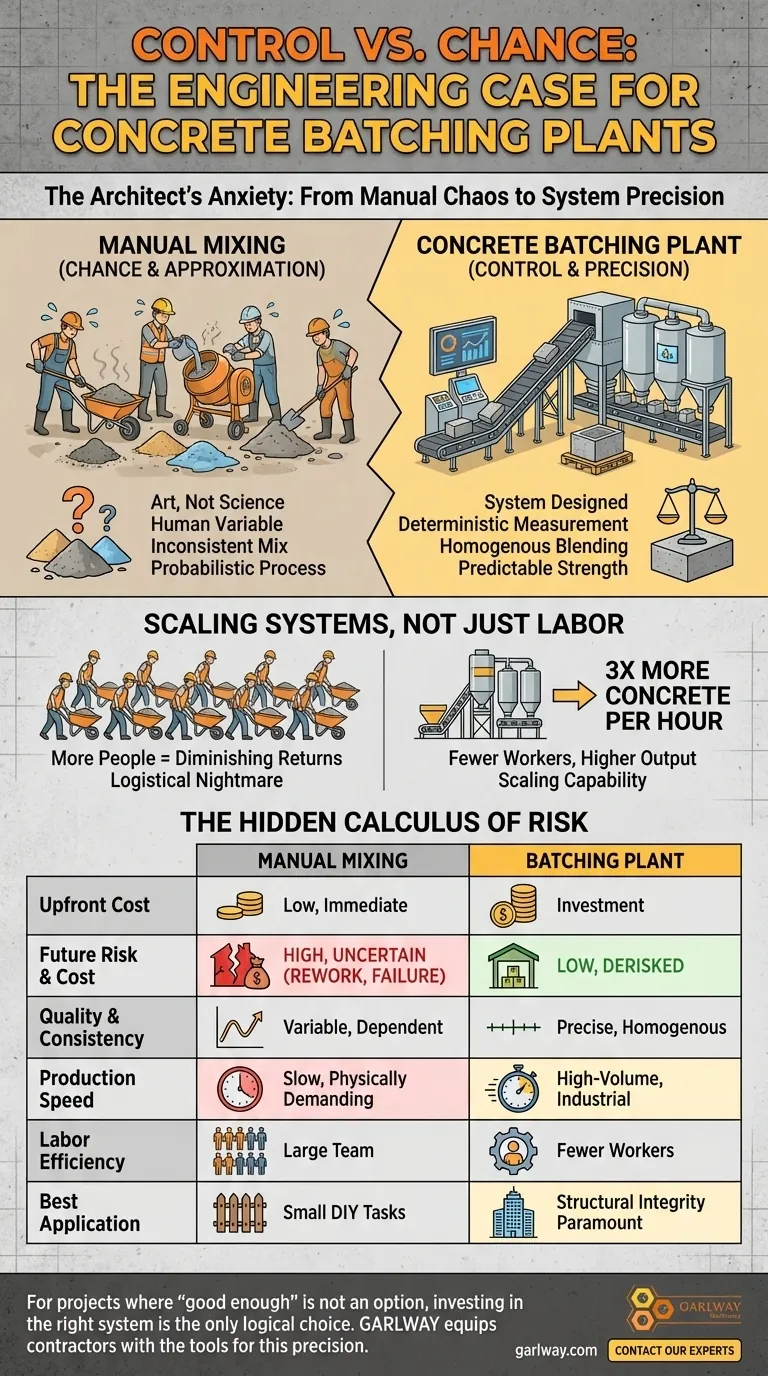
Manual concrete mixing is an art, not a science. The final product depends entirely on the skill, focus, and physical state of the person holding the shovel. One worker's "just right" amount of water is another's soupy mix. This variability is the enemy of structural integrity.
A concrete batching plant operates on a different principle entirely. It is a system designed to eliminate variables.
- Deterministic Measurement: Automated sensors and digital scales measure cement, water, and aggregates with unwavering accuracy, batch after batch.
- Homogenous Blending: The mechanical mixing process ensures every particle is evenly coated and distributed, creating a homogenous product with predictable strength and texture.
This isn't an incremental improvement. It is a fundamental shift from a probabilistic process (hoping it's right) to a deterministic one (knowing it's right). For any project where the concrete's performance is non-negotiable, this level of consistency is the only way to guarantee it meets engineering specifications.
Scaling Systems, Not Just Labor
When a project deadline looms, the instinct is to add more people. With manual mixing, however, this approach yields diminishing returns. Coordinating a large team to mix concrete consistently is a logistical nightmare, introducing more opportunities for error and inefficiency.
This is a classic trap: trying to solve a system problem by adding more resources.
A batching plant solves the problem at the system level. It doesn't just add more hands; it introduces a new, more efficient engine of production. A plant can produce up to three times more concrete per hour with a fraction of the workforce.
This frees up valuable labor for other critical tasks, transforming the entire site's efficiency. You are no longer scaling your workforce; you are scaling your capability.
The Hidden Calculus of Risk
The most common objection to a batching plant is its upfront cost. The initial capital investment is tangible and easily measured. A shovel and a wheelbarrow are cheap.
But this view ignores the hidden, and far more dangerous, cost of inconsistency.
The true trade-off isn't money; it's risk. Manual mixing seems cheaper for a small job, but it carries a high risk of poor quality, weak spots, and potential structural failure. The cost of rework, or worse, a structural failure down the line, can dwarf the initial savings a thousand times over.
This is a psychological bias we all share: we overvalue immediate, certain costs and undervalue future, uncertain risks. A batching plant is an investment in de-risking the most foundational element of your project.
When to Choose Which System
The right method is determined by the project's tolerance for risk and its demand for quality.
| Aspect | Concrete Batching Plant (System Control) | Manual Mixing (Human Chance) |
|---|---|---|
| Quality & Consistency | Precise, automated, homogenous mix | Variable, dependent on individual skill |
| Production Speed | High-volume, industrial output | Slow, physically demanding process |
| Labor Efficiency | Fewer workers for higher output | Requires a large, coordinated team |
| Best Application | Structural projects requiring integrity | Small, non-critical DIY tasks (e.g., a post) |
For projects where "good enough" is not an option and structural integrity is paramount, investing in the right system is the only logical choice. As a global provider of robust construction machinery, GARLWAY equips contractors with the tools for this precision. Our concrete batching plants are engineered to deliver the unwavering quality and efficiency that modern construction demands.
To explore how a reliable batching plant can become the foundation of your project's success, Contact Our Experts.
Visual Guide
Related Products
- HZS120 Ready Mix Concrete Batching Plant Commercial Mud Cement Mixer
- HZS35 Small Cement Concrete Mixing Batch Plant
- HZS75 Concrete Batching Plant Cement Mixer Price Concrete Mixer Bunnings Mixing Plant
- HZS180 Ready Mix Concrete Plant for Foundations with Sand and Cement
- Commercial Electric Concrete Mixer Machine HZS 50 Small Batch Plant for Sale
Related Articles
- How Raw Material Variability Impacts Concrete Batching Accuracy
- How to Optimize Dust Control in Concrete Batching Plants: A Compliance-Focused Guide
- Optimizing Concrete Batching Accuracy: Technology-Driven Solutions for Modern Plants
- How Sensor Technologies Revolutionize Concrete Batching Accuracy
- How Sensor Technologies Reduce Concrete Batching Errors and Boost ROI





