The Margin of Error in a Hand-Guided World
Picture a seasoned operator at a traditional concrete plant. For years, their skill has been an art form, a mix of muscle memory, listening to the rumble of the mixer, and visually judging the flow of aggregates. They are good at their job.
But even the best operator has variances. A slight hesitation on a lever, a moment of distraction—these introduce tiny inconsistencies. Across a thousand batches, these small deviations compound into significant material waste, fluctuating quality, and unpredictable production schedules.
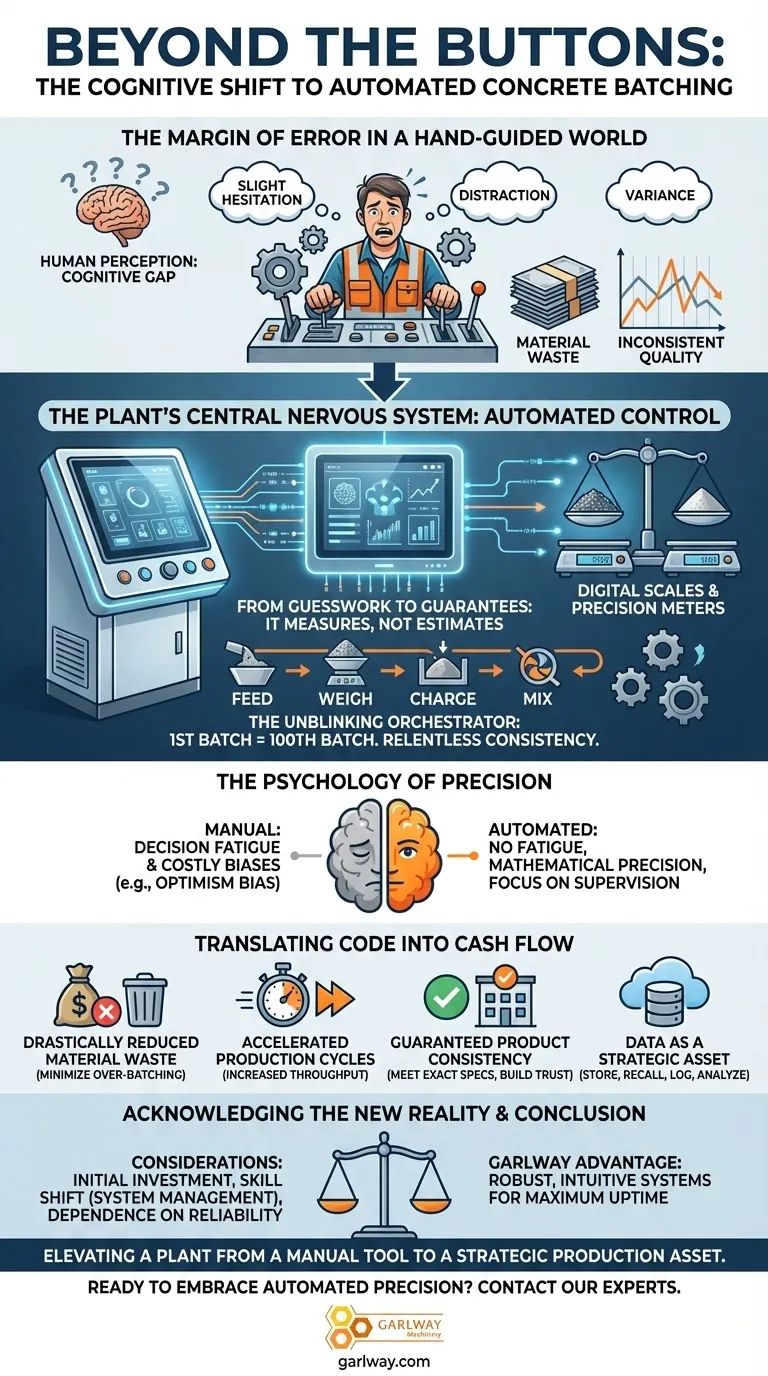
The fundamental problem isn't the operator's skill; it's the reliance on human perception in a process that demands absolute, repeatable precision. This is the cognitive gap that modern control systems were engineered to close.
The Plant's Central Nervous System
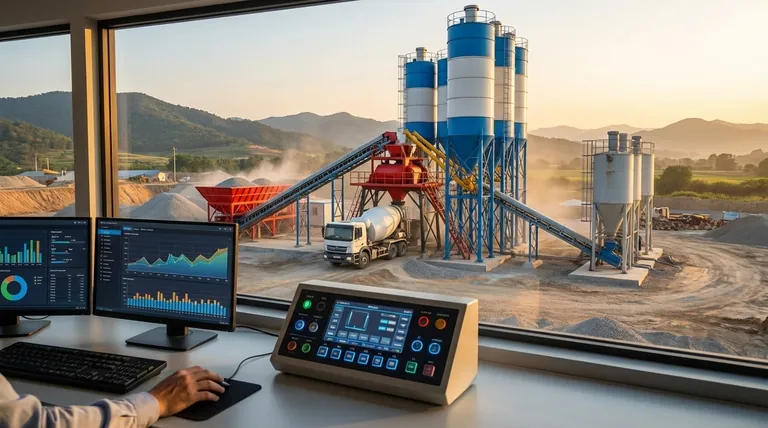
At its heart, a modern control panel is the brain of a concrete batching plant. It transforms a collection of powerful motors, belts, and bins into a single, cohesive, and intelligent system.
It doesn't just start and stop machinery. It orchestrates the entire complex ballet of production with digital accuracy, serving as the central nervous system for the entire operation.
From Guesswork to Guarantees
Instead of relying on an operator's eye, the control system uses a network of digital scales and precision meters. It doesn't estimate; it measures.
This automated measurement is the bedrock of efficiency. It removes the cognitive load and potential for error from the human element, ensuring every gram of cement and every liter of water is accounted for according to the specified mix design.
The Unblinking Orchestrator
The control panel executes the batching sequence—feeding aggregates, weighing materials, charging the mixer, and adding water and admixtures—in a perfect, unvarying loop.
The 1st batch is identical to the 100th. This relentless consistency is something no manual operation can truly replicate, and it's the foundation of a reputation for quality.
The Psychology of Precision
The shift to an automated control panel is more than a technical upgrade; it's a psychological one. It replaces the variable nature of human intuition with the certainty of a system.
Eliminating Decision Fatigue
A manual operator makes hundreds of micro-decisions every hour. This leads to decision fatigue, where the quality of choices degrades over time. An automated system feels no fatigue. It frees the operator to focus on higher-level tasks: supervising the overall process, anticipating maintenance needs, and ensuring site safety.
Overcoming Costly Biases
Humans are prone to cognitive biases. An operator might add a little extra cement "just to be safe"—a form of optimism bias that, when repeated, leads to significant material over-consumption. A control system has no biases. It executes the recipe with cold, mathematical precision, directly protecting your bottom line.
Translating Code into Cash Flow
This automated precision delivers direct, measurable benefits that are immediately visible in a company's financial performance.
- Drastically Reduced Material Waste: By using the exact amount of each ingredient required, the system minimizes over-batching and all but eliminates costly, out-of-spec batches that must be discarded.
- Accelerated Production Cycles: An automated sequence is invariably faster and more fluid than a manual one. This increases the plant’s throughput, allowing you to complete more jobs in less time.
- Guaranteed Product Consistency: Every batch meets the exact design specifications, which is critical for meeting stringent project requirements and building trust with clients.
Data as a Strategic Asset
Beyond the physical process, modern control panels are powerful data management tools. They allow operators to store, recall, and execute hundreds of complex mix designs with the push of a button. This system also logs production data, providing an invaluable record for quality control verification, inventory management, and performance analysis.
Acknowledging the New Reality
Of course, adopting such a sophisticated system involves key considerations. An objective analysis requires acknowledging them.
- The Initial Investment: Advanced control systems require a capital expense, but the ROI is typically rapid through savings in material, labor, and waste reduction.
- The Shift in Skill: The need for manual dexterity is replaced by the need for system management. Operators must be trained to manage recipes, interpret data, and perform basic diagnostics.
- The Dependence on Reliability: The entire plant's productivity hinges on the control system. This makes the quality of the hardware, software, and technical support a critical factor in your investment decision.
At GARLWAY, our concrete batching plants are engineered with robust, intuitive control systems designed for maximum uptime and operational efficiency. We understand that the "brain" of the plant must be as reliable as its steel frame.
| Key Function | Direct Business Impact |
|---|---|
| Automated Measurement | Minimizes material waste, directly lowering input costs. |
| Orchestrated Sequencing | Increases throughput and accelerates project timelines. |
| Recipe & Data Management | Ensures consistent quality and provides actionable data. |
By elevating a batching plant from a manual tool to a strategic production asset, a modern control system is no longer a luxury—it's the engine of a competitive construction operation.
If you are ready to move beyond the limits of manual operation and embrace the efficiency of automated precision, our team can help you configure the perfect system for your needs. Contact Our Experts
Visual Guide
Related Products
- HZS120 Ready Mix Concrete Batching Plant Commercial Mud Cement Mixer
- HZS35 Small Cement Concrete Mixing Batch Plant
- HZS75 Concrete Batching Plant Cement Mixer Price Concrete Mixer Bunnings Mixing Plant
- HZS180 Ready Mix Concrete Plant for Foundations with Sand and Cement
- Commercial Electric Concrete Mixer Machine HZS 50 Small Batch Plant for Sale
Related Articles
- How Raw Material Variability Impacts Concrete Batching Accuracy
- How to Optimize Dust Control in Concrete Batching Plants: A Compliance-Focused Guide
- Optimizing Concrete Batching Accuracy: Technology-Driven Solutions for Modern Plants
- How Sensor Technologies Revolutionize Concrete Batching Accuracy
- How Sensor Technologies Reduce Concrete Batching Errors and Boost ROI