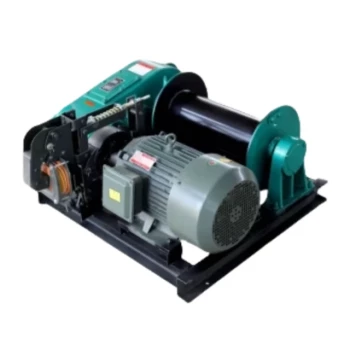
The single greatest advantage of an electric winch for a solo off-roader is its ability to function even when your vehicle's engine is dead. This transforms it from a simple recovery tool into a critical lifeline, providing a path to safety when you are otherwise completely stranded and without assistance.
Solo off-roading fundamentally changes the risk equation. Without a support vehicle, your equipment must be capable of rescuing you from a worst-case scenario, and a stalled engine combined with being stuck is the definition of a worst-case scenario.
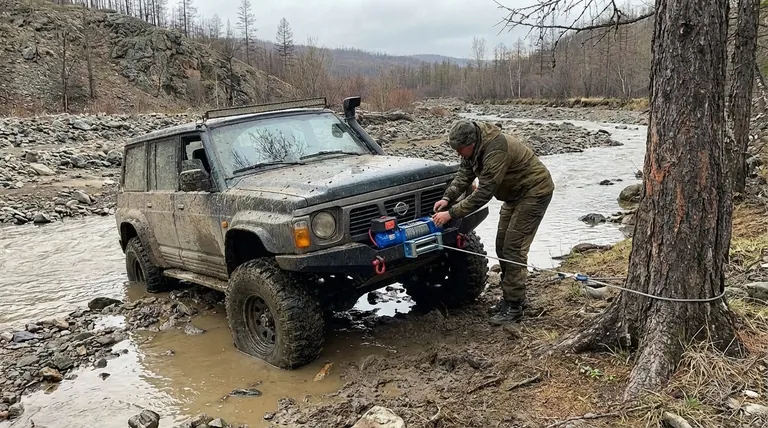
The Critical Factor: Engine-Independent Operation
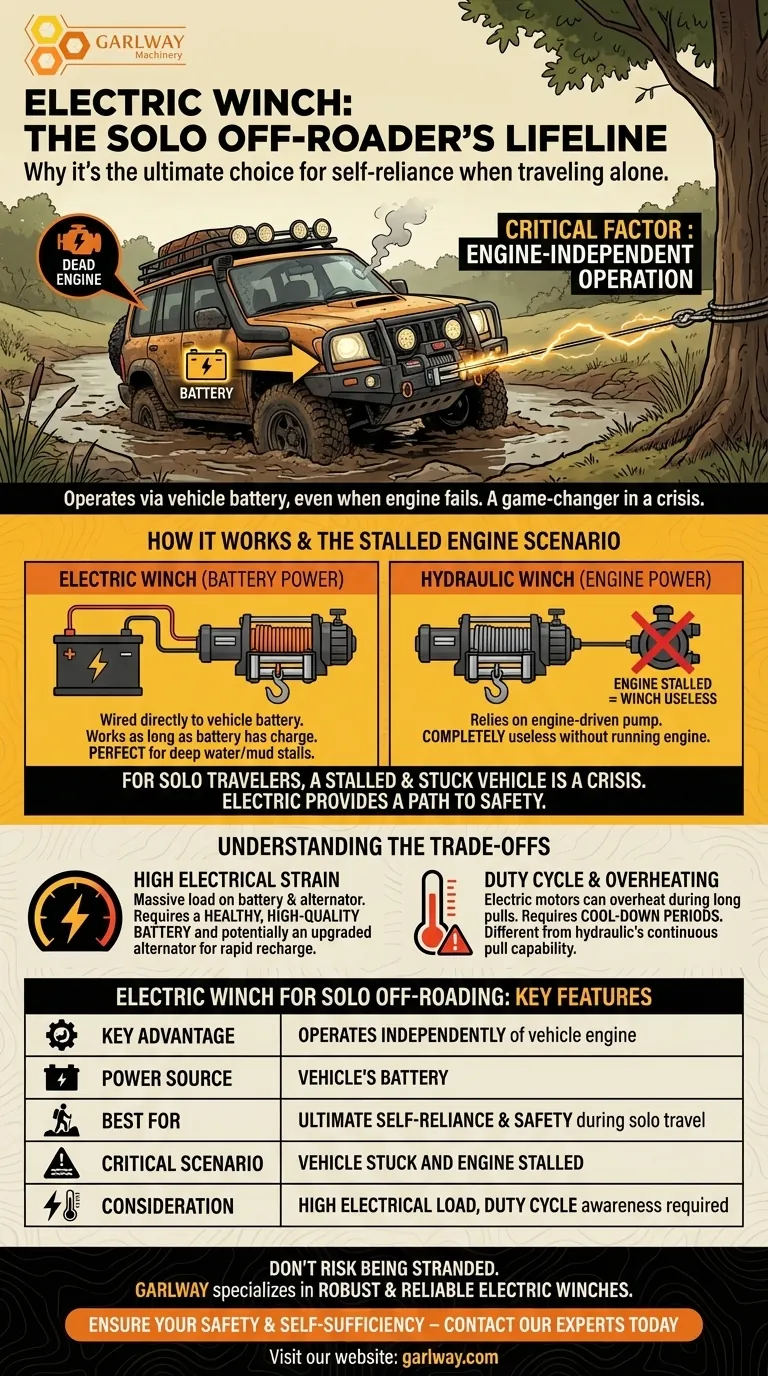
The defining characteristic that makes an electric winch superior for solo travel is its power source. It operates independently of your vehicle's engine, which is a game-changer in a recovery situation.
How an Electric Winch Works
An electric winch is wired directly to your vehicle's battery. It uses an electric motor to turn a drum, winding a cable and creating the pulling force necessary for recovery.
As long as your battery has sufficient charge, the winch will operate.
The Stalled Engine Scenario
Imagine your vehicle is stuck in deep water or mud, and the engine has stalled. This is a common and dangerous situation where water may have entered the intake or critical electronics have failed.
In this scenario, a hydraulic winch, which relies on the engine-driven power steering pump, is completely useless. An electric winch, however, can still draw power from the battery to pull you to safety.
The Solo Operator's Lifeline
For a group of travelers, a stalled vehicle is an inconvenience; another truck can simply pull them out. For the solo traveler, a stalled and stuck vehicle is a crisis.
The ability to self-recover without a running engine is the ultimate layer of self-sufficiency.
Understanding the Trade-offs
While engine independence makes an electric winch the clear choice for solo recovery, it's essential to understand its operational limitations.
The Strain on Your Electrical System
Electric winches place a massive electrical load on your vehicle's battery and alternator. A heavy pull can draw hundreds of amps, rapidly draining a standard battery.
For this reason, a healthy, high-quality battery is non-negotiable. Many serious off-roaders upgrade their alternator as well to help replenish the battery's charge more quickly after a pull.
Duty Cycle and Overheating
The electric motors in winches can overheat during long, sustained pulls under heavy load. They have a limited "duty cycle," meaning they require cool-down periods to prevent damage.
While this is a manageable limitation, it's a key difference from hydraulic winches, which can often pull continuously as long as the vehicle's engine is running to cool the hydraulic fluid.
Making the Right Choice for Your Goal
Your choice of equipment should always be guided by the situations you are preparing for.
- If your primary focus is solo exploration and ultimate self-reliance: An electric winch is the only responsible choice, as it is your only means of self-recovery during a compound failure of being both stuck and stalled.
- If your primary focus is group travel or commercial work with long, continuous pulls: The benefits of a hydraulic winch's duty cycle may be a factor, but this comes with the accepted risk of engine dependency.
Ultimately, for the solo adventurer, choosing your gear is about preparing for the moment when you are your only rescuer.
Summary Table:
| Feature | Electric Winch for Solo Off-Roading |
|---|---|
| Key Advantage | Operates independently of the vehicle's engine |
| Power Source | Vehicle's battery |
| Best For | Ultimate self-reliance and safety during solo travel |
| Critical Scenario | Vehicle is stuck AND the engine has stalled |
| Consideration | High electrical load; requires a healthy battery and understanding of duty cycle |
Don't risk being stranded on your next solo adventure. GARLWAY specializes in robust and reliable electric winches, designed for construction companies and contractors who demand performance in the toughest conditions. Our winches provide the critical, engine-independent power you need for safe self-recovery. Ensure your safety and self-sufficiency — contact our experts today to find the perfect winch for your vehicle.
Visual Guide
Related Products
- Electric 120V Boat Winch by Badlands
- Electric and Hydraulic Winch for Heavy Duty Applications
- Small Electric Winch 120V and 240V for Compact Applications
- 12000 lb Electric Boat Trailer Winch with Windlass Anchor Warn
- Electric Hoist Winch Boat Anchor Windlass for Marine Applications
People Also Ask
- How do electric boat winches work? Unlock Effortless Launching & Retrieval
- How much current does an electric boat winch draw? Plan Your Electrical System for Peak Performance
- Can I run a winch straight from a battery? Essential Power Setup for Safe Operation
- What are the types of electric winches available? Choose the Right Winch for Your Job
- What are the uses of electric winches in mining and tunneling? Enhance Safety and Efficiency Underground