
Ensuring uniform mixing in a flat mouth mixer truck is absolutely critical for the structural integrity of the final concrete and the overall efficiency of a construction project. When concrete is not mixed homogeneously, its components—cement, water, sand, and aggregate—are not evenly distributed, leading to inconsistencies in strength and durability that can compromise the entire structure.
The quality of any concrete structure is ultimately determined by its weakest point. Uniform mixing is the fundamental process that eliminates these weak points, ensuring that the material performs predictably and safely from one end of the pour to the other.
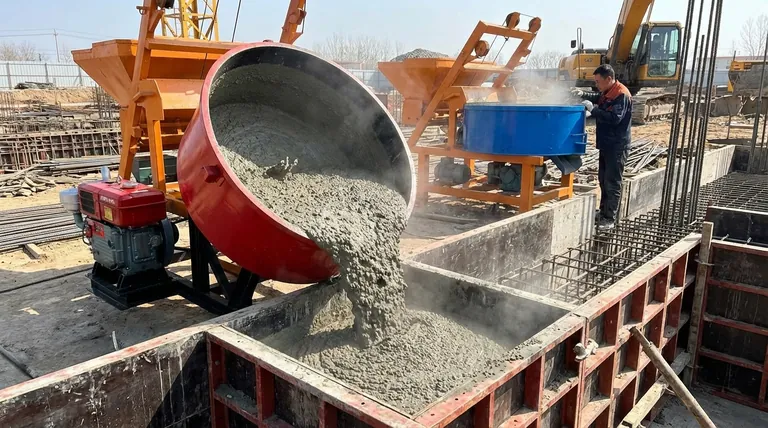
The Consequence of Non-Uniform Mixing
A flat mouth mixer truck is more than a transport vehicle; it is a mobile batching plant responsible for creating the final construction material. The quality of its output directly impacts the project's success.
Impact on Concrete Quality
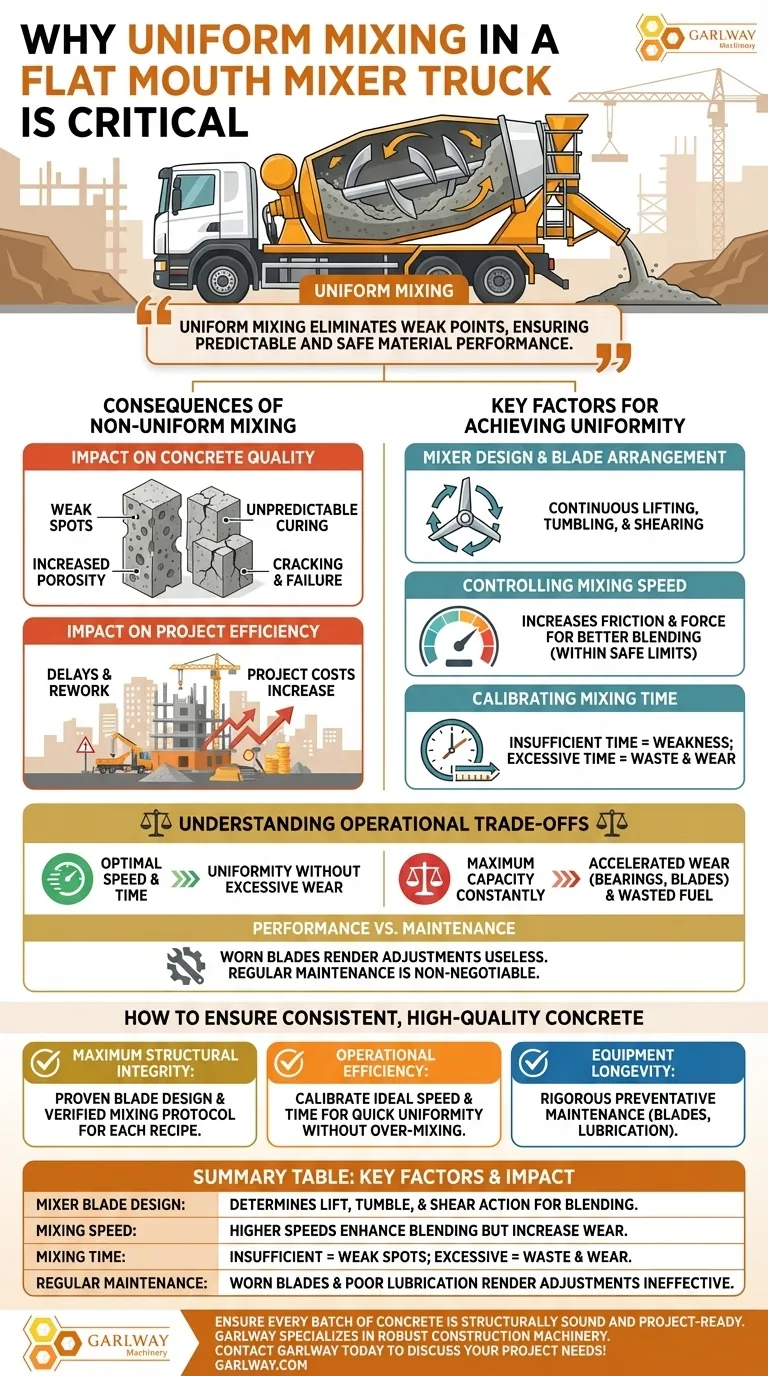
Poorly mixed concrete contains pockets with too much water or too much aggregate. These inconsistencies create weak spots, increase porosity, and lead to unpredictable curing times, which can cause cracking and long-term structural failure.
Impact on Project Efficiency
When concrete is uniform, it flows and sets predictably. This allows construction crews to work efficiently and confidently. Inconsistent batches can cause delays, require rework, and ultimately drive up project costs significantly.
Key Factors for Achieving Uniformity
Achieving a perfectly homogeneous mix is not a matter of chance. It is the result of controlling several key mechanical and operational variables.
The Critical Role of Mixer Design
The internal design of the mixer, particularly the blade arrangement, is foundational. Well-designed blades are engineered to lift, tumble, and shear the materials continuously, forcing them to combine thoroughly and preventing any single component from settling or segregating.
Controlling Mixing Speed
Increasing the mixer's rotational speed, within safe operational limits, enhances the mixing action. Higher speeds increase the friction and force between particles, accelerating the blending process and promoting a more uniform distribution of all raw materials.
Calibrating Mixing Time
Time is a crucial variable that must be precisely controlled. Insufficient mixing time is a primary cause of uneven mixing, leaving the concrete weak and inconsistent. Conversely, excessive mixing time provides no additional quality benefit and only serves to waste fuel and cause unnecessary wear on the equipment.
Understanding the Operational Trade-offs
Optimizing for uniform mixing requires balancing competing factors. Simply maximizing one variable can lead to negative consequences in another area.
Speed vs. Equipment Longevity
While higher speeds can improve mixing, running the equipment at maximum capacity constantly will accelerate wear on the mixer’s bearings, blades, and lubrication system. The goal is to find the optimal speed that achieves uniformity without needlessly shortening the truck's service life.
Performance vs. Maintenance
A high-quality mixer with an excellent design is only effective if it is properly maintained. Worn or damaged blades lose their ability to lift and shear material effectively, rendering speed and time adjustments useless. Regular inspection and maintenance are non-negotiable for consistent performance.
How to Ensure Consistent, High-Quality Concrete
Your operational approach should be dictated by your project's primary objective. Use these principles to guide your process.
- If your primary focus is maximum structural integrity: Prioritize the use of a mixer with a proven blade design and establish a strict, verified protocol for mixing time for each specific concrete recipe.
- If your primary focus is operational efficiency: Calibrate the ideal mixing speed and time to produce a uniform batch quickly, avoiding the energy waste and equipment strain of over-mixing.
- If your primary focus is equipment longevity: Adhere to a rigorous preventative maintenance schedule, focusing on blade condition and the lubrication system, to ensure the truck operates reliably for its entire intended lifespan.
Ultimately, mastering these variables transforms the mixer truck from a simple transport vehicle into a precision manufacturing tool for high-quality concrete.
Summary Table:
| Key Factor | Impact on Mixing Uniformity |
|---|---|
| Mixer Blade Design | Determines the lift, tumble, and shear action for thorough blending. |
| Mixing Speed | Higher speeds (within limits) enhance blending but increase equipment wear. |
| Mixing Time | Insufficient time causes weak spots; excessive time wastes fuel and causes wear. |
| Regular Maintenance | Worn blades and poor lubrication render speed/time adjustments ineffective. |
Ensure every batch of concrete is structurally sound and project-ready.
GARLWAY specializes in providing robust construction machinery, including reliable concrete mixers and batching plants, for construction companies and contractors globally. Our equipment is engineered for optimal mixing performance and durability, helping you avoid costly delays and ensure project success.
Contact GARLWAY today to discuss your project needs and find the right mixing solution for you!
Visual Guide
Related Products
- Mini Cement Mortar Mixer Truck for Construction
- Ready Mixer Machine for Construction Ready Mix Machinery
- JW1000 Mobile Cement Mixer Concrete Mixer Truck and Batching Plant
- Portable Ready Mix Concrete Mixer Equipment
- Portable Concrete Mixer Machine Equipment for Mixing Concrete
People Also Ask
- Why might mixing mortar in a cement truck be problematic? Avoid Costly Mixing Mistakes
- What are the main types of construction cement mixers available? Choose the Right Mixer for Your Project
- What are the two primary methods for filling a cement mixer truck? Central vs. Transit Mix Explained
- What are the common uses of cement mixer trucks? Boosting Construction Efficiency and Quality
- What are the primary methods to fill a cement mixer truck? Central Mix vs. Transit Mix Explained


