
An anchoring system is far more than a simple parking brake for your boat. It is a fundamental piece of safety equipment that provides control and stability when your vessel is stationary, holding it securely against the forces of wind and current. This capability is absolutely critical during unexpected weather changes or mechanical failure when returning to shore is not a viable option.
Your anchor is your ultimate safeguard against being at the mercy of the elements. It transforms your boat from an object adrift to a secure position, giving you control in situations where you would otherwise have none.
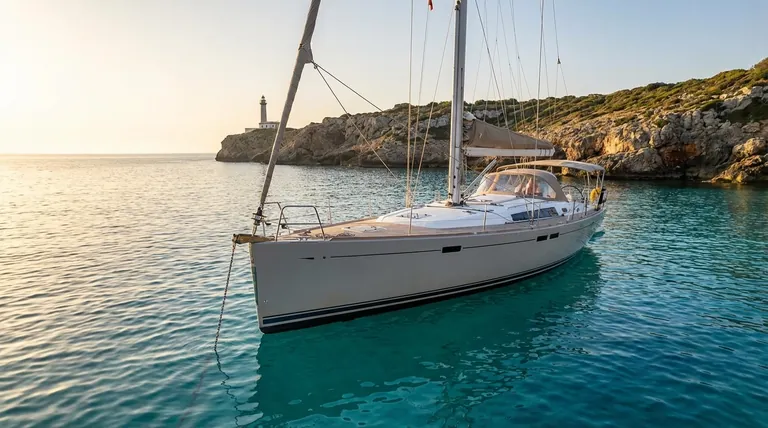
The Core Functions of an Anchor System
An anchoring system serves three distinct and equally important roles. Understanding each one clarifies why it is considered essential equipment for any vessel, regardless of size.
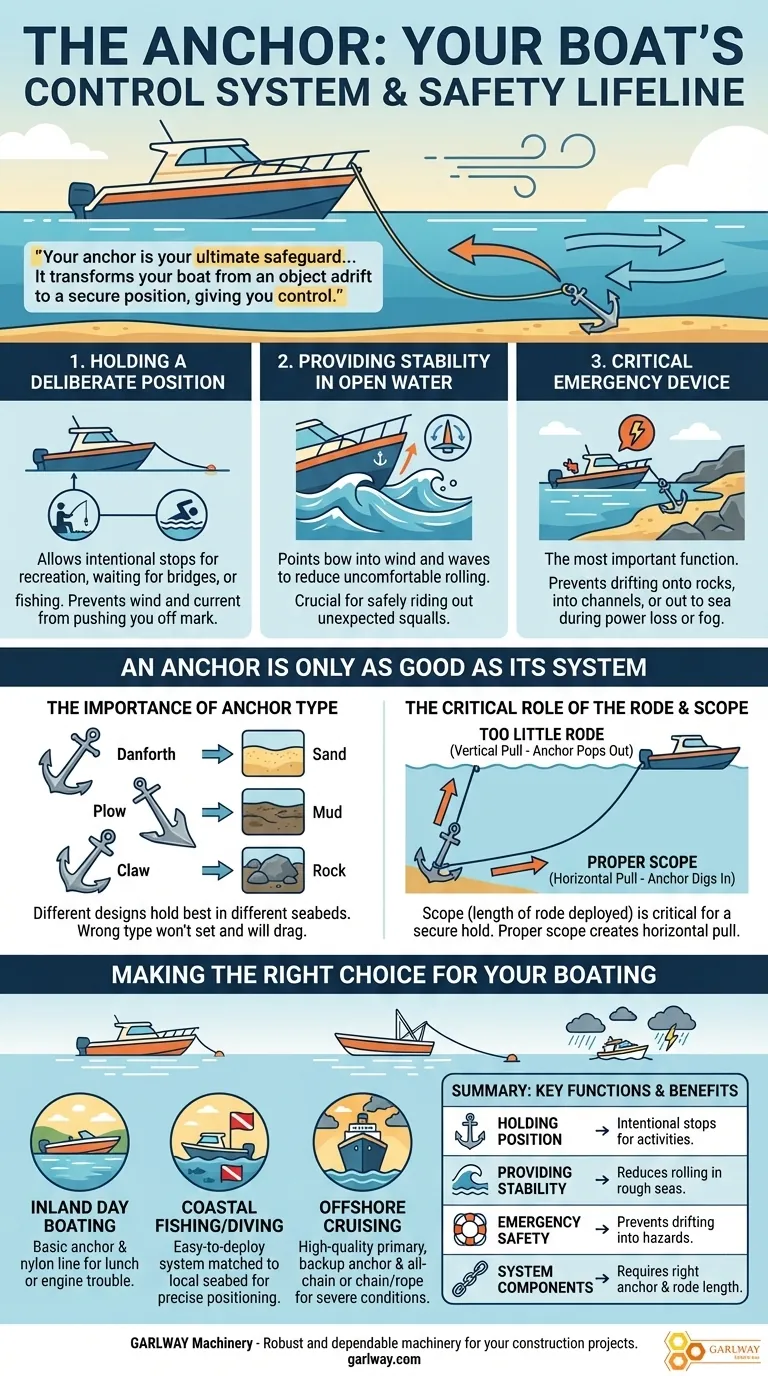
Holding a Deliberate Position
This is the most common and obvious use. An anchor allows you to intentionally stop and remain in a specific location on the water.
This could be for recreational purposes, like fishing over a known reef, swimming in a secluded cove, or simply waiting for a bridge to open. Without an anchor, wind and current would immediately begin to push the boat off its mark.
Providing Stability in Open Water
When conditions become rough, an anchor provides significant stability. By setting the anchor, you can keep the bow of the boat pointed directly into the oncoming wind and waves.
This orientation dramatically reduces uncomfortable rolling from side to side (beam seas) and makes the vessel a more stable platform. It's a crucial technique for safely and comfortably riding out an unexpected squall.
Acting as a Critical Emergency Device
This is the most important function of an anchor. In an emergency, it can be the difference between a minor inconvenience and a catastrophic event.
A sudden engine failure, for example, leaves your boat powerless and drifting. An anchor prevents you from being pushed onto rocks, into a busy shipping channel, or further out to sea while you await assistance.
Similarly, if you are caught in fog or darkness and lose your bearings, anchoring allows you to stop safely in one place until conditions improve or you can re-establish your position.
An Anchor Is Only as Good as Its System
Simply having an anchor aboard is not enough. The entire system must be appropriate for the vessel and the conditions, as a poorly chosen or deployed anchor provides a false and dangerous sense of security.
The Importance of Anchor Type
Different anchor designs (like a Danforth, CQR/Plow, or Bruce/Claw) are engineered to hold best in different types of seabeds, such as mud, sand, or rock.
Using the wrong type of anchor for the bottom conditions can prevent it from digging in, or "setting," properly. This will cause the anchor to drag along the bottom, offering no holding power at all.
The Critical Role of the Rode
The line or chain connecting the anchor to your boat is called the rode. The length of rode you deploy, known as scope, is critical for a secure hold.
A common mistake is letting out too little rode. This results in an upward, vertical pull on the anchor, causing it to pop out of the seabed. A proper scope creates a horizontal pull, allowing the anchor to dig in deeper and hold firm.
Making the Right Choice for Your Boating
Your anchoring system should be matched to how you use your vessel.
- If your primary focus is inland day boating: A basic, properly sized anchor and sufficient nylon line are essential for holding position for lunch or in case of engine trouble.
- If your primary focus is coastal fishing or diving: A system that is easy to deploy and retrieve, with an anchor matched to the local seabed, is key for precise positioning over specific spots.
- If your primary focus is offshore cruising: Your anchor is a primary lifeline; invest in a high-quality primary anchor, a secondary backup, and an all-chain or chain/rope rode sufficient for holding in severe storm conditions.
Ultimately, a reliable anchor system gives a skipper the one thing they need most: absolute control over their vessel's position, no matter the situation.
Summary Table:
| Function | Key Benefit |
|---|---|
| Holding Position | Allows intentional stops for fishing, swimming, or waiting. |
| Providing Stability | Reduces rolling in rough seas by pointing the bow into waves. |
| Emergency Safety | Prevents drifting into hazards during engine failure or bad weather. |
| System Components | Requires the right anchor type and rode length for a secure hold. |
Ready to secure your vessel with the right equipment? Just as a reliable anchor system is fundamental for boat safety and control, GARLWAY provides robust and dependable machinery for your construction projects. We specialize in winches, concrete mixers, and concrete batching plants, engineered for the demanding needs of construction companies and contractors globally. Ensure your project's foundation is as secure as a well-anchored boat—contact our experts today to discuss your specific requirements and discover the GARLWAY advantage.
Visual Guide
Related Products
- Electric Hoist Winch Boat Anchor Windlass for Marine Applications
- Heavy Duty Electric Boat Winch Windlass Anchor
- 12000 lb Electric Boat Trailer Winch with Windlass Anchor Warn
- Best 18000 Pound Drum Anchor Trailer Winch
People Also Ask
- How does an electric anchor winch work? Power, Safety, and Reliable Operation Explained
- What are the advantages of installing an electric anchor winch on a boat? Boost Safety & Ease for Boaters
- What are the operational differences between electric hoists and winches? A Guide to Safe Lifting vs. Pulling
- What are the main benefits of a boat anchor winch? Boost Safety & Efficiency for Your Vessel
- How does a boat anchor winch work? A Guide to Reliable Anchor Handling


