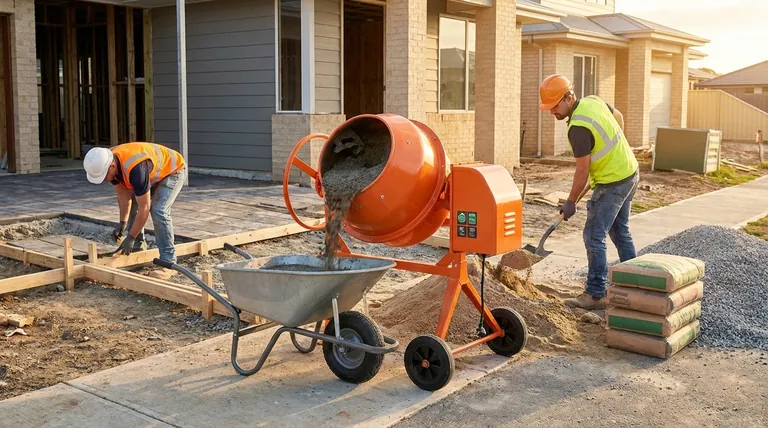
The primary way a small cement mixer saves time is by automating the mixing process. This frees up the operator to perform other essential tasks, such as preparing the site or transporting materials, while the machine does the strenuous work. This ability to multitask transforms a labor bottleneck into an efficient, parallel workflow.
A small cement mixer’s value isn't just that it mixes concrete faster than a person. Its real power is in how it streamlines the entire workflow by reducing physical fatigue, ensuring consistent quality, and enabling a single worker to accomplish what would otherwise require a team.
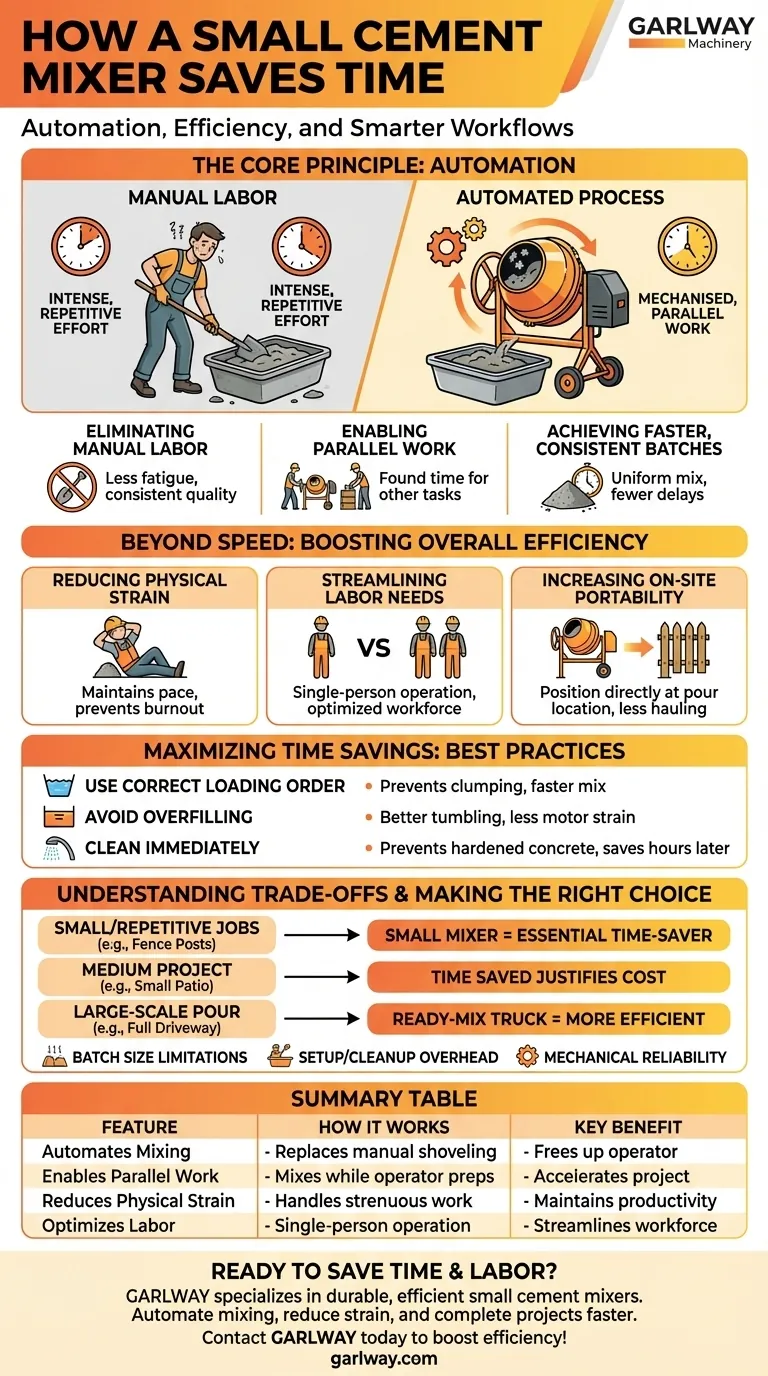
The Core Principle of Time Savings: Automation
A small cement mixer fundamentally changes the equation of time and labor on a construction site. It replaces a slow, manual process with a faster, automated one.
Eliminating Manual Labor
Manual mixing with a shovel or hoe is physically draining and slow. Each batch requires intense, repetitive effort that quickly leads to fatigue.
A mixer mechanizes this entire process, producing a finished batch with minimal human intervention beyond loading the materials.
Enabling Parallel Work
This is the most significant time-saving factor. While the drum is turning, the operator is not idle.
This "found time" can be used to prepare the next set of forms, gather tools, or move the previously mixed batch to its destination, effectively allowing two jobs to happen at once.
Achieving Faster, Consistent Batches
A machine mixes far more thoroughly and rapidly than a person can. It ensures every batch has a uniform consistency, which is critical for structural integrity.
This eliminates the time wasted on poorly mixed batches that may need to be adjusted or discarded, preventing costly delays.
Beyond Speed: How Overall Efficiency Is Boosted
The time savings extend beyond the mixing cycle itself. The tool improves the efficiency of the entire project by optimizing labor and reducing physical strain.
Reducing Physical Strain
Worker fatigue is a major cause of slowdowns. The physical toll of manual mixing means productivity drops significantly as the day wears on.
By handling the most strenuous part of the job, a mixer keeps workers fresher and able to maintain a consistent pace, preventing the project from dragging.
Streamlining Labor Needs
Mixing concrete by hand often requires two people: one to mix and one to supply water and materials.
A small mixer can be operated by a single person, freeing up other workers to focus on different construction tasks. This accelerates the overall project timeline by optimizing your workforce.
Increasing On-Site Portability
Small mixers are designed to be moved easily. They can be positioned directly next to the pour location, whether it's for a fence post or a small footing.
This convenience drastically cuts down on the time and effort spent hauling heavy, wet concrete in a wheelbarrow from a central mixing station.
Understanding the Trade-offs
While highly effective, a small mixer is not a universal solution. Understanding its limitations is key to using it efficiently.
Batch Size Limitations
The most obvious trade-off is its small capacity. For large projects like a driveway or foundation, the time spent mixing dozens of small batches would be far greater than ordering a ready-mix concrete truck.
Setup and Cleanup Overhead
Using a mixer involves more than just the mixing time. You must account for the time needed to set it up, connect it to a power source, and, most importantly, clean it thoroughly after use. Skipping a proper cleaning can render the machine useless, causing major future delays.
Mechanical Reliability
Unlike a shovel, a machine can break down. A sudden motor failure or a jammed drum can bring work to a complete halt, creating an unpredictable delay that manual mixing avoids.
Maximizing Your Time Savings
To get the most out of the mixer, follow these best practices that ensure every batch is perfect and the machine runs smoothly.
Use the Correct Loading Order
Always add a portion of the water to the drum first. This prevents dry cement and sand from clumping and sticking to the sides, which ensures a faster, more uniform mix.
Avoid Overfilling the Drum
Overloading the mixer prevents the materials from tumbling effectively. This results in a poor, inconsistent mix and puts unnecessary strain on the motor, ultimately costing you more time.
Clean Immediately After Use
As soon as you are finished, empty and rinse the drum thoroughly. Hardened concrete is extremely difficult to remove and will ruin the mixer's efficiency for all future jobs. A few minutes of cleaning saves hours of future frustration.
Making the Right Choice for Your Project
Choosing the right tool is the first step to saving time.
- If your primary focus is small, repetitive jobs like setting fence posts or pouring footings: A small mixer is an essential time-saver that will dramatically improve your workflow.
- If your primary focus is a single, medium-sized project like a small patio or walkway: The time saved from reduced labor and physical fatigue will almost certainly justify the investment or rental cost.
- If your primary focus is any large-scale pour like a full slab or driveway: A small mixer is the wrong tool for the job; ordering ready-mix concrete is vastly more efficient and will save you days of work.
Ultimately, a small cement mixer saves time by turning a manual bottleneck into an efficient, automated process, allowing you to focus your energy on moving the project forward.
Summary Table:
| Time-Saving Feature | How It Works | Key Benefit |
|---|---|---|
| Automates Mixing | Replaces slow, manual shoveling with a rotating drum. | Frees up the operator for other tasks. |
| Enables Parallel Work | Mixes concrete while the operator preps the site or transports materials. | Two jobs happen at once, accelerating the project. |
| Reduces Physical Strain | Handles the strenuous work, keeping workers fresher. | Maintains consistent productivity throughout the day. |
| Optimizes Labor | One person can operate it, freeing up other workers. | Streamlines workforce for faster project completion. |
Ready to save time and labor on your next project?
GARLWAY specializes in durable and efficient construction machinery, including small cement mixers designed for contractors and construction companies. Our equipment helps you automate mixing, reduce physical strain, and complete projects faster.
Contact GARLWAY today to find the perfect mixer for your needs and see how we can boost your on-site efficiency!
Visual Guide
Related Products
- JDC350 Small Cement Concrete Mortar Mixer
- JZC400 Mobile Small Concrete Mixer Cement Mixer Machine
- Portable Electric Small Cement Mixer Concrete Machine
- HZS35 Small Cement Concrete Mixing Batch Plant
- Mini Cement Mortar Mixer Truck for Construction
People Also Ask
- What are the primary uses of a small cement mixer? Boost Efficiency for Small to Medium Construction Jobs
- What are the physical benefits of using a small cement mixer? Reduce Strain and Prevent Injury
- What are the cost benefits of using a small cement mixer? Save on Labor, Materials & Time
- What makes small cement mixers easy and convenient to use? Boost Productivity on Any Job Site
- What factors should be considered before purchasing a small cement mixer? Find the Perfect Match for Your Project